
Why a 1985 Soviet film remains one of the great antiwar films of our time.
Deep Life Reflections: Essay 191 | November 13, 2026 | James Gibb
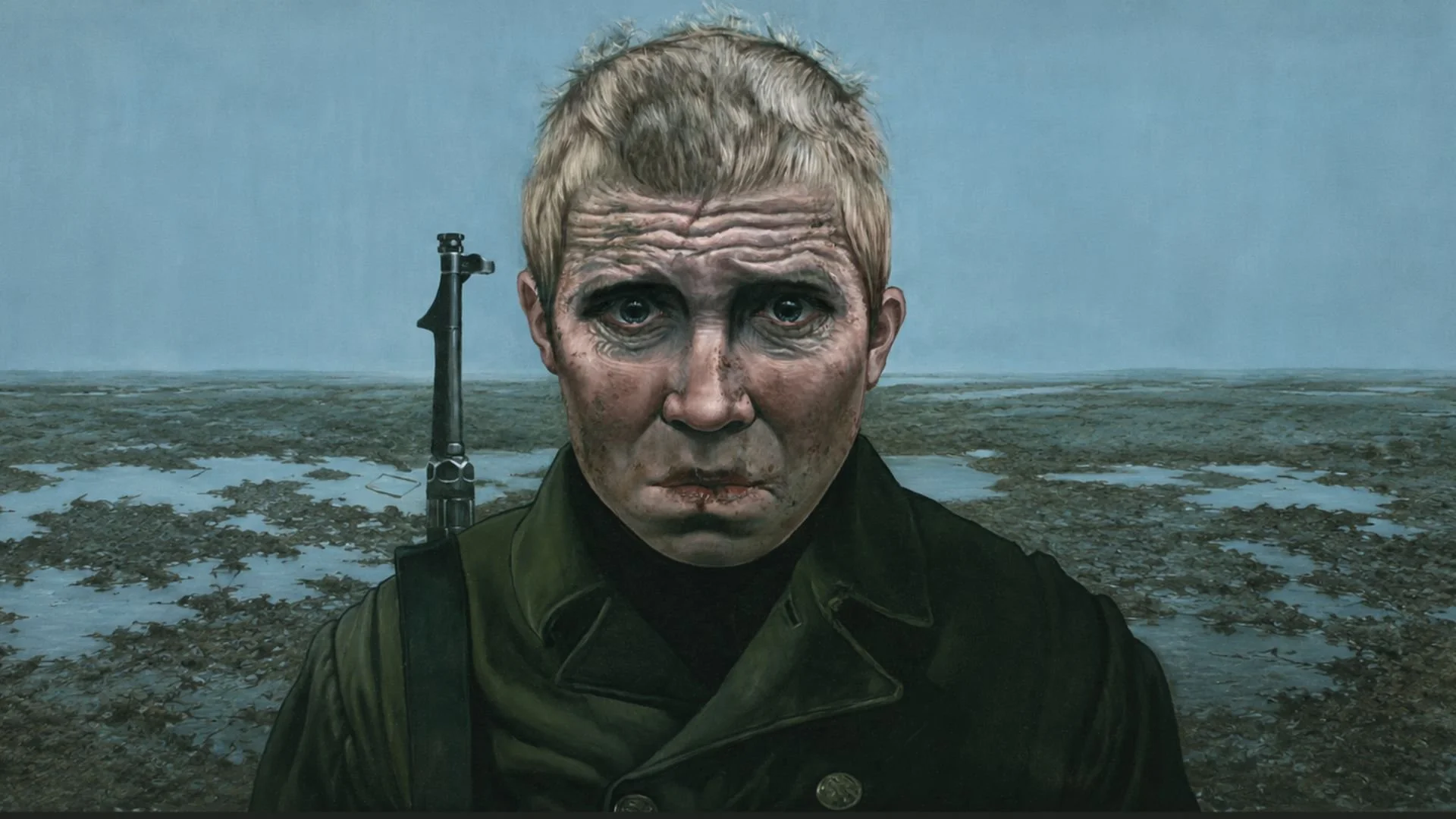
To bear witness to terrible acts is necessary, yet offers no redemption.
In the late 1970s, a Soviet filmmaker called Elem Klimov and his co-writer Ales Adamovich started working on a project about the atrocities of the Second World War. Specifically the war crimes carried out by Hitler’s Nazi forces on Byelorussian villages and their occupants. The film ended up taking seven years to come to fruition because of the continual objections by Soviet officials to the script. They attacked its relentless brutality, the lack of a heroic redemption, and what they saw as an excessively bleak portrayal of war. And they were right about all of it.
When permission was finally granted, the resulting film was Come and See, released in 1985. It is seen today as one of the great antiwar films. If we assume an antiwar film is to show war honestly, Come and See gives us precisely that: war’s power, pity, dehumanisation, cruelty, carnage, and indifference. It gives us no catharsis and no hope. Especially no hope. That makes the film a heavy burden. Film critic Roger Ebert called it “one of the most devastating films ever about anything, and in it, the survivors must envy the dead.” Klimov knows this. Born in Stalingrad in 1933, Klimov was still a child when the city became the site of one of the most ferocious battles of the twentieth century. As an adult, he used that experience, along with his feverish skills and sensory intensity to show us a world where lives are removed viciously and without reason.
We see this world unravel through the eyes of a boy, Flyora. He lives in a village in Byelorussia (today Belarus) with his mother and younger twin sisters. He is perhaps 12 or 13, although we are never told his actual age. All we know is he is far too young to be marching off to war. He wants to defend his homeland and become a hero. With the naivety and exuberance of youth, he joins a local partisan fighting unit, much against the wishes of his mother. It is 1943. Operation Barbarossa, the code name for Germany’s catastrophic invasion of the Soviet Union, had begun two years earlier, with more than 3.5 million Axis troops advancing along an almost 2,000-mile front from the Baltic to the Black Sea. Belarus was directly in Hitler’s path.
The coming-of-age story has been used in countless films, but this might be the most shattering we have witnessed on screen. The film is almost entirely shot from Flyora’s point of view. We slowly watch his traumatisation and brutalisation, his mental unravelling as he bears witness to barbaric events, as well as the harsh realities of warfare like shelling and troop invasion. He seems to age decades in weeks, his face at once unbelieving, petrified, and detached. Klimov shoots many scenes in extreme close-up of the boy’s face. We see him and then we see what he sees.
One of the most disturbing scenes is when he returns to his village with a young girl, Glasha, whom he has befriended. They have become separated from his fighting unit. He tells her his mother will give them a warm welcome. The house is empty. It has been ransacked, unfinished meals sit on the table infested by flies. It seems his family have only just left; there is warm soup on the stove. The girl appears to understand what has happened from the sights and smells around her. Flyora seemingly does not, acting as if all is normal and they will return soon. He suddenly becomes convinced he knows where his mother and sisters are. As they exit the house, the girl looks back and sees an appalling sight, confirming our worst fears. Flyora does not look. He leads her to a thick swamp, still insisting his family must be elsewhere. He is deeply traumatised. He sees horrors throughout the film, but here he has chosen not to see the horror.
Flyora is played by an actor called Aleksey Kravchenko, who was 13 at the time. Klimov was worried about the psychological effects of the most harrowing scenes—like the swamp scene—on his young actor, so he brought in a psychologist and considered using hypnosis to shield Kravchenko from fully absorbing them. Kravchenko later said he wasn’t susceptible to hypnosis, so he simply pretended to be hypnotised. Klimov himself said that the boy was able to concentrate with such intensity that it almost seemed he had “hypnotised himself” into the role. That hypnotic sense is palpable throughout, enhanced by the significant use of Steadicam, which gives the film a floaty, nightmarish feel, and a sound design that works to gradually untether Flyora from humanity. Early in the film, he temporarily loses his hearing after an artillery blast deep in the forest. He exists as a witness—for himself and for us.
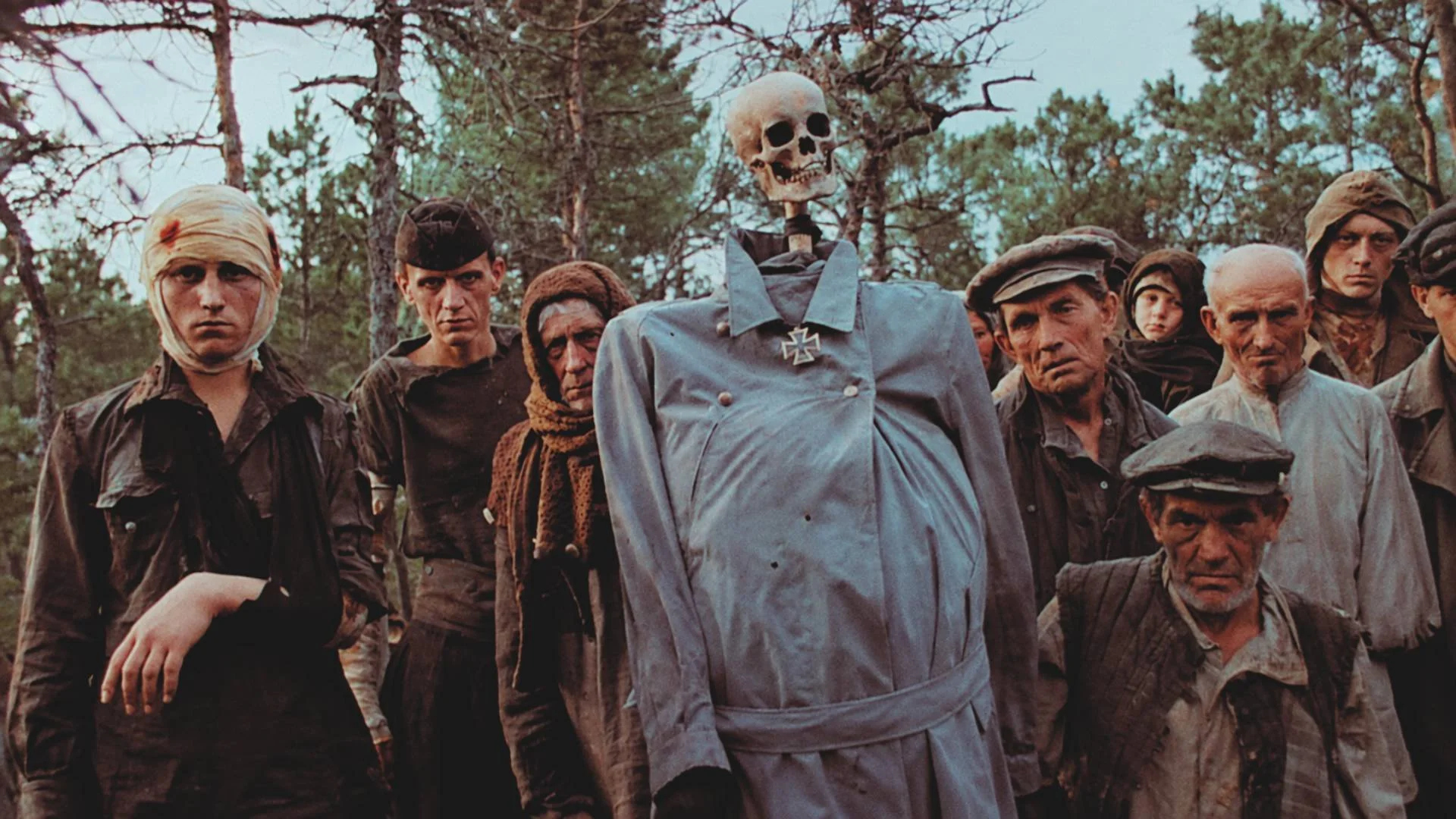
Come and See (1985). Directed by Elem Klimov and based on historical events.
The film’s title comes from the New Testament’s Book of Revelation, where witnesses are summoned to see the devastation inflicted by the Four Horsemen of the Apocalypse:
“Come and see. And I looked, and behold a pale horse: and his name that sat on him was Death, and Hell followed with him. And power was given unto them over the fourth part of the earth, to kill with sword, and with hunger, and with death, and with the beasts of the earth.”
When I read those words, it’s hard for me not to hear the husked voice of Johnny Cash, who used the lines at the start of his song, The Man Comes Around. That is a song about the arrival of judgement, recognising there comes a point when everyone is called to account and there is nowhere left to hide from whatever sins we may have committed. That idea of judgement hangs over the film too. This is a film about the atrocities of men following orders. In the opening scene, Flyora finds a rifle buried in the sand. The butt of the gun is split because it’s made of cheap birch wood. He holds and protects this rifle for the whole film, but never once fires it or uses it upon another human being. It’s only at the end he uses it, not on flesh but on a propaganda poster by the Nazis that reads, ‘Hitler is a liberator’.
Hitler is a recurring motif throughout the film—the original title for the film was Kill Hitler but it was too charged for the Soviet censors. In the film, one of the Byelorussian soldiers creates a grotesque scarecrow version of the Fuhrer, sculpted from clay and skull, lugging him across muddy fields and forests. It is both to mock and to maim, fitted as it is with high explosives. Hitler returns at the end in a much-acclaimed and famous scene, as history is rolled back and the sins of the few and the many are undone until we are left simply with a mother and child—classical Christian imagery. Except this child will not go on to sacrifice himself, but rather tens of millions of others. The blame is sent back generations, but of course, neither time nor history works like that.
The film’s closing title card tells us 628 Belorussian villages were burnt to the ground—with all their inhabitants. Belarus suffered the highest percentage of population loss of any Soviet republic, with roughly one in four residents—more than 2.2 million people—killed during the three-year German occupation. Several Soviet films have depicted the horrors of Nazism because Hitler could represent both the actual enemy and, more safely, a political stand-in for monsters closer to home. When Come and See was eventually released, the Soviet authorities used it for their own propaganda narrative, presenting the film as part of the commemoration of the 40th anniversary of the Soviet victory over Nazi Germany in the Great Patriotic War of 1941-1945.
Come and See was Elem Klimov’s last film. He said afterwards, “I lost interest in making films. Everything that was possible I felt had already been done.” Klimov has spoken of how he felt pained for not having made his war film up until that point. Stalingrad weighed heavily on him. He remembered fleeing into the Ural mountains with his mother and baby brother. That was October 1942. Looking back at the city, he recalled, “It was all on fire, all of it, everywhere. The river [the Volga] was on fire too. The water was on fire. And we were all being bombed. Our mothers covered us with their bodies. My father stayed in Stalingrad to defend the city. Naturally, I’m burdened with very strong recollections about that hell. And it lives with me forever.”
Pass It On
If this idea was worth your time, it may be worth someone else’s.
Share this essay with a friend:
https://www.deeplifejourney.com/deep-life-reflections/come-and-see-and-i-looked
If you have a thought you’d like to share, please leave a comment below.
You can read all previous issues of Deep Life Reflections here.