
Living Deliberately
Walden and The Tree of Life—on attention, simplicity, nature, and grace.
Deep Life Reflections | Essay 91 | James Gibb
Most of life is lived by default. Very little of it is lived deliberately.
“I went to the woods because I wished to live deliberately…I wanted to live deep and suck out all the marrow of life.”
—Henry David Thoreau, Walden
There’s something inherently appealing about retreating to the woods. Living amongst nature, harvesting the land, embracing solitude and quietness. To listen. To think. No doubt the relentlessness and noise of modern life plays its part in our yearning to return to nature. But I suspect something deeper is at work too: a desire to strip away the excess and reclaim what truly matters.
That desire inspired Henry David Thoreau’s Walden. In 1845, Thoreau left Concord, Massachusetts, and spent a little over two years living in a simple wooden cabin he built with his own hands on the shore of Walden Pond. He wanted to see if he could live independently and apart from society, to reduce life to its essentials and discover what remained.
He lived off the land, growing beans and other crops to sell, while devoting much of his time to reading, writing, and observing. From these experiences came Walden, his great meditation on simplicity, solitude, nature, and deliberate living. Poet Robert Frost said, “In one book… he surpasses everything we have had in America.” In chapters like ‘The Beanfield,’ ‘The Ponds,’ and ‘Winter Animals,’ Thoreau writes with a depth of feeling and attention well beyond his 28 years.
Thoreau writes beautifully about solitude:
“I find it wholesome to be alone the greater part of the time. I love to be alone. I never found the companion that was so companionable as solitude. I am no more lonely than the loon in the pond, than the Mill Brook, or a weathercock, or the north star, or the south wind, or an April shower, or a January thaw, or the first spider in a new house. I am no more lonely than Walden Pond itself. What company has that lonely lake, I pray?”
Yet Thoreau was no hermit in the romantic sense. He talks of the visitors who made the short journey to his cabin, often out of sheer curiosity to see the man who had forgone modernity for a simpler way of life. Thoreau stripped everything back to simplicity, observing “Our life is frittered away by detail.”
Published in 1854, Walden came before the U.S. Civil War, before the wreckage of the twentieth century, before radio, television, space shuttles, and the internet. Before smart phones and AI. Thoreau’s world feels like an antidote to the chaos of what was to come, of what we risk losing in our progress.
Perhaps the landscape has changed less than we think.
“We are in great haste to construct a magnetic telegraph from Maine to Texas, but Maine and Texas, it may be, have nothing important to communicate.”
Thoreau’s words 180 years ago. If the tools are different today, the problem is much the same. An argument for attention, an attempt to refuse the trivialities of the world.
“Let us spend one day as deliberately as nature, and not be thrown off the track by every nutshell and mosquito’s wing that falls on the rails.”
That same desire to resist distraction, to attend more closely to life and its mystery, appears in Terrence Malick’s The Tree of Life, though on an entirely different scale.
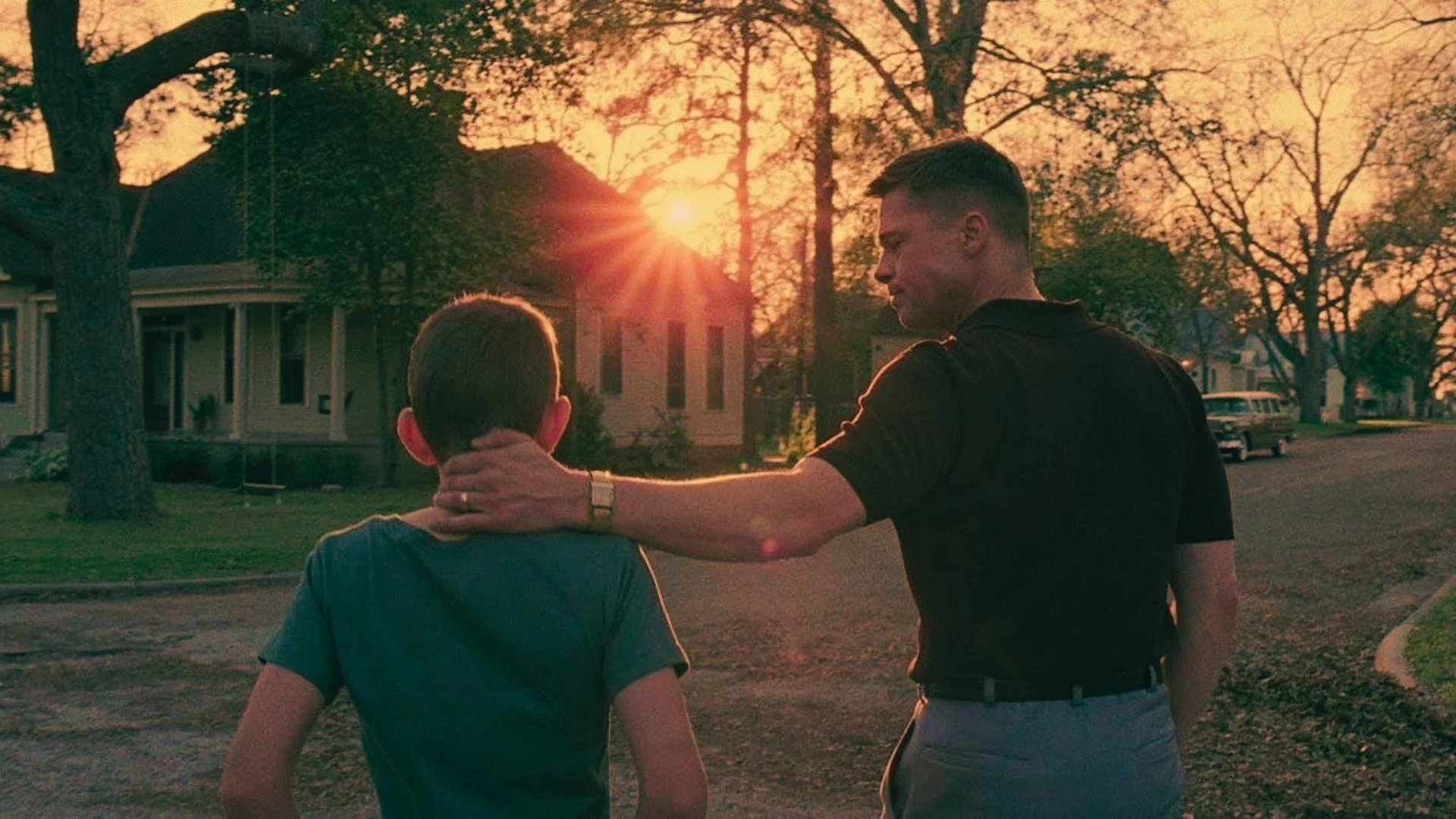
The Tree of Life. Directed by Terence Malick
Malick is not prolific, but he is deliberate. Over five decades, he has made just nine films, beginning with Badlands (1973) and most recently A Hidden Life (2019). Malick takes his time, spending over a year in the editing room on all his films. He is a filmmaker of serious craft, patience, and thought. The Tree of Life, released in 2011, may be his most ambitious. It is a film about family, loss, love, forgiveness, and the search for meaning. But to describe it that way is also to make it sound smaller than it is.
Malick explores these universal experiences through the everyday life of the O’Brien family in 1950s Texas. There is a stern father, a tender mother, and their sons coming of age. The film opens with the family dealing with the death of one of the three sons. Nature and grace are the deep, intertwined roots of the same tree that permeates the film. Brad Pitt embodies the disciplinarian father, representing what the film calls the way of nature, with its focus on survival, discipline, and control. Jessica Chastain’s kind and accepting mother reflects the way of grace, offering compassion, forgiveness, and love. Together, they shape the O’Brien family’s world. Two different forces, not always staying in balance.
After introducing the family, Malick moves beyond them, presenting a series of images that evoke nature, the universe, and the growth, expansion, and connectedness of everything within and beyond. These sequences show us life on a microscopic level and the evolution of the species, including the birth of compassion. This journey through time leads us back to the present moment—to all of us. Living our lives in the blink of an eye, surrounded by the vastness of time and space.
The Tree of Life explores cosmic ambition through the prism of relationship dynamics, particularly the children’s struggles to find their way, reflected in the present day through the eldest son (Sean Penn), now grown, trying to make sense of his life and journey. Throughout the film, characters voice philosophical statements like, “The only way to be happy is to love. Unless you love, your life will flash by.”
Malick had been thinking about this film since the 70s. He asks questions for us to consider. Questions about our fragility, the interconnectedness of all things, and the evolution and passage of time. Nature gives, and it takes away, reminding us that our private griefs and daily routines exist within something immeasurably larger.
The Tree of Life is a film about life itself: its beauty, pain and transience. It acknowledges our mortality but also suggests a lasting connection that can continue long after we leave the earth. Trees, as symbols of life, death, and renewal, aren’t new, but here they feel familiar and comforting. It all culminates in a vision of the afterlife, where loved ones reconnect and greet each other, offering a sense of closure and transcendence, suggesting that love and connection endure, even beyond our fleeting time on earth.
That is where The Tree of Life joins the footpath walked by Walden.
Thoreau retreats to the woods to simplify life and pay closer attention to it. Malick expands outward toward creation, memory, and mortality to ask much the same question: how should we live when life is so brief, beautiful, and difficult to hold?
This is partly why both feel like antidotes to the condition we now slip into so easily. Thoreau once asked, “While England endeavours to cure the potato rot, will not any endeavour to cure the brain rot—which prevails much more widely and fatally?”
‘Brain rot’ has recently been revived. It is the Oxford Word of the Year for 2024 and it describes the deterioration of a person’s mental or intellectual state brought on by the overconsumption of trivial or unchallenging material. It is a depressing recognition of how chronically online life has become. Today’s culture is fuelled by a relentless stream of images, video, commentary, updates, and noise. We skim, react, move on, and come back.
Thoreau’s words are prescient, warning against a decline in intellectual rigour that he saw even in his time. This was the 1850s. Long before radio, television, and of course, social media. It suggests that even in earlier centuries we were concerned about triviality invading our lives, distracting us and eroding our sense of meaning and focus.
Both works offer a remedy: life is not something to rush through, but something to attend to. They restore perspective. They remind us that a life can be diminished by distraction just as surely as by suffering. Simplicity is neither deprivation nor weakness. And grace may depend, at least in some measure, on whether we are awake enough to notice it.
Little of life is lived deliberately.
Thoreau knew this. Malick does too.
The question is whether we do.
Pass It On
If this idea was worth your time, it may be worth someone else’s.
Share this essay with a friend:
https://www.deeplifejourney.com/deep-life-reflections/december-13-2024
If you have a thought you’d like to share, please leave a comment below.
You can read all previous issues of Deep Life Reflections here.
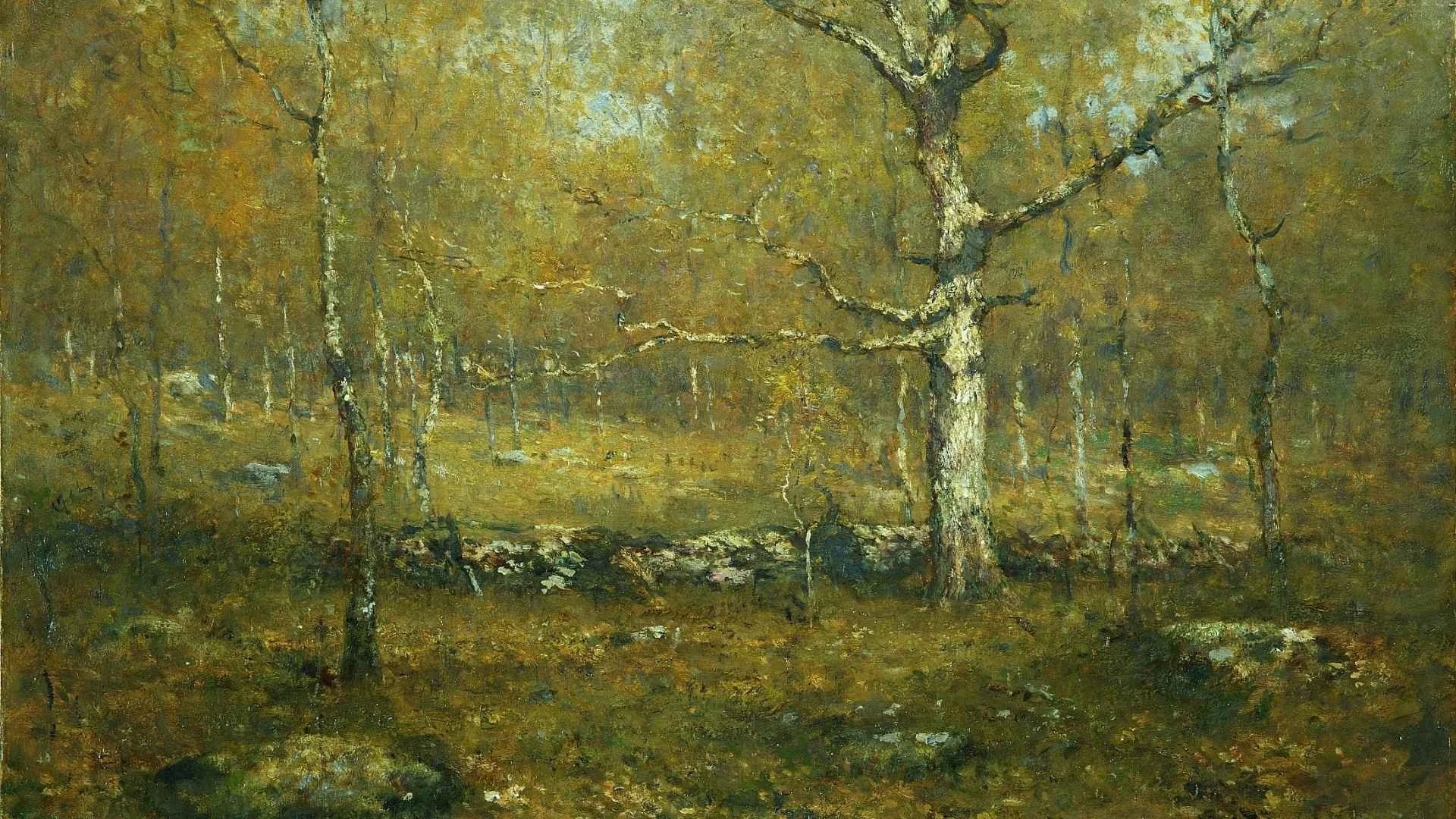
Title image credit: Spring Woods by Henry Ward Range, ca. 1895-1900.