
I Put a Spell on You
Leonardo da Vinci, Nina Simone, and lives that can’t be held back.
Deep Life Reflections | Essay 64 | James Gibb
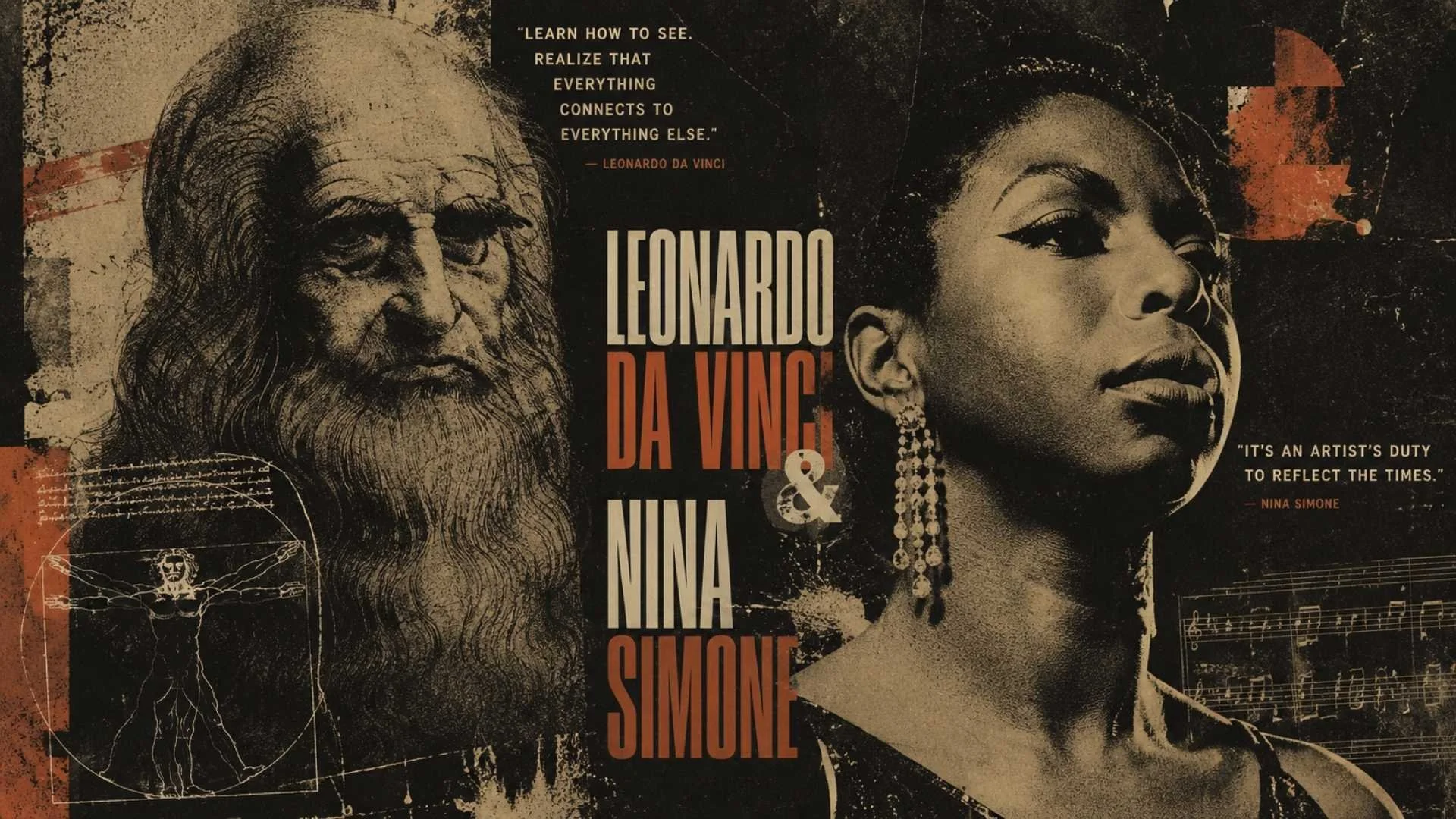
Some lives refuse to be boxed in or neatly categorised. That is where their power comes from.
I’ve been fortunate to see four pieces of Leonardo da Vinci’s art: three in the Uffizi Gallery in Florence and the Mona Lisa in the Louvre, behind a mass of people, cameras, glass, and security (somewhere I still have a shiny, blurred grainy photo that will not win any awards). However, Leonardo was much more than an artist. As has been well documented, the man had a Herculean curiosity about everything around him. That inquisitiveness took him from anatomy to architecture, sculpture to science, engineering to ornithology.
Walter Isaacson pieces together the extraordinary life of Leonardo in his biography, Leonardo da Vinci. Isaacson draws from thousands of pages from da Vinci’s sublime and elaborate notebooks, including ‘The Codex Leicester’—considered the most important of his 30 scientific notebooks—to bring back to life in resplendent colour one of history’s most creative and brilliant individuals.
For Leonardo, art and science were immeasurably connected. He was fascinated by the mechanics of movement, the principles of light and optics, rocks and fossils, birds and flight. He would carefully observe, always keeping an open and imaginative mind. One of the most fascinating entries in his many notebooks is a simple note to self:
“Learn about the tongue of a woodpecker.”
Leonardo’s ability to stand at the meeting point of the humanities and the sciences, and create magnificently from that epicentre—most epitomised by his drawing of the Vitruvian Man—cemented his status as a genius.
The book gives us Leonardo’s life but, just as importantly, the times he lived in. He is the quintessential Renaissance man, fully at home in flourishing fifteenth and sixteenth-century Florence, backed by the Medici family who ran the powerful city-state. Isaacson also explores Leonardo’s ease with being a bit of a misfit: illegitimate, vegetarian, left-handed, easily distracted, and at times, heretical. He took everything in his flamboyant stride.
In his most famous and iconic work, the Mona Lisa, the genius is in the smile. Leonardo achieved this effort by using a technique known as sfumato, which involved blending colours and softening edges to create a hazy, dreamlike effect. In this technique, he hinted there is always a veil to people; what we see is never the whole story.
Therein lies the genius of Leonardo da Vinci. The smile reveals just enough, and no more.
We remain curious. Like the man himself.
“Don't play what’s there; play what's not there.”
—Miles Davis
Five hundred years or so later, Eunice Waymon was born in Tryon, North Carolina. She was the sixth of eight children. It’s 1933. Depression-era and hard times, especially for a Black family in the Deep South. Eunice began playing classical piano at the age of three. Today, she is better known as Nina Simone.
In 2015, Liz Garbus directed the Oscar-nominated documentary ‘What Happened, Miss Simone?’ about the life and legend of Nina Simone. Known as the ‘High Priestess of Soul,’ Simone emerged from her poor, southern upbringing to become one of the world’s greatest jazz singers, pianists, and songwriters. She was completely uninhibited and uniquely original. I’ve been listening to Nina Simone for over twenty years but hadn’t been familiar with her story.
Trained by a white piano teacher, the young Simone literally crossed the tracks to take her piano lessons and felt ostracised by both communities. Unwelcome by the whites who felt she was invading their world, she was also pushed out by her own community who felt a sense of betrayal. This conflict would be a defining and repeating part of Simone’s life.
Simone’s prodigious talent led to her acceptance into the prestigious Juilliard School in New York City, where she studied classical piano. She then started performing at a dive bar in Atlantic City, where the owner insisted she sing as well as play the piano. She’d never sung before. This is where the legend was born. Without following an accepted vocal style, she fused different musical styles, in the process creating her own unique vocal sound.
Garbus creates a captivating, complex, and intense documentary culled from hours of autobiographical tapes and archive film footage, reflecting the many sides of Nina Simone. Despite her talent and success, Simone faced many external battles with racism, domestic violence from her husband/manager, and her role as a Civil Rights activist amidst the turmoil of 1960s America. Her struggles were also internal, as she tried to deal with depression and bipolar disorder.
At the height of her fame, Simone walked away from her family, country, career and fans, moving to Liberia and giving up performing. Garbus doesn’t shy away from the darkness Simone experienced and sometimes inflicted on others.
The film is a portrait of a torn soul, embracing Simone in all her contradictions. It entraps the muscle and intensity of her music and presence, which remains just as sublime today. The documentary features some of the best concert footage ever shot; her performances are mesmerising. She channels her rage into classics such as ‘Mississippi Goddam,’ ‘I Loves You, Porgy,’ and the hypnotic, electrifying 10-minute epic ‘Sinnerman.’
The question posed by the title of What Happened, Miss Simone? isn’t really answered. Lives that complex tend to reject simple explanations.
Nina Simone had much to say. She used everything she had to say it.
Categories might help us understand people, but they can also make them smaller. In artists like Leonardo da Vinci and Nina Simone, their creativity became so formidable precisely because they refused to stay welded to one place.
Perhaps that is what convention fears most: the person who will not stay where the world has placed them.
For they are too alive.
Pass It On
If this idea was worth your time, it may be worth someone else’s.
Share this essay with a friend:
https://www.deeplifejourney.com/deep-life-reflections/june-7-2024
If you have a thought you’d like to share, please leave a comment below.
You can read all previous issues of Deep Life Reflections here.