
Unseen
Camera phones, Adolescence, and the gap between watching and understanding.
Deep Life Reflections | Essay 105 | James Gibb

Seeing everything has never made it easier to miss what matters.
Teacher and parent Russell Shaw recently posed a hard question in The Atlantic: In trying to capture so much of our children’s lives, are we failing to truly see them?
It was part of an article he wrote called Parents, Put Down Your Phone Cameras.
Every parent, and non-parent, is familiar with the modern habit of reaching for a phone at every event a child is involved in, from school plays to sports days to birthday parties. Technology has conditioned us to believe if we don’t chronicle every moment, we’re missing something precious, like being handed a gift voucher and letting it expire.
Shaw argues that all our documenting of every video, photo, and memory saved to the cloud isn’t helping us remember, but making us forget what really matters.
“The more I see parents reflexively reaching for their phones,” he writes, “the more I come to believe that when we turn our kids into the subjects of our personal documentaries, we risk muting the richness of the very thing we’re trying to record.”
He’s quick to say we shouldn’t stop recording our children’s lives entirely. Photos in particular freeze time and carry powerful memory and emotion. Hence the enduring potency of the traditional hardcover photo album.
Shaw’s remedy is simple: next time you’re at your child’s event, take a few photos at the start and then put your phone away. Childhood is fleeting. Savour it.
The real magic is in the moment. When your child spots you in the audience, whether delighted, mortified, or somewhere in between. The present is the meaningful part. When we lose that, we lose connection, and our own emotional response. We might be physically there, but the many assaults of modern life on our time and energy have us mentally elsewhere. We’re recording childhood in ever greater detail, yet understanding it less.
The phone becomes a safety net, a way to believe we can relive what we’ve missed. But that ‘later’ rarely comes. And when it does, it never carries the same emotional weight.
This idea reminds me of Tolstoy’s short story, The Death of Ivan Ilyich. It’s about a man confronting death, suddenly realising he’s lived superficially, prioritising appearances over truth. The people around him look at him but don’t see his suffering. He, in turn, realises he never paid attention to what mattered.
“Can it be that I have not lived as one ought?” Ivan asks rhetorically.
We live in a culture where visibility equals validation. Perhaps we can model the alternative: less visible, more present. We have more opportunities to put down our phones than we think.
But putting down the phone is only half the battle.
We are watching, but we are not seeing beneath the surface.
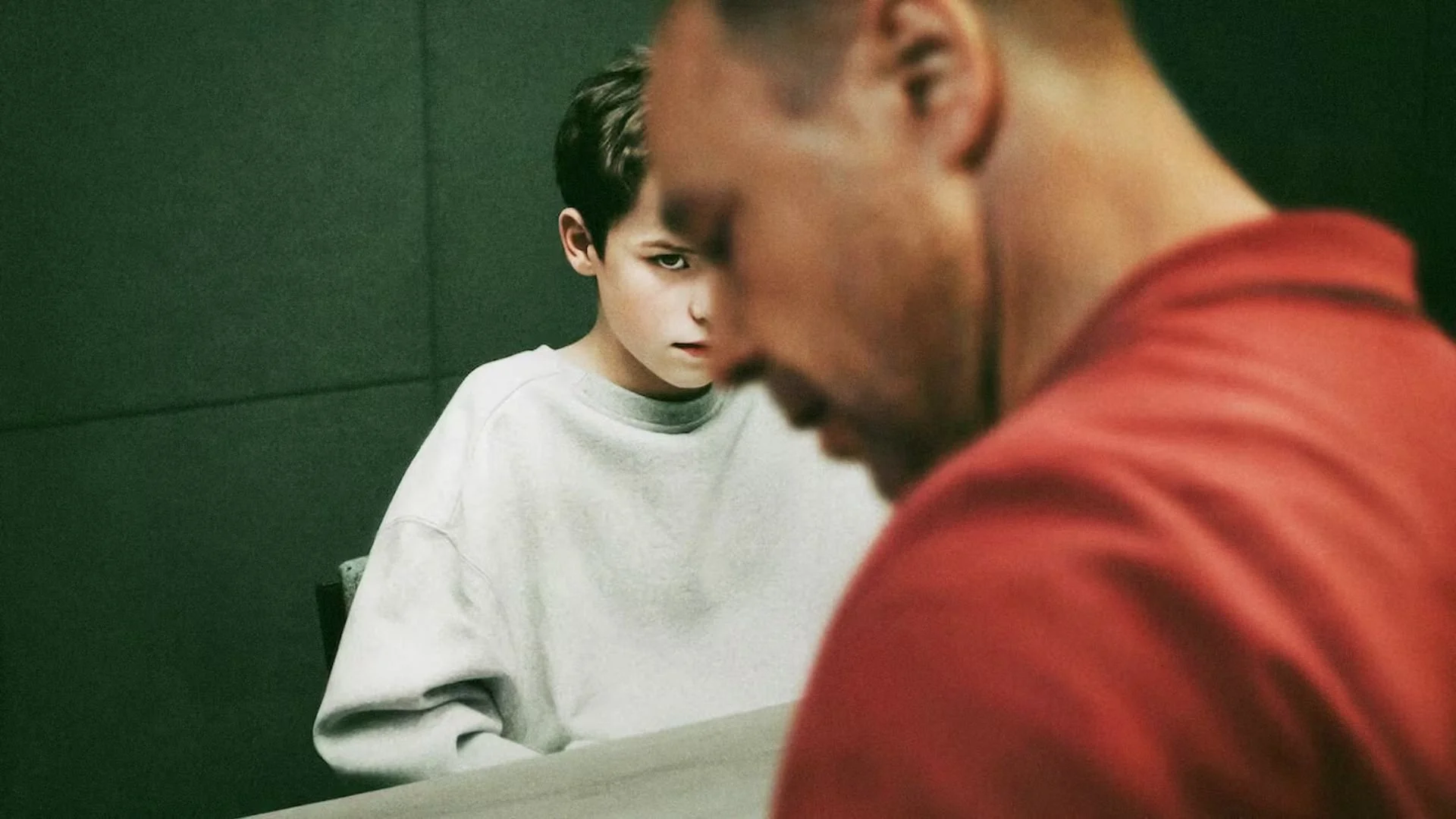
Adolescence. Created by Stephen Graham and Jack Thorne.
Adolescence makes clear how little most adults and parents understand about the digital lives of their children. And the devastating fallout.
It’s a four-part limited series that arrived on Netflix earlier this month and follows a 13-year-old boy accused of murdering his classmate. On the surface, the show centres on the terrible crime, but it’s really about what no one saw coming. It exposes the gulf between what adults think their children are experiencing and what they’re actually living.
The series opens with armed police storming the Miller family home at dawn, breaking down the door and arresting 13-year-old Jamie for the suspected murder of his classmate, Katie. The camera is a witness to the invasion, tracking the chaos but ultimately staying with Jamie as he’s led to the waiting police car. We remain with him through the ride to the station, the booking process, and his first interview, all unfolding in real time over the course of the first episode.
It feels less like a fictional show and more like a real-life documentary. Raw and disorienting. The bar is set high from the start, and it stays there as the next three episodes shift focus: the school and its pupils; a psychologist interviewing Jamie; and the Miller family struggling to hold their lives together.
Stephen Graham, who plays Jamie’s father, Eddie, and also co-wrote the series, said the idea for Adolescence came after a spate of violent crimes in England. “It really hit my heart,” Graham said. “I just thought, what’s happening? How have we come to this? What’s going on with our society?”
The result forces parents to confront harrowing questions and a blunt truth: parents have no idea what their children are being exposed to. Adolescence exposes how easily young men can be radicalised online without their parents noticing. Most adults don’t understand the coded language of social media or the hidden meanings embedded in emojis. It’s a different world and one they’re barely aware of.
One scene captures this generational gap perfectly. The chief investigator, a skilled officer and a father himself, interviews students at the school. He’s competent, able to speak the language of the street, until his own son pulls him aside and tells him he’s embarrassing himself. The officer has no idea how deep the cultural divide runs. His son explains the real meaning behind certain emojis, decoding an entire language for him, and us.
At one point, the father tries to relate: “Oh yeah, likeThe Matrix.” His son just stares at him. “What?” To today’s teenagers, The Matrix (1999) is as ancient and irrelevant as black-and-white films were to kids in the 1980s.
Adolescence explores toxic masculinity, the ‘manosphere,’ and influencers like Andrew Tate. But it’s the adults who bring up Tate. Jamie himself never mentions any of this. The show refuses easy answers. His father isn’t abusive. His home life is normal. There’s no clear reason why he would commit such a horrific act. And that uncertainty is what makes the series so disturbing, especially for parents.
Jamie’s grief-stricken parents come to an awful realisation: they didn’t truly know their own son. They lost control. They were oblivious. And that will haunt many parents.
I read that British Prime Minister Keir Starmer watched Adolescence with his own teenage children and praised it. Successive governments have hesitated to take real action to protect children from the harms of social media. Stephen Graham and everyone involved in this show have now created the opportunity for an honest conversation about something difficult and important.
Whether that conversation leads to action remains to be seen. In the meantime, the algorithm keeps feeding us the red pill.
We are watching more than ever. But what are we really seeing?
Last November, Australia banned social media for children under 16, citing the risks to physical and mental health, especially the impact on girls from distorted body image, and on boys from the rise of online misogyny. The debate was intense, with both strong advocates and critics of the ban.
Denmark is preparing to ban smartphones in schools and after-school clubs. In the UAE, where I live, the Ministry of Education recently banned students and parents from bringing phones onto school campuses. Other countries are moving in similar directions, or already have.
This is a conversation that will continue. But perhaps it also demands something more personal: a reconsideration of how we use our phones, especially around children. That’s something they may later thank us for.
Because the more we watch without seeing, the easier it becomes to miss what matters.

A note on this week’s cover image.
I took this photo in 2019, during a visit to Chernobyl. A rusting dodgem car in an abandoned playground. I later learned the playground was brand new, scheduled to open just one week after the nuclear disaster.
It was never seen.
Pass It On
If this idea was worth your time, it may be worth someone else’s.
Share this essay with a friend:
https://www.deeplifejourney.com/deep-life-reflections/march-21-2025
If you have a thought you’d like to share, please leave a comment below.
You can read all previous issues of Deep Life Reflections here.