
The Second Curve
Notes on the Second Half of Life
Deep Life Notes | The Second Half of Life
As we get older, our sense of worth may be less about adding, and more about chipping away the things that no longer belong.
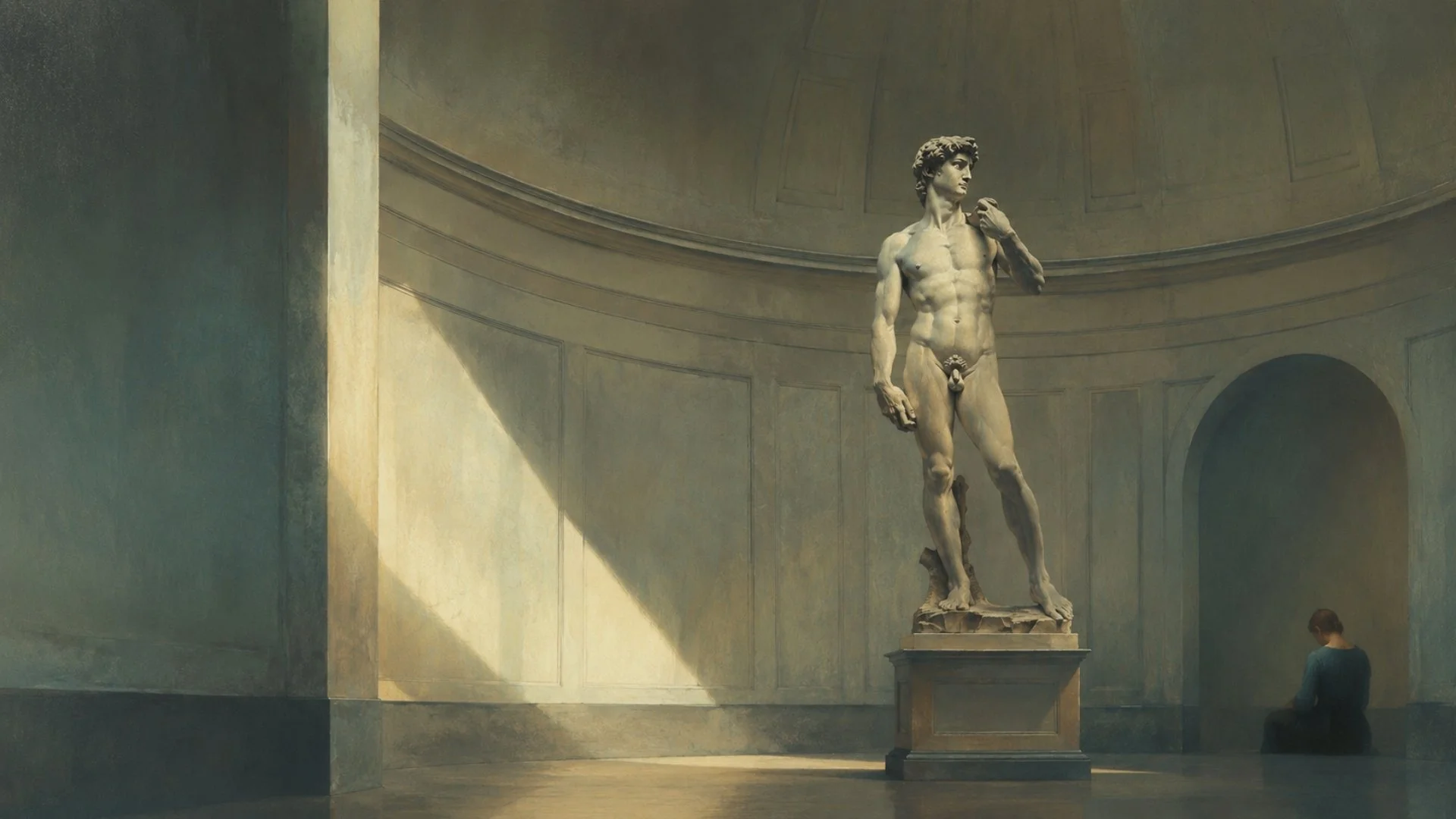
I visited the beautiful city of Florence this month, home of the Renaissance. Amongst all the incredible works of art that fill the city, Michelangelo’s David has become the defining representation of the period. A sculpture of perfect balance, form, and harmony from the hands of a genius who was less than thirty years old.
Michelangelo said sculpture was the hardest of the arts because there was no room for error, unlike in painting, where an artist could simply apply another brush to cover a mistake. When Michelangelo received the commission for David, they gave him a discarded and flawed block of marble. It would take him just under three years to complete his masterpiece for the city.
Upon finishing in 1504, the David was placed at the entrance to the Palazzo della Signoria. In Irving Stone’s biographical novel of Michelangelo, The Agony and the Ecstasy, the residents of Florence began attaching little handwritten notes to it. Michelangelo was worried at first, as the public could be fickle. Then he started reading them:
“You have given us back our self-respect.”
“We are proud to be Florentines.”
“Never can they tell me man is vile; he is the proudest creature on earth. You have made a thing of beauty. Bravo!”
As I joined the thousands of other visitors in the Accademia Gallery to marvel at Michelangelo’s iconic statue hundreds of years later, I remembered a quote attributed to him:
“The sculpture is already complete within the marble block before I start my work. It is already there. I just have to chisel away the superfluous material.”
I wondered if we could apply this to ourselves, too.
Chipping away to reveal more
In our search for a meaningful life, we often add things to our lives. The quest for more is evolutionary. More money, more status, more possessions. But the reverse may suit us better, especially as we get older. Chipping away, not adding.
The social psychologist Arthur Brooks talks about our lives as art. We begin life as a blank canvas, with colour and texture added to the canvas as we age, representing our accumulation of things and experiences. But there comes a point when the canvas is full. New brush strokes only make the painting worse, not better. Brooks suggests that as we age, we move from the canvas to the sculpture, removing the rough marble in order to better reveal our changing selves and our sense of worth.
Finding our ‘Second Curve’ in life
Brooks also talks about the need for us to move from our ‘first curve’ to our ‘second curve’ in life, believing our professional decline happens much earlier than we think, between our late thirties and early fifties. That may surprise quite a few people. It surprised me.
He believes decline is inevitable, but that we can develop new strengths and skills into older age. In order to make this jump to a second curve, we first need to understand the two types of intelligence behind these two curves.
Fluid Intelligence vs Crystallised Intelligence
In the early 1970s, British psychologist Raymond Cattell identified two types of intelligence people have: fluid intelligence and crystallised intelligence.
Fluid intelligence is the ability to create ideas, think flexibly, and solve hard problems quickly. It’s most common when we are young, but it declines with age. Fluid intelligence is largely behind our first curve in life, that first decade or two of our careers.
Crystallised intelligence is the body of knowledge learned from life. Call it wisdom. Unlike fluid intelligence, it increases with age through our forties, fifties, and sixties, and is our second curve. If fluid intelligence is solving problems, crystallised intelligence is knowing which problems to solve.
People with crystallised intelligence tend to rely more on their abilities to synthesise knowledge, see historical patterns, and guide, develop, and teach others.
Research suggests we may be better suited to different kinds of work at different stages of life, shaped by these two types of intelligence. The key is to move from one to the other before the decline sets in, shifting our work to rely more on crystallised intelligence as we age.
Why organisations still need wisdom
As more professionals make that move into a second curve, this is also worth remembering inside organisations. A culture too heavily weighted toward youth and novelty may prize speed, invention, and disruption, while undervaluing memory, judgement, and consequence.
Older workers with crystallised intelligence still have a vital role to play. Their wisdom, built over decades, need not be lost.
Moving toward the Second Curve
Making the jump from the first curve to the second curve of our professional lives isn’t easy. The first curve is responsible for accumulating many worldly rewards after all, which are difficult to let go. But these rewards are unlikely to provide lasting satisfaction.
Instead, we can begin to think about what might belong in a satisfying next chapter of life.
Meaningful work matters. Research shows productive human effort is vital in creating a sense of purpose in life. What makes work meaningful isn’t always the work itself, but the sense that our effort is connected to something bigger than ourselves.
The reverse bucket list. Bucket lists can be temporarily satisfying, but they can also create attachments, which become dissatisfaction as more items get added. A reverse bucket list is more selective, keeping only those things that are inherently satisfying. There’s nothing wrong with visiting a place we’ve always wished to see, running a marathon, or mastering a difficult skill, but it’s worth asking whether these desires come from meaning or from wanting others to admire or envy us. The list is probably better kept to a handful of things linked to friendships, family, and pursuits that are satisfying and meaningful.
Sharing what we have learned is one way to make use of crystallised intelligence. Mentoring is a simple example, passing on knowledge, experience, and perspective to others who may benefit from it. I mentor several people both within my organisation and outside of work, and find it a rewarding experience linked to my purpose.
Now is all we ever get
Research suggests that on average people become psychologically healthier after thirty and well into later life. Maybe it’s because we realise now is all we ever get. To find our second curve, we might consider taking things away rather than adding more.
Just like Michelangelo did to that discarded block of marble five hundred years ago.
Pass It On
If this note was worth your time, it may be worth someone else’s.
Share it with a friend, or read more Deep Life Notes here.