
The Prophecy of Ignatius J. Reilly
What A Confederacy of Dunces understood before the internet did.
Deep Life Reflections | Essay 162 | James Gibb
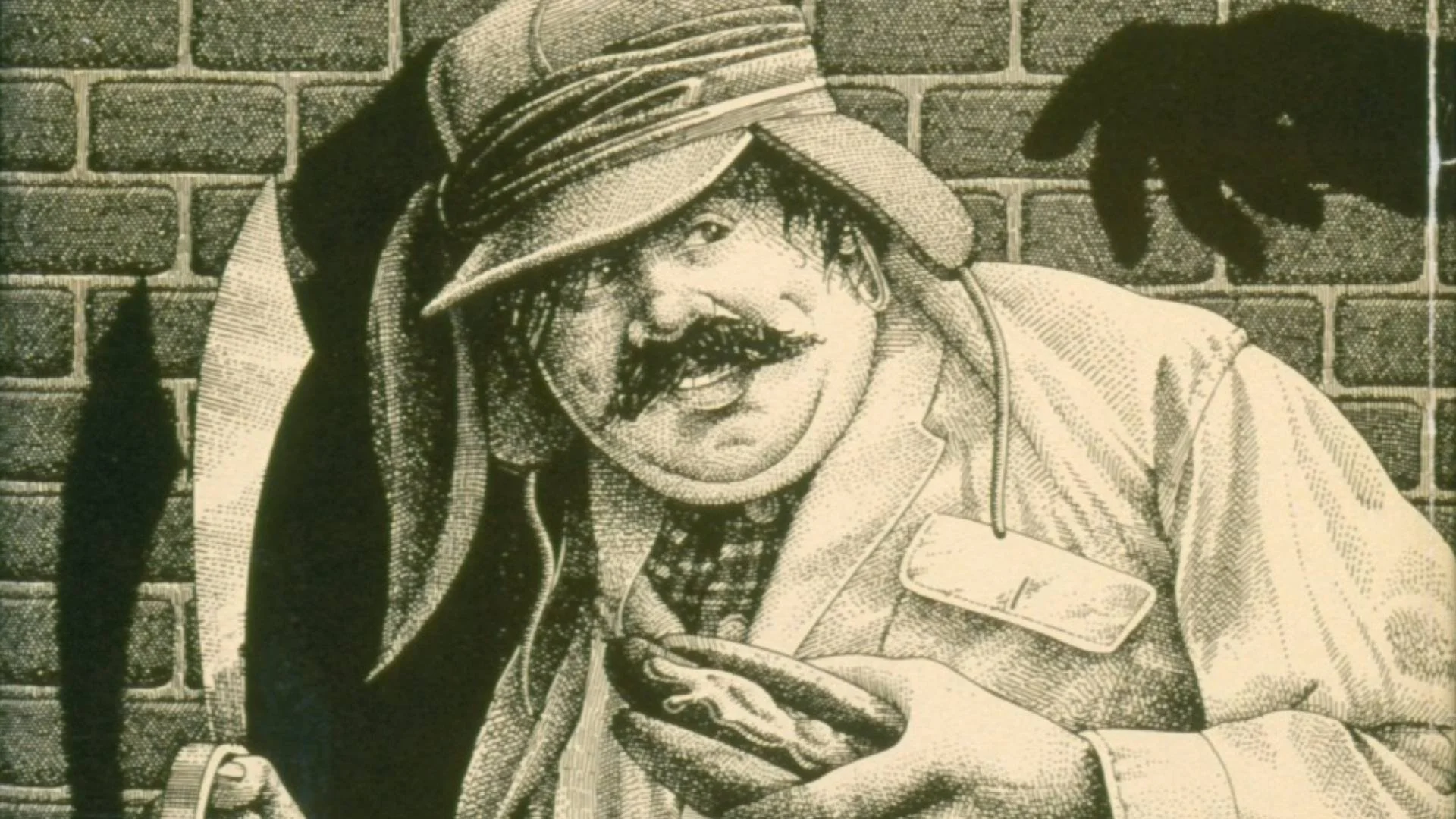
The truly disturbing satirical characters are not the ones exaggerated beyond belief, but the ones reality slowly catches up with.
“...When my brain begins to reel from my literary labors, I make an occasional cheese dip.”—Ignatius J. Reilly
Behind every novel is the story of how that novel came to be. Most of those stories remain between the writer and their own private universe. Occasionally one breaks free. In the foreword to A Confederacy of Dunces, the writer Walker Percy begins by explaining how he first encountered the novel. In 1976, while teaching, Percy began to get telephone calls from a woman he didn’t know. Her name was Thelma Toole. She said her son had killed himself in 1969. She also said he had written an entire novel during the early sixties and wanted Percy to read it. Percy asked her why on earth he would want to read a stranger’s book? A big book no less. Because it is a great novel, she said. And because my son is a genius.
And so the world—or more specifically, someone who wasn’t a member of the Toole family—got its first taste of the fictional character of one Ignatius J. Reilly, a noble crusader against a world of dunces. At least, that’s how Ignatius would describe himself. As he read, Percy chose different words: “slob extraordinaire, a mad Oliver Hardy, a fat Don Quixote, a perverse Thomas Aquinas rolled into one.” A thirty-year-old man from New Orleans still living with his mother and in revolt against the entire modern age. A man conjured from the mind of its creator, John Kennedy Toole, who took his own life at the age of thirty-one.
Toole’s short life was tragic, but in his creation of Ignatius J. Reilly, his finest achievement. One that would give him a literary afterlife he couldn’t foresee. When Toole sketched him out back in the early 1960s, Ignatius could be seen as a comic overstatement. Intellectual but puffed-up, revolutionary in thought but a buffoon in his actions. A glutton, a deadbeat, a contradiction, and yet also a writer of manifestos in glorious prose. When Ignatius was finally given to the world in 1980 (it took Percy three years to find a publisher), that comic overstatement still rang true. But today, Ignatius feels like a familiar public type. Indeed, Ignatius no longer feels quite so absurd.
Consider some of Ignatius’ most potent traits: his grandiosity, his hostility, his delight in provocation, his inability to function in ordinary life while maintaining a total theory of why everyone else is degraded. Ignatius was the first internet troll. The first ‘personality’ who delights in the distorted, whose life mission is to help you understand why everything you thought was true is in fact a heinous lie; why Churchill, and not Hitler, was the true despot of the twentieth century. The prototype of the aggrieved and high-minded who turns personal failure into a theory of civilisation’s decline. Ignatius, unwittingly or not, became a blueprint for the worst of the internet. He is here among us, his trademark flannel jacket, baggy pants and large hunting cap with ear flaps, multiplied infinitely. Munching a hot dog (or eight).
“I mingle with my peers or no one, and since I have no peers, I mingle with no one.”—Ignatius J. Reilly
Ignatius is a medievalist. To him, human society peaked around the fourteenth century. Everything since—the Renaissance, the Enlightenment, the Industrial Revolution—has been one long, vulgar decline of humanity. The twentieth century was basically the equivalent of Dante’s lowest rung of Hell. Living with his overburdened mother Irene in a back bedroom on Constantinople Street in New Orleans, Ignatius dresses like a slob, lacks personal hygiene (to put it mildly) and has considerable delusions of grandeur. When Irene crashes her car into a building, causing a thousand dollars in damage, she demands Ignatius find a job to help pay off her debts. His two attempts at a job—the first for Levy Pants and the second as the world’s worst hot dog vendor (he eats way more than he sells)—allow us further insight into his mind and philosophy. He sees both endeavours as a doomed yet righteous attempt to “wrest a living from an unthinking and uncaring society.” Ignatius being Ignatius means he embraces employment on his own terms.
“I avoid that bleak first hour of the working day during which my still sluggish senses and body make every chore a penance. I find that in arriving later, the work which I do perform is of a much higher quality.”—Ignatius J. Reilly
Toole’s characters are comedic and argue constantly, but they never change their minds. They never seem to learn and even appear proud not to have learned anything from their choices or the world around them. Toole is getting at an important human behaviour: that people use argument to stage themselves. They are less concerned with arriving at truth. It’s more about vanity and self-justification. Again, that feels very relevant to today. The inhabitants of A Confederacy of Dunces are more akin to jazz musicians, just waiting for a chance to improvise an impressive solo under the spotlight.
Many of Ignatius’ solos are his wonderful diatribes in his self-penned letters to his “passionless flame,” Myrna Minkoff, a self-styled New York City revolutionary who briefly lived in New Orleans and exchanges back-and-forth letters with Ignatius throughout the book, amusingly always starting her letters with ‘Sirs.’ These letters and most of the novel confounded potential publishers in 1968, who complained that the book wasn’t about anything. By 1981, it had found its audience, winning the Pulitzer Prize for Fiction.
Ignatius tells readers early in the novel that “I am an anachronism. People realise this and resent it.” While the novel was delayed by two decades, it exists today in a culture that could finally recognise what it contained: the aggrieved narcissist souped up on superiority, cultural contempt, theatrical alienation, and an arrested adulthood, armed with a theory of civilisation’s decline. The internet merely handed Ignatius’ descendants a keyboard, a microphone, and a growing audience.
Ignatius was never an anachronism. He was simply early.
He would be delighted.
Pass It On
If this idea was worth your time, it may be worth someone else’s.
Share this essay with a friend:
https://www.deeplifejourney.com/deep-life-reflections/april-24-2026
If you have a thought you’d like to share, please leave a comment below.
You can read all previous issues of Deep Life Reflections here.