
Hiroshima, 8:15
John Hersey and Kiyoshi Tanimoto on the human cost that history must not reduce to argument.
Deep Life Reflections | Essay 177 | James Gibb
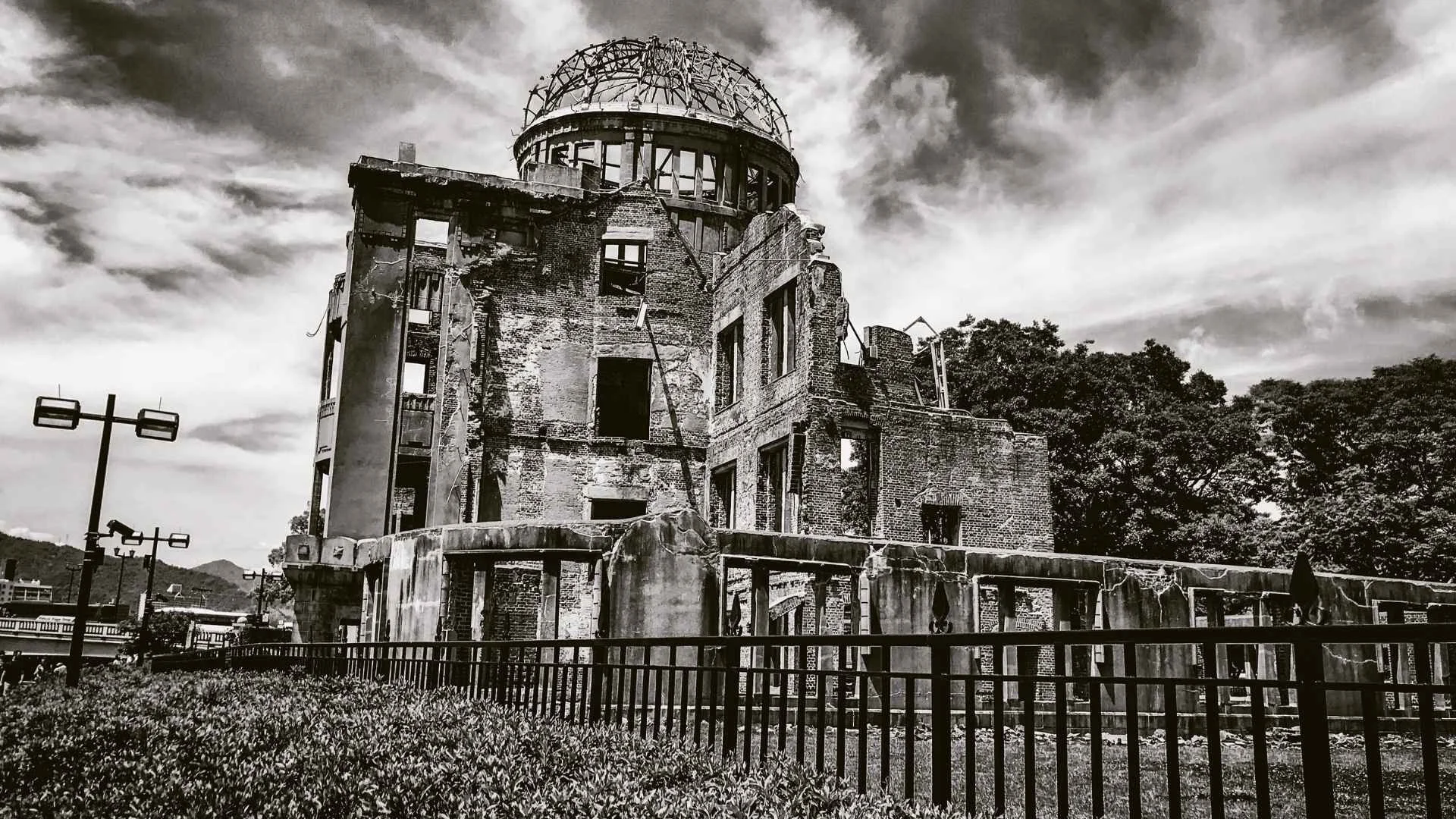
History may continue to debate Hiroshima as a moral decision, but the voices of those who endured it remind us that it must also be held as human testimony.
On the morning of August 6, 1945, at exactly 8:15am, the world’s first atomic bomb used in warfare was dropped on Hiroshima. The Japanese city, home to around 350,000 residents, had until then largely been spared the conventional bombing inflicted on many other Japanese cities. Witnesses described the moment as a sheet of sun flashing across the sky. Almost no-one recalls hearing any noise. In the immediate aftermath, the bomb killed an estimated 78,000 people and reduced most of the city to an inferno.
It has been 81 years and one day since the atomic bomb was dropped on Hiroshima, and then the second, three days later, on Nagasaki. The world bore witness to the devastation these new weapons could unleash, developed in the research laboratories and the barren desert of Los Alamos, New Mexico, as part of the Manhattan Project.
In 2018, I visited Hiroshima and its Peace Memorial Museum. I saw the photos and artefacts of a city that in many ways became burned into a very specific moment of history with no release. Glass bottles deformed by extreme heat, fused lumps of silver and copper coins, the shadow left on stone by a person who one moment existed and then did not, battered wrist watches stopped at 8:15am. Here, I also read the letter signed by Albert Einstein to President Roosevelt on August 2, 1939—a plea to expedite experimental efforts in the United States, spurred by the spectre of Germany’s pursuit of “extremely powerful bombs of a new type.” Einstein would later regret signing the letter.
“Had I known that the Germans would not succeed in producing an atomic bomb, I would have never lifted a finger,” he said.
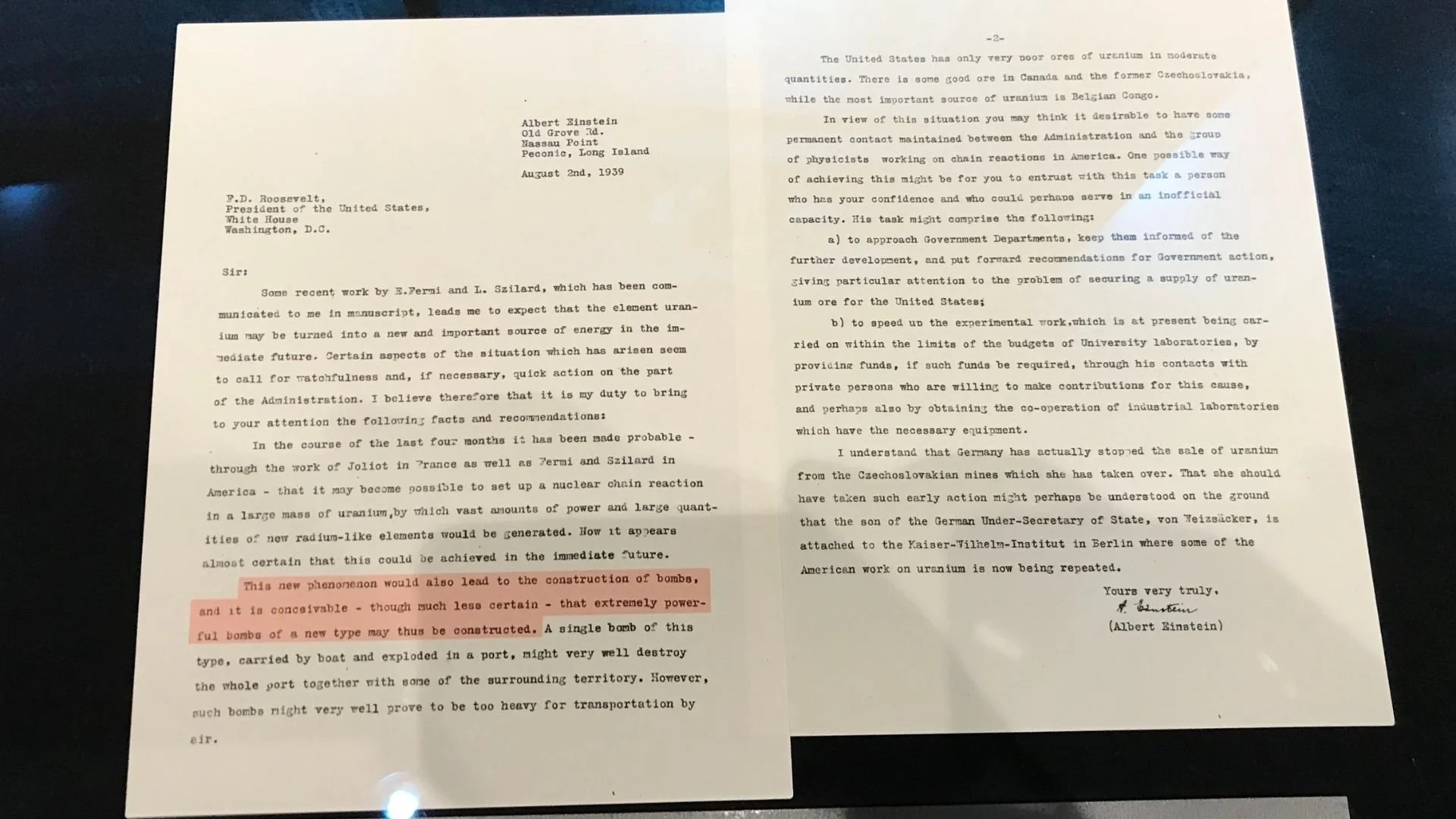
Albert Einstein’s signed 1939 letter to President Roosevelt.
John Hersey was among the first Western journalists to witness the aftermath of Hiroshima. He travelled to Hiroshima in 1946 to document the human fallout of the bombing. It became his book, Hiroshima, which was originally an article in The New Yorker. It tells what happened on the day through the memories of six individuals. Six survivors.
They are a widowed seamstress, a young factory worker, a Protestant minister, two doctors, and a German Catholic priest. Hersey describes what each was doing on the morning before the bomb was dropped. We follow them as their lives come together, sharing in the unimaginable devastation of those first 24 hours: the city a ball of flames, parks filled with radiation rain and whirlwinds, and the living beginning to wonder why they had been spared.
Hersey documents the survivors’ struggles to endure and help others as best they can. He recounts selfless acts and dignity amid total chaos; survivors, for example, repeating “Excuse me” as they step over the injured, carrying water to those in dire need.
One of Hersey’s six survivors was Reverend Kiyoshi Tanimoto, the Protestant minister. In 1947, he wrote his own memoir, almost lost to time and discovered decades later. Hiroshima, 8:15: The Lost Memoir is released this week and gives Tanimoto’s first-person account of August 6: his terrifying journey across the burning city to find his wife and child.
Like Hersey’s book, it starts with the explosion. Tanimoto recalls the parents of a Mr. Konda, one of his church members, who had been waiting for a train at Yokogawa station, around two kilometres from the centre of the bomb’s explosion. They saw a B-29 and then a parachute drifting through the air. The next thing they knew they were unconscious. When they came around, they found themselves lying on the ground, burned, and without any clothing. The houses all around them were rubble. They ran toward the suburbs.
Tanimoto himself was outside the immediate blast zone when the atomic bomb exploded. He managed to reach a spot around a kilometre from the explosion. He recalls the houses were badly damaged but some were still standing, unlike those closer to the epicentre, which had been flattened, “as if they had been toy buildings crushed by a hammer.”
He heard painful cries of “Tasukete!”–“Help!” from within the decimated homes. He knew people were buried under masses of concrete and steel, but quickly realised the hopelessness of the situation. He was but one man. Yet he tried. It was then he thought of his own wife and baby and neighbours. Tanimoto was the defence coordinator of his neighbourhood, responsible for 120 lives. He ran in tears back to his post, saying “Excuse me, I’m sorry, but excuse me!”. He recalls he ran like a wild man, as the city incinerated around him.
He saw terribly injured people. Many had stopped moving due to their injuries. They simply lay in the streets. The closer Tanimoto got to the centre, the more bodies he saw. After running for an hour, he plunged into a river as the bridge was too damaged to cross. There he almost drowned, which seemed, he reflected, a cruel irony: to drown on the day of a nuclear attack. He prayed while he was sinking, “Oh God, do help me. Protect my body until I can save my wife and child and my neighbours.” Some practical instincts helped too. He removed items of clothing and the remaining shoe he had on, using the last of his energy to swim and reach the other side.
Completely exhausted, and down to the bare minimum of clothes, he started walking to Ushita, the district where his family lived. The dead, dying, and wounded were everywhere. He differed from the wounded around him only in having no burns. He felt the guilt in his bones.
Tanimoto stopped at a house where his wife often stayed overnight. To his surprise, he found her there, carrying their child in her arms, alive. She was bloodstained and ghostlike, part of a long line of refugees. Tanimoto recalled he hadn’t the slightest pleasure in seeing his wife and child safe. Instead, he was filled with indignation. His thoughts, like his wife’s, were with their neighbours and their community. The community he felt he hadn’t protected.
Tanimoto’s story carries shame and responsibility. As Hersey records, the survivors had different feelings about what they had experienced and about the use of the atomic bomb. Yet even amidst the destruction, many shared a restrained sense of community spirit, a pride in their collective resilience and endurance.
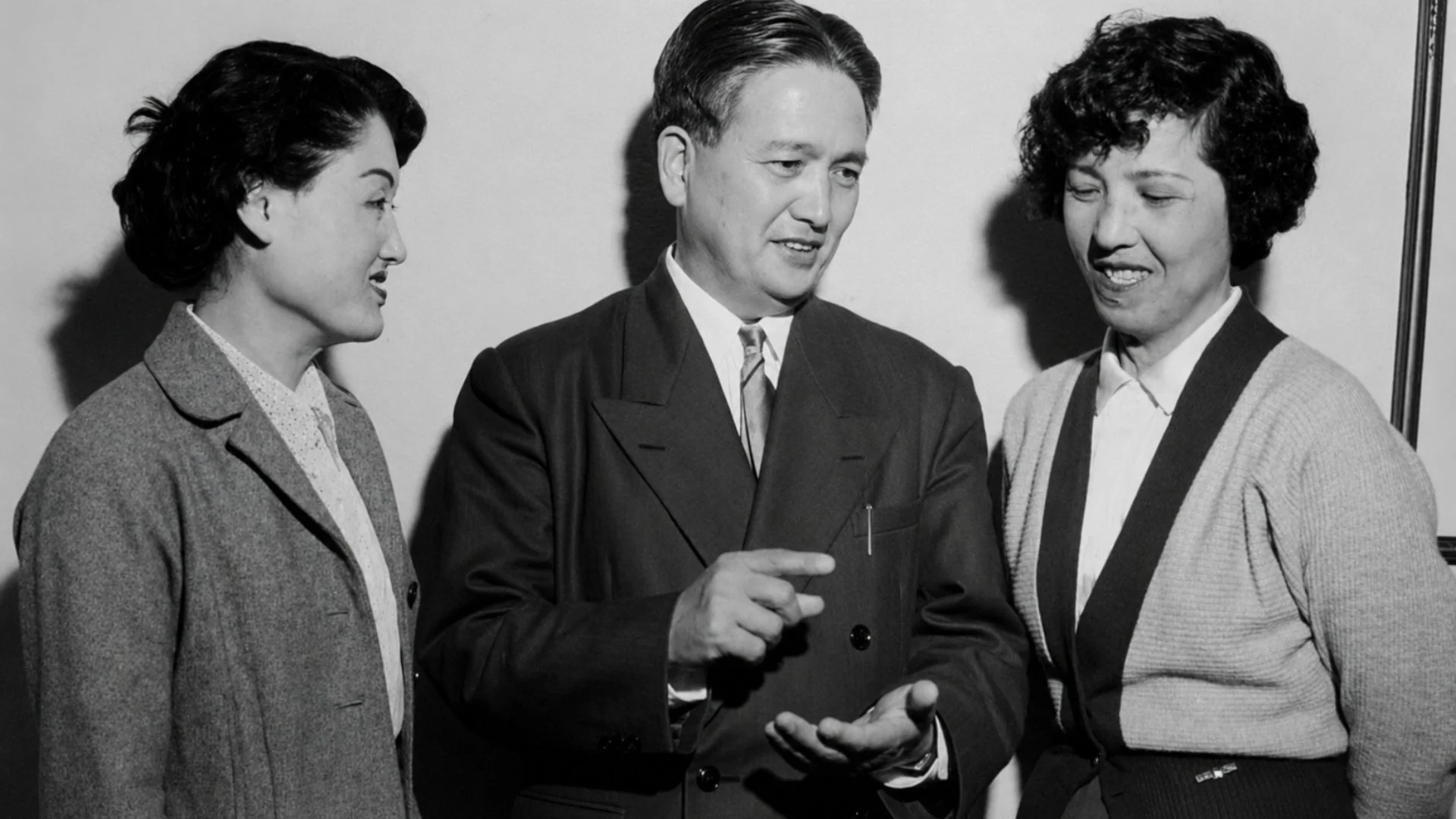
Reverend Kiyoshi Tanimoto and two Hiroshima survivors in California, 1955.
The argument over whether the bomb was necessary will continue. Perhaps it should. For some, the atomic bomb—as devastating a weapon as it was—led to the swift conclusion of the raging Pacific conflict, potentially saving countless lives, both those in Japan and beyond. It also showed the horror and totality of nuclear warfare. Not just mass death but the fragile vulnerability of civilisation itself. A moment when the world could say in unison, ‘Never again,’ and actually mean it. Indeed, the message of the Hiroshima Peace Memorial Museum appeared on its large display boards more than once: “No more Hiroshimas.”
But through the words of Hersey and Tanimoto, Hiroshima cannot be held only as an argument about war. It must also be held as human testimony. Those who survived among the rubble and ruins, and those who would later die from causes related to the bombing. And the generations that followed in its permanent shadow.
The argument over the necessity of Hiroshima and Nagasaki will continue.
The obligation to look at the human cost should not.
Pass It On
If this idea was worth your time, it may be worth someone else’s.
Share this essay with a friend:
https://www.deeplifejourney.com/deep-life-reflections/august-7-2026
If you have a thought you’d like to share, please leave a comment below.
You can read all previous issues of Deep Life Reflections here.
This essay’s main image is a photograph of the Atomic Bomb Dome from my visit to Hiroshima in 2018.