
Men of Contradiction
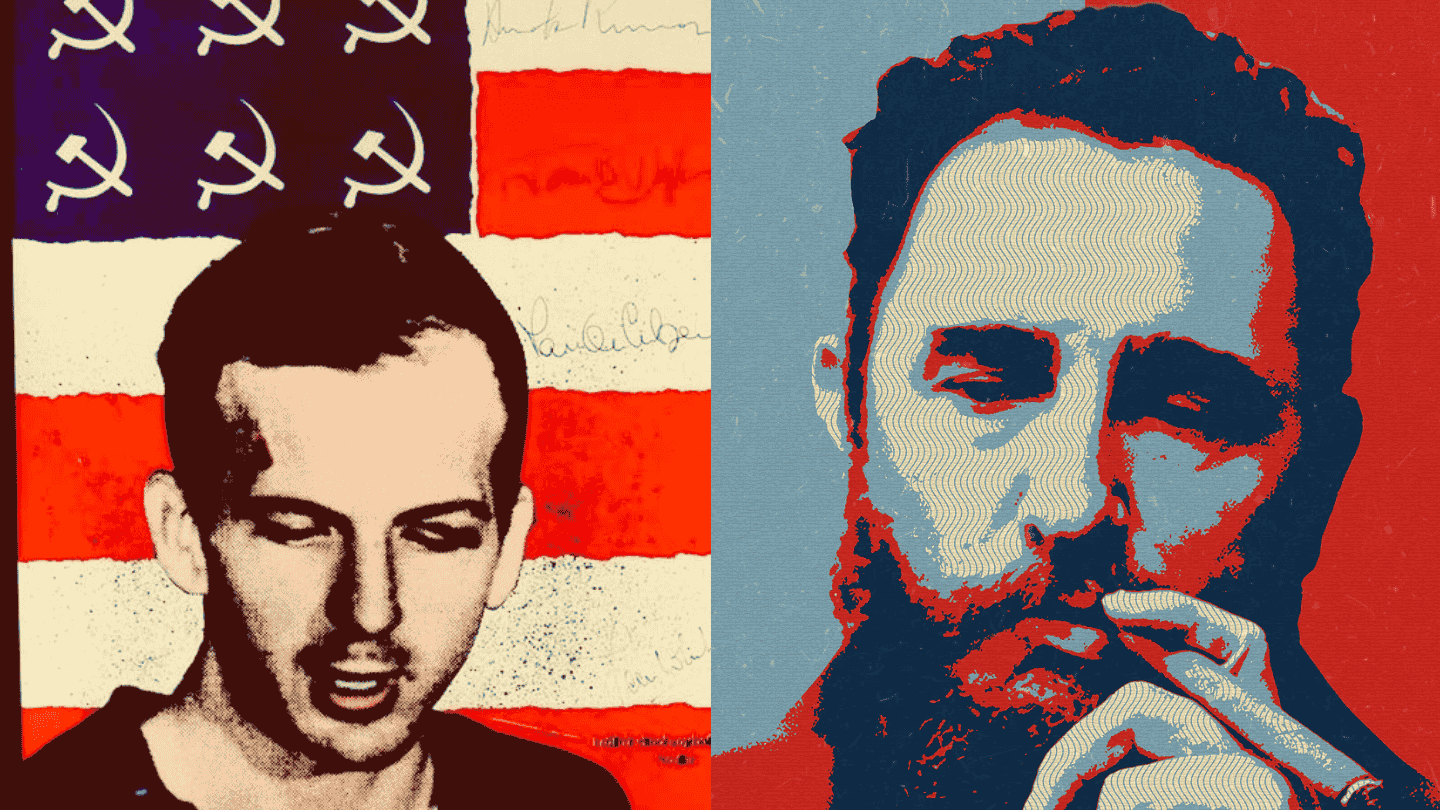
Fidel Castro and Lee Harvey Oswald: Bound by contradiction, complexity—and JFK.
Deep Life Reflections | Essay 143 | James Gibb
We like simple stories. History rarely gives us any.
“The seven seconds that broke the back of the American century.”
—Don DeLillo, Libra
Dallas. November 22, 1963. 12:30pm. The most consequential act of violence in modern U.S. history is also the most ambiguous.
Countless books, documentaries, films, conversations, and conspiracies have been dedicated to the assassination of President Kennedy. The definitive take remains out of reach though, like an entire floor missing from a newly constructed building.
In 1989, American novelist and playwright Don DeLillo wrote Libra, a dense and acclaimed work of fact and fiction that revisited and reimagined the events leading up to the assassination. DeLillo takes everything we know—from the Warren Commission and all the decades of research and testimony—and fuses it with fantasy, altering and embellishing reality, inventing incidents and characters. A picture of what may have gone down.
At the heart of Libra is Lee Oswald.
Not yet the Lee Harvey Oswald forever etched in the collective memory of the world. DeLillo gives us a remarkable portrait of Oswald, more like a series of portraits as we follow him from his difficult upbringing in Texas, to his military time in Japan, his defection to Russia, and his return to the United States with his Russian wife, Marina. DeLillo doesn’t paint Oswald as the lone gunman or explicit villain, but as an antihero. He’s complex, often confused, caught between grander schemes beyond his control.
Oswald, born on October 18, is a libra in name and nature. Libra is represented by The Scales. By Balance. Balance is the key, but Oswald is overweighted. As the eccentric anti-communist and alleged associate of Oswald, David Ferrie, remarks:
“He [Oswald] is a man who harbours contradictions. Here’s a Marine recruit who reads Karl Marx. This boy is sitting on the scales, ready to be tilted either way.”
Oswald moves to the control of others. He’s a vessel. We see this through the richly rendered inner monologues of Oswald—his confused reasoning, his doubts, his political affirmations. His contradictions are also represented in his names. He’s known by several, including ‘Leon’, ‘Alek’ (his nickname in Russia) and ‘A. Hidell’ (the infamous name he used when ordering the gun that would later be used to shoot Kennedy.) Oswald doesn’t seem able to grasp his role in the century. Not fully. Maybe not at all.
Surrounding Oswald is a constellation of figures: CIA operatives, government officials, Cuban sympathisers and agitators, KGB agents, mob men, mercenaries, nightclub owners, dancers, wives, mothers, children. They all orbit Oswald in a non-linear, layered way, revealing the convergence of ambition, ideology, chance, and fate.
It all leads ominously to the day in Dallas and the motorcade. We sit in the car with the Kennedys. For a time, we are inside the head of JFK. With his thoughts. Then the shots. DeLillo writes the moment like a dream half remembered; a whirr of blurs, patches, sounds, and shadows. Like the Zapruder 8mm film itself, over-scrutinised and murky. It’s both the timing device of the assassination and the metaphor: grainy, incomplete, hypnotic.
DeLillo has said the writer’s job is to “stand outside society, independent of affiliation and independent of influence.” Writers, he argues, should live in the margins.
Libra is written from those margins. It resists convention, closure, and the illusion of order. There is no healing of the fracture.
While his novel is a work of fiction, and should be read and enjoyed as such, DeLillo doesn’t mythologise the conspiracy. Conspiracies are often thought to be perfect workings of a scheme.
“Silent nameless men with unadorned hearts. A conspiracy is everything a normal life is not. It’s the inside game, forever closed off to us. Conspirators have a logic and daring beyond our reach.”
But DeLillo muddies the conspiracy. It’s a mess of bluff, crossed wires, and luck. “Deft men and fools, ambivalence and fixed will and what the weather was like.”
Oswald embodies this contradiction and chance. He’s symbolic of the fracture in the narrative. Just like the assassination: unresolved, obsessed over, altered by every rewatch of the Zapruder film. Oswald became the trigger of distrust, of conspiracy.
And of something broken that hasn’t been repaired since.
“Do I contradict myself? Very well then, I contradict myself. (I am large, I contain multitudes.)”
— Walt Whitman, Song of Myself
Moving to our second man of contradiction.
The Cuba Libre Story is an eight-part 2015 documentary that charts the turbulent sweep of Cuba’s modern history—from Spanish colony to American satellite to revolutionary state.
I started watching the series while reading Libra. Not only is there a direct historical connection (Kennedy and the Bay of Pigs) but also a parallel between two men. Castro and Oswald. Both embody contradiction. Both are ambiguous. Both have been flattened into myth. Oswald became the lone gunman. Castro, the Communist dictator. But neither fits quite so neatly.
Historians, political insiders, former revolutionaries, and various operatives all give informed perspectives and weight to the documentary. Many of the voices are Cuban. The early episodes trace Cuba’s so-called discovery by Columbus in 1492, the Spanish-American War of 1898, and Cuba’s contested independence in 1902, shaped by José Martí, the poet-philosopher widely considered the father of Cuban nationhood.
But the bulk of the series belongs to the twentieth century. A portrait not so much of ideological purity, but one of pragmatism, opportunism, theatre, and myth.
To understand Castro, you first have to understand Fulgencio Batista, the military strongman whose rise in the 1930s shaped the Cuba Castro would later seize. Batista ran Cuba from behind the curtain before taking power directly. Corruption flourished. American business interests thrived. The American mafia took a seat at the table, run by no less a figure that Mayer Lansky, right-hand man to Charles ‘Lucky’ Luciano. Lansky ran the criminal underworld in Cuba, as well as the hotels and casinos. (The character of Hyman Roth in The Godfather Part II is based on Lansky). Poverty deepened. By the 1950s, resistance was brewing.
In 1953, Castro launched his first attempt to overthrow Batista with a failed attack on the Moncada Barracks in Santiago. Most of his rebels were killed. Castro was arrested and put on trial. As a lawyer, he defended himself. He closed with his famous words: “History will absolve me.”
Sentenced to fifteen years, he served just nineteen months. Batista released him in 1955 under political pressure. Castro left for Mexico, regrouped, met Che Guevara, and began the real revolution.
The day of the Moncada attack, July 26, was adopted by Castro and other guerillas as the name of his movement. Six years later, the 26th of July Movement overthrew Batista, and Castro took power. But the revolution was never clean.
Castro was born to wealth. His father, Ángel Castro, was a Spanish immigrant from Galicia who made his fortune in Cuba as a landowner. Ironically, he had earlier fought against Cuba in the Spanish-American War. Castro and his brother Raúl were born out of wedlock. Their father kept his distance. Castro was educated by Jesuits. He admired Bolívar and Martí more than Marx.
At the start of the revolution, Castro was not a doctrinaire communist but a nationalist opportunist. One biographer in The Cuba Libre Story puts it plainly: “Castro wasn’t a communist. He was a pragmatist.”
While Castro was anti-American, he was fascinated by American power. He never tore his eyes from it. His revolution was less Marx, more Machiavelli. After nationalising American businesses, Washington responded with sanctions and hostility. Castro aligned with Khrushchev and the Soviet Union. The revolution radicalised and the world teetered on the brink of nuclear war in 1962.
Castro also understood theatre. When he spoke at the UN, pigeons landed on his shoulder. The cameras rolled. Out of frame, a handler had trained the birds.
Castro has been positioned as both liberator and tyrant. Like Oswald, a contradiction.
Neither man was who he claimed to be. Both are products of America’s reach—and reactions to it.
A reminder that as much as we like a simple narrative, they are rare.
Pass It On
If this idea was worth your time, it may be worth someone else’s.
Share this essay with a friend:
https://www.deeplifejourney.com/deep-life-reflections/december-12-2025
If you have a thought you’d like to share, please leave a comment below.
You can read all previous issues of Deep Life Reflections here.