
What Disturbs Us Most
Revisiting The Exorcist and why the violation of innocence unsettles us so deeply.
Deep Life Reflections | Essay 153 | James Gibb
What disturbs us most is not violence, but the corruption of what should be protected.
When I was growing up, there were two films banned in the U.K. One was A Clockwork Orange, removed from distribution by the film’s director, Stanley Kubrick, after a copycat incident. The other was The Exorcist, withdrawn from U.K. video shelves after being deemed too shocking and blasphemous by the British censors. Of course, I wanted to see both desperately.
It wasn’t until my short time in the United States in the late 90s that I had that opportunity. I found A Clockwork Orange a little underwhelming on my first viewing. And quite dated. It wouldn’t be until years later that I’d revise my opinion higher based on a greater appreciation of Kubrick’s style and genius. But The Exorcist—watched alone, at night, in a big house—was a different story. It terrified me. It lived up to its reputation. The story of a young girl, Regan, possessed by a demon in modern-day Washington D.C. I haven’t watched it again.
Until this week.
As with A Clockwork Orange, I have revised my opinion on The Exorcist three decades since that first viewing. Because of its cultural impact and defining legacy—it elevated and refined the horror genre to new levels—it perhaps has a rather unfair reputation as simply a horror/shock film. But on repeated viewing, it is much deeper, much more human than horror (and its ten Oscar nominations support that). One of the film’s core themes, for example, revolves around faith. Specifically, the erosion of it by grief, doubt, and guilt.
To better understand the core themes of The Exorcist, I went to the source material: William Peter Blatty’s novel of the same name, published in 1971. I read it in a few days this week. Blatty produced the film in 1973, hiring the young and precocious director, William Friedkin, fresh from his Oscar-winning film, The French Connection, in 1972. The novel and the film are essentially identical, except the book fleshes out certain parts and gives additional context through expanded conversations. Theology and psychiatry are prevalent, mostly concerning the Jesuit priest, Father Damien Karras, one of the two priests who will ultimately carry out the exorcism of Regan in the electric climax.
One of the reasons I think The Exorcist works so well, and continues to stand up today, is because it takes its subject so seriously. Unlike the gore and fantastical excess of many modern-day horror films, the film stays rooted in science, doctors, and medicine, at least until all those areas have been thoroughly (and painfully) exhausted. With few new ideas left, the weary doctors suggest, almost in embarrassment, a last-ditch solution: find a priest to give an exorcism. Even then, the doctors see this religious act as more psychological than physiological. Their inference is that if the patient thinks they are possessed by an evil spirit, an exorcism performed correctly can convince them they have now been released. This is another interesting theme of The Exorcist: the failure of modern medicine to provide relief from suffering.
Suffering is heavily present throughout. Not only of Regan, but also her mother, Chris McNeil, a successful and famous actress who wants nothing more than her daughter to return to who she was. Her daughter’s spiral is agonising and her pain is in her powerlessness to stop it. Father Karras is also suffering, from doubt because of his loss of faith, and guilt over the recent death of his mother who he feels he abandoned. Those are heavy themes. The film shows us suffering without easy explanation. Regan’s suffering isn’t deserved or symbolic. It simply happens. Medicine and doctors fail her. Psychology fails. The film shows us that suffering can exist without a reason that satisfies us.
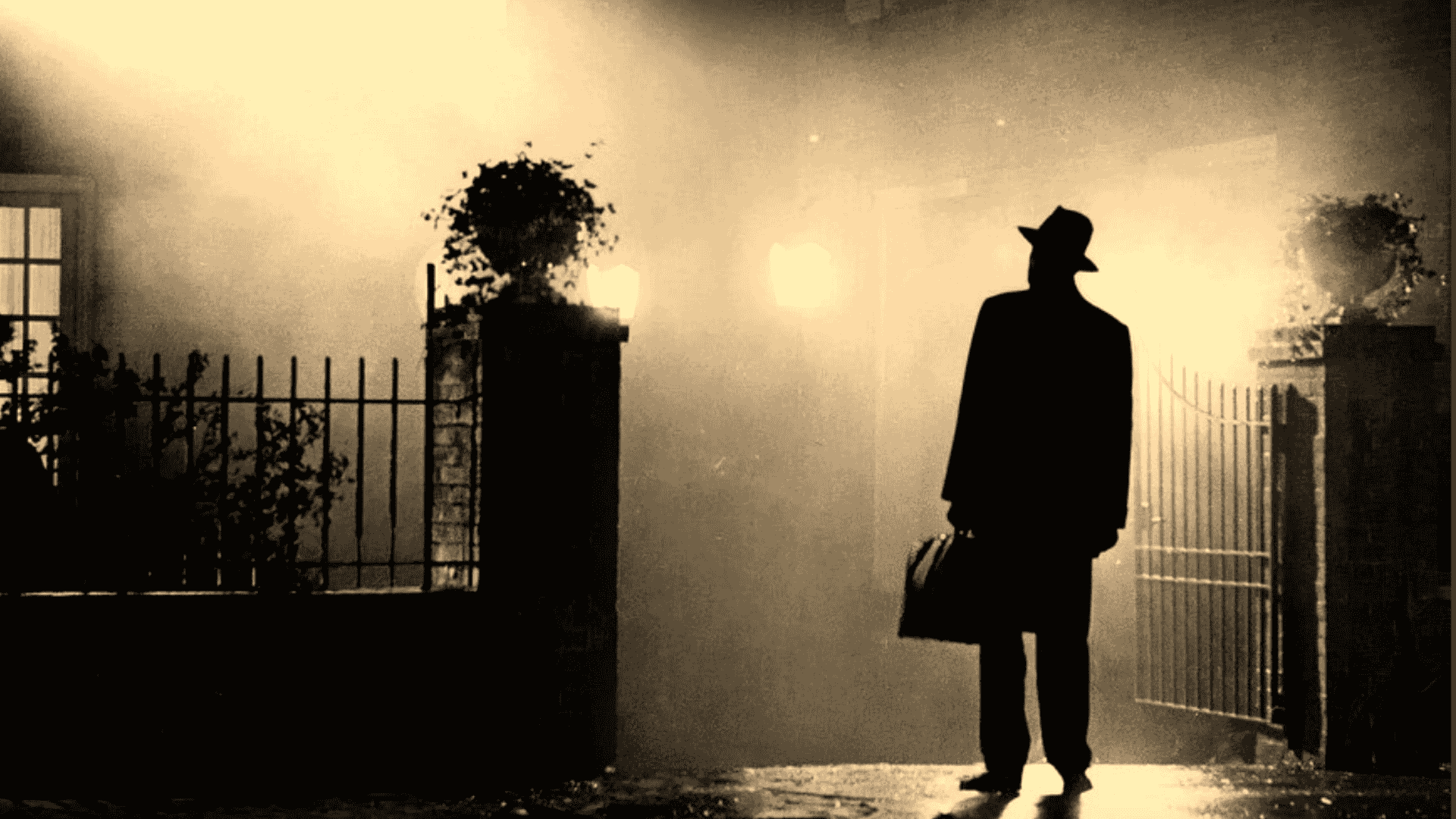
Blatty took inspiration for his novel by the actual 1949 exorcism of a young boy in Cottage City, Maryland, as well as the brutal 1634 Loudun exorcisms. We may be in the present day, in the affluent district of Georgetown, with its brown-bricked colonial homes, but the film has to travel to the distant past for its resolution. In Father Merrin, introduced at the start of the film on an archaeological dig in Iraq, we learn he has experience of a real-life exorcism, and through the finding of a small demonic statue called Pazuzu on the dig, he understands that he will have to face the demon again. And he does. Merrin’s arrival at the McNeil house, cloaked in silhouetted darkness and illuminated by a spectral light, creates one of the most iconic movie posters in history (and is the cover image this week). The image was inspired by René Magritte’s Empire of Light series.
While The Exorcist is known for several grotesque and graphic moments which so disturbed theatre audiences back in 1973 (and still do today to be honest)—the 360-degree head turn, the crucifix stabbing, the projectile green vomit, the foul, inhuman language and so on—underneath it all is the indisputable fact that innocence has been violated. Regan is a happy, fun, twelve-year-old normal girl robbed of all her goodness by something evil. Blatty and Friedkin understand that this is one of our deepest human fears: the corruption of what should be protected. And the terror of being helpless to stop it.
But stop it they do. Through the two priests, Merrin and Karras, and in Chris, the mother, who never gives up her responsibility, despite such terror, uncertainty, and her own atheistic beliefs. To her, inaction is simply unacceptable. The humanity of the film is drawn from this courage and solidarity. Regan isn’t abandoned. The two priests do what they have to do, and even here, there is contrast. Merrin, fragile through age and ill-health yet powerful through his absolute faith; Karras, young and physically strong, but conflicted by doubt in his faith and the guilt and grief over his mother. When Karras has to carry the burden alone, he is able to find the will, the strength, the belief, to do what must be done. His final act is one of supreme good. Even in doubt, one can find moral courage.
This cost of goodness though is expensive. In time, humiliation, physical pain, and ultimately life itself. There is no reward or praise. The film shows that moral action is costly and often unacknowledged. The film ends on a reserved note. But a clear one: that people still matter to each other. Blatty wanted to make this point at the end of his novel. That despite the evils of the world, which will always linger restlessly in the shadows, they can be overcome.
But not without a struggle, especially when what is at stake should never have been touched.
That is where the horror lies.
Pass It On
If this idea was worth your time, it may be worth someone else’s.
Share this essay with a friend:
https://www.deeplifejourney.com/deep-life-reflections/february-20-2026
If you have a thought you’d like to share, please leave a comment below.
You can read all previous issues of Deep Life Reflections here.