
Unintended Consequences
The Coddling of the American Mind and Barton Fink on how good intentions go wrong.
Deep Life Reflections | Essay 102 | James Gibb
The line between help and harm is more fragile than we think.
“God save us from people who mean well.”
―Vikram Seth, A Suitable Boy
In 2018, Greg Lukianoff and Jonathan Haidt made the case that overprotection is harming university students. Instead of equipping them with the skills required to tackle life and its challenges, initiatives like trigger warnings and safe spaces, while well-intentioned, are doing more harm than good. The result is increased anxiety, depression, and an unhealthy intellectual climate.
I’ve followed Haidt’s work for some time. He’s a social psychologist who studies morality and moral emotions. The Coddling of the American Mind: How Good Intentions and Bad Ideas are Setting Up a Generation for Failure feels even more relevant today given the recent high-profile demonstrations and fallout on U.S. college campuses and in other Western universities.
The authors introduce the concept of “safetyism”—a culture or belief system where emotional safety is treated as sacred at the expense of other practical or moral concerns. They argue that this mindset, this new morality, is interfering with young people’s social, emotional, and intellectual development by undermining the traditional virtues of academic life: truthfulness, free inquiry, reasoned argument, equal opportunity, and the pursuit of excellence.
Lukianoff and Haidt identify three ‘Great Untruths’ that they believe have taken hold in American culture, particularly among younger generations on college campuses. These untruths, they argue, contradict both modern psychology and ancient wisdom, creating anxiety and division.
The Untruth of Fragility: “What doesn’t kill you makes you weaker.” This promotes the idea that individuals should avoid stress, discomfort, or adversity because they are harmful. But in reality, exposure to challenges builds resilience and an ability to cope with real-world difficulties, much like how the immune system strengthens through exposure to germs.
The Untruth of Emotional Reasoning: “Always trust your feelings.” This suggests that emotions are the most reliable guide to understanding the world. But feelings can be misleading and often distort reality, leading to cognitive distortions such as black-and-white thinking and catastrophising, where one assumes the worst possible outcome in any situation. This leads to demands for “safety” from ideas that cause distress.
The Untruth of Us vs. Them: “Life is a battle between good people and evil people.” This mindset creates a binary, tribal view of the world, one where people are seen as either allies or enemies based on identity or beliefs. It encourages cancel culture, polarisation, and intellectual intolerance, making debate impossible because the very idea of debating is framed as harmful.
In their 2018 conclusion, Lukianoff and Haidt ended on a hopeful note, predicting that universities would soon develop a different kind of academic culture, one that made students from all identity groups feel welcome without using divisive methods.
This didn’t happen.
In the seven years since, the divisions on college campuses have only deepened, and confidence in Higher Education is at an all-time low. In December 2023, Haidt revisited these ideas, warning that the Three Great Untruths have become more pervasive, not less. He argues that “wiser universities” will be those that commit to free inquiry and prepare students for productive disagreement.
Being young isn’t easy. But it’s hard to make the case that fragility is strength, that avoiding discomfort makes us stronger, or that eight billion people are neatly categorised into simply good or bad.

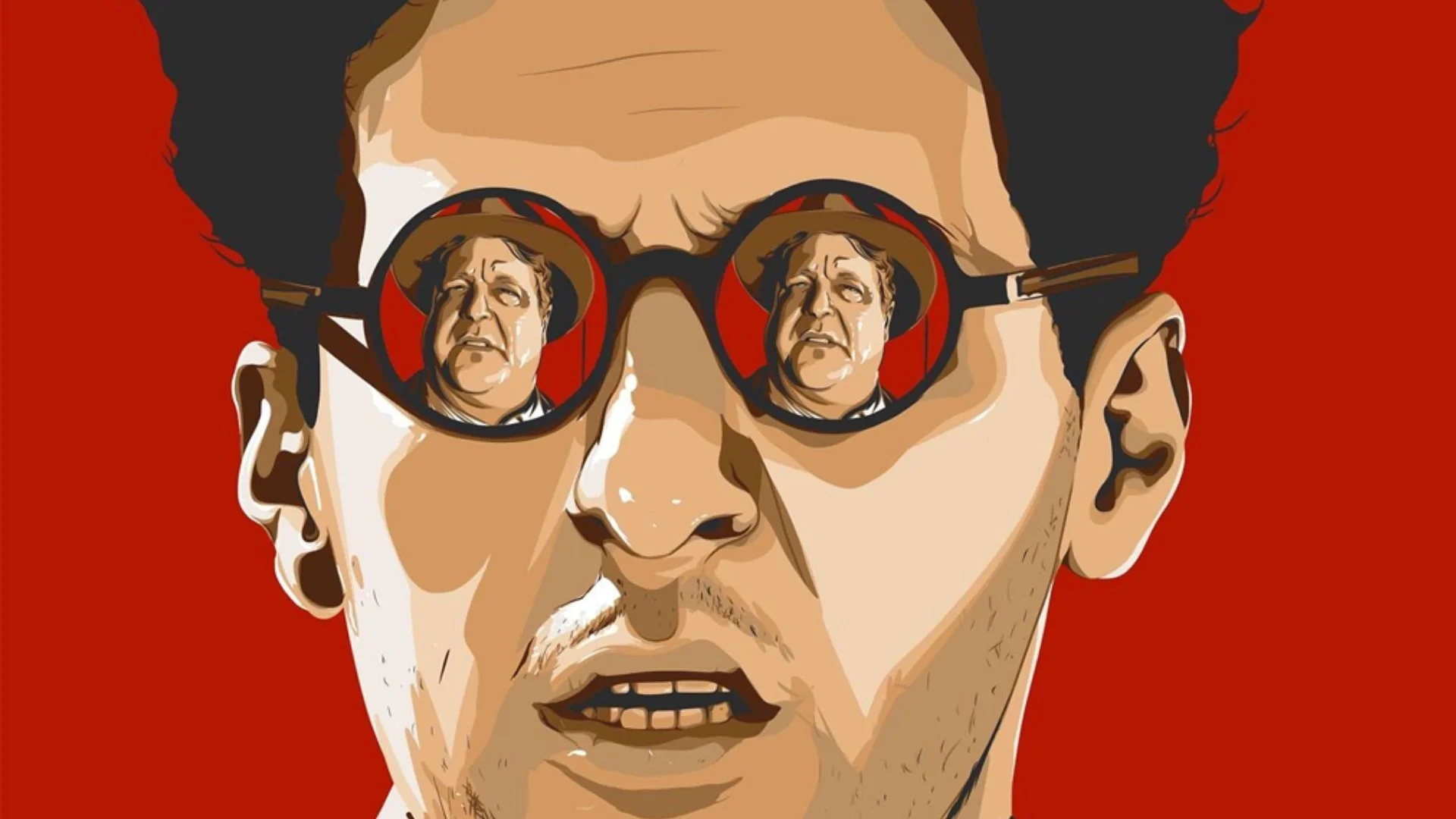
Barton Fink (1991). Directed by Joel and Ethan Coen
In Haidt and Lukianoff’s world, the problem is cultural: ideas, systems, institutions.
In Barton Fink, it becomes personal.
Barton Fink is a young, Jewish New York playwright. It’s 1941. Fresh off his first critical success, Hollywood comes calling. A major studio throws a truckload of money at him to write a B-movie wrestling picture for Wallace Beery (a real Hollywood star from the era). It’s a step down artistically, but Fink reluctantly accepts. We’re not sure why. Maybe for the money. Maybe because Fink sees himself as a champion of the common man.
But there’s a problem: he can’t write. He stares at his typewriter in despair.
This is the surreal, stylised, and darkly comic world of Joel and Ethan Coen. The Coens wrote Barton Fink while suffering from writer’s block themselves on Miller’s Crossing. John Turturro delivers a brilliant performance as Fink, playing him as sincere but spectacularly self-righteous, blind to the world outside his bubble. The film became the first to win all three major awards at Cannes: Palme D’or, Best Director, and Best Actor.
When Fink takes the Hollywood job, he moves to Los Angeles and checks into the eerie Earle Hotel, a decaying Art Deco labyrinth full of shadows, long corridors, peeling wallpaper, and sickly greens, yellows, and reds. Cinematographer Roger Deakins makes every frame of the hotel feel like a painting; thick and textured. No other guests seem to be there, except for Charlie (an also brilliant John Goodman), Fink’s next-door neighbour and affable traveling salesman who tells him, “I could tell you some stories.”
But Fink doesn’t listen. He doesn’t care. He’s too self-absorbed.
The hotel is suffocating, decaying, and dark. The only sign of life is a vast row of shoes neatly placed outside the doors for shining, evidence that other people exist, even if we never see them. The hotel is a metaphor for Fink’s isolation. An ideological purgatory: hot and claustrophobic, representing a mind trapped in itself.
As Fink gets increasingly desperate for writing inspiration, he befriends W.P. Mayhew, a drunken, washed-up, formerly great novelist modelled on William Faulkner. This leads to both comedy and horror.
The Coen brothers clearly had Hollywood firmly in their sights. But the sharper critique is aimed at Fink himself. He believes his work is monumental, but he is woefully detached from the people he claims to represent. People like Charlie. The film has something to say about intellectual elitism and arrogance, about characters like Fink who are unable to engage with others outside their ideology and grand designs. There’s a growing tension, that something sinister is festering.
Sure enough, Barton Fink builds toward an apocalyptic finale of blood, fire, and ruin. We learn that Charlie is not who he seems. Is the film a foretelling of the rise in Nazism? The film suggests that intellectuals like Fink never really understood the seductive appeal of fascism to the common man. And when it’s too late, he’s helpless to stop it. Neither his art nor his intellect has any influence. He’s impotent. The Coen brothers aren’t known for spelling things out, but there’s a definite sense that Fink thought he was a man of the people. He wasn’t.
Fink’s failure points to something broader.
The gap between claiming to speak for people and actually understanding them is not unique to him. It shows up anywhere ideas become more important than the people they’re meant to serve.
Identity Politics has become a loaded term today. But it’s not new, unusual, nor inherently illegitimate. For decades, groups have organised politically to advocate for their rights. In the 1960s, professional footballers in Britain worked together to secure a minimum wage. The real question is not whether Identity Politics should exist, but how it is pursued.
Two frameworks help explain why some forms of Identity Politics unite and create lasting change while others fracture and implode society. Both The Coddling of the American Mind and Barton Fink reflect this tension, where good intentions, when misapplied, often cause more harm than good.
Common Humanity Identity Politics (CHIP) focuses on shared values and collective progress. It seeks inclusion, understanding, and coalition-building, like the civil rights movement under Martin Luther King Jr., which emphasised universal human dignity. King’s famous words embody this mindset:
“Darkness cannot drive out darkness; only light can do that. Hate cannot drive out hate; only love can do that.”
Figures like King and Nelson Mandela humanised their opponents. They framed their struggles in a way that appealed to common identities and histories, rather than deepening existing divides.
Common Enemy Identity Politics (CEIP) thrives on division. It frames the world as oppressed vs. oppressor, reducing complex realities to tribalism, grievance culture, and moral purity tests. This mindset spreads rapidly and easily because human psychology is wired for tribal conflict, and social media accelerates it, rewarding simplistic, moralistic, and sensational narratives. At its most extreme, this is also the ideological fuel behind most genocides.
If true understanding and change are the goals, Common Humanity Identity Politics represents the better path forward. But it’s also the harder one. It requires nuance over absolutes, complexity over simple stories, and a willingness to see beyond zero-sum thinking.
It’s often easier to take the easy option.
And that’s where good intentions begin to go wrong.
Pass It On
If this idea was worth your time, it may be worth someone else’s.
Share this essay with a friend:
https://www.deeplifejourney.com/deep-life-reflections/february-28-2025
If you have a thought you’d like to share, please leave a comment below.
You can read all previous issues of Deep Life Reflections here.