
The Lions on the Beach
The Old Man and the Sea and Master and Commander—on continuing when nothing is guaranteed.
Deep Life Reflections | Essay 149 | James Gibb
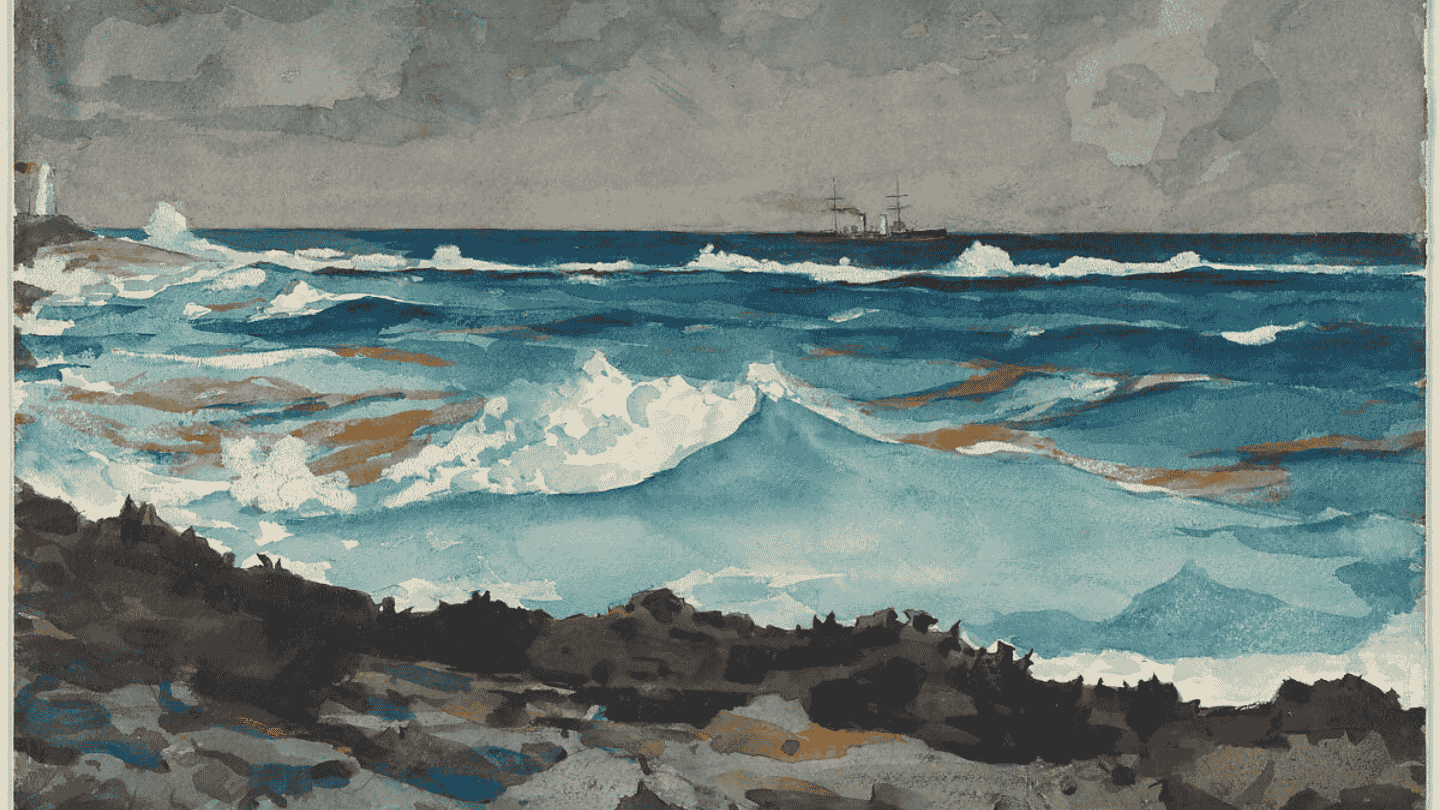
Some forms of endurance begin when hope has already gone—when you realise nothing is coming back.
“He no longer dreamed of storms, nor of women, nor of great occurrences, nor of great fish, nor fights, nor contests of strength, nor of his wife. He only dreamed of places now and the lions on the beach. They played like young cats in the dusk and he loved them as he loved the boy. He never dreamed about the boy. He simply woke, looked out the open door at the moon and unrolled his trousers and put them on.”
—Ernest Hemingway, The Old Man and the Sea
In 1935, Ernest Hemingway wrote a letter detailing his capture of a huge fish—a 500lb blue marlin. The handwritten letter was sent by Hemingway to the fishing editor of the Miami Herald, describing in rich detail how the author and his friend first hooked the fish and then battled the chasing sharks. The letter eventually sold for $28,000. It’s also believed to have seeded the acclaimed story he would write two decades later—his 1952 short novel, The Old Man and the Sea.
The novel had been on my shortlist a while. My dad bought me a hardback edition for Christmas (part of a collection of Hemingway’s best work). I read it during that surreal, listless period between Christmas and New Year when nobody knows what day it is and normal routines disappear. A perfect time to row out to sea.
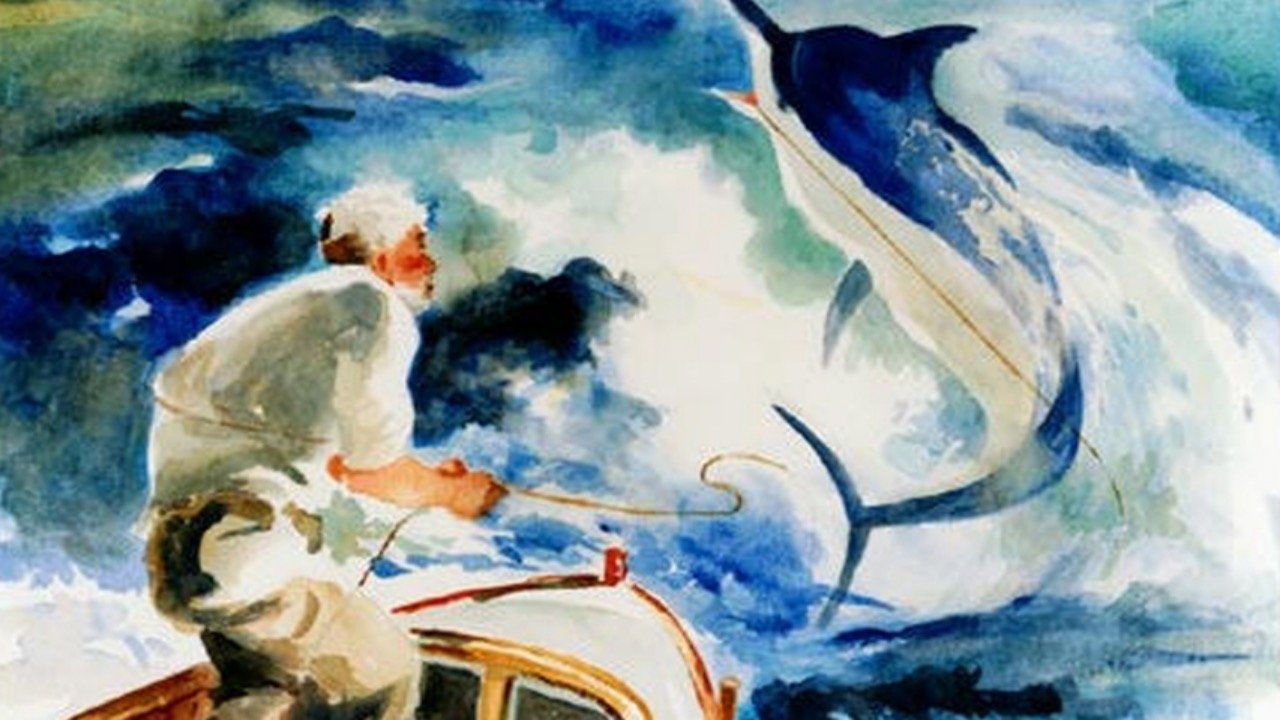
Hemingway, who wrote the draft in just eight weeks, called it “the best I can ever write for all of my life.” It won him the Pulitzer Prize in 1953 and the next year he received the Nobel Prize in Literature. The story is simple. We meet Santiago, an aging Cuban fisherman on a bad run of luck: he hasn’t caught a fish in 84 days. The sea has been cruel. The villagers have bestowed on him the status of saleo—“the worst form of unlucky.” Undeterred, he sets out on the 85th day, sure of a catch. He rows his small boat far into the blue, many miles from land and other fishermen. He’s prepared to go as far as it takes.
In far-out waters, alone with a soft breeze and an ocean mirror, Santiago hooks his fish: a giant marlin. It’s bigger than his boat. He can’t bring it to the surface. It’s too strong. And so begins the battle between man and fish. Day turns to night. Night into dawn. And then come the sharks.
Written in the aftermath of World War II, and shaped by Hemingway’s own experiences in the First World War and the Spanish Civil War, the novel is a study in sustained crisis. Santiago is engaged in a brutal contest of wills, of strength, of perseverance. He has little food, little water. He dare not sleep. The taut fishing line in his weathered hands cuts them to shreds. His body, still lean and strong from a lifetime of labour and sweat, bends and breaks with the strain. But he will not let go of the fish. They are intertwined.
Hemingway’s Santiago is a simple man. He loves fishing and baseball, especially Joe DiMaggio and the New York Yankees. DiMaggio is Santiago’s earthly deity. He wonders what DiMaggio would do in the same situation. He already knows the answer.
Santiago is also at one with nature. Unlike Melville’s Captain Ahab, whose pursuit of the white whale is obsessive and ruinous, Santiago has a respect and even love for the fish. But it isn’t sentimental. He knows his job is to kill fish, and it’s also what gives him pride. He wants to outsmart the fish, trick him. Yet he can see that man and sea are not so different. Both yield to something greater.
“Fish,” he said softly, aloud, “I’ll stay with you until I am dead.”
Santiago wins the battle but loses the prize. He comes to see the desperation that lay at the heart of his loss. How it gripped him. Yet he remains upstanding and hopeful:
“A man can be destroyed but not defeated.”
The Old Man and the Sea is a beautiful tale written by someone familiar with the generational rhythms of Havana life: the salt, sweat, and lilt of fishermen who knew the seas better than they knew themselves. It’s a pleasure to read. Hemingway’s words are steady and affecting—tough, spare, and somewhat life-affirming. He gives us loss, hope, strength, dignity. And dreams.
Santiago is a dreamer. Several times in the story, we are witness to his dreams. When he closes his eyes, he returns to only one memory, a childhood one: lions playing on an African beach.
We may wonder, like him, why the lions are the only thing remaining.
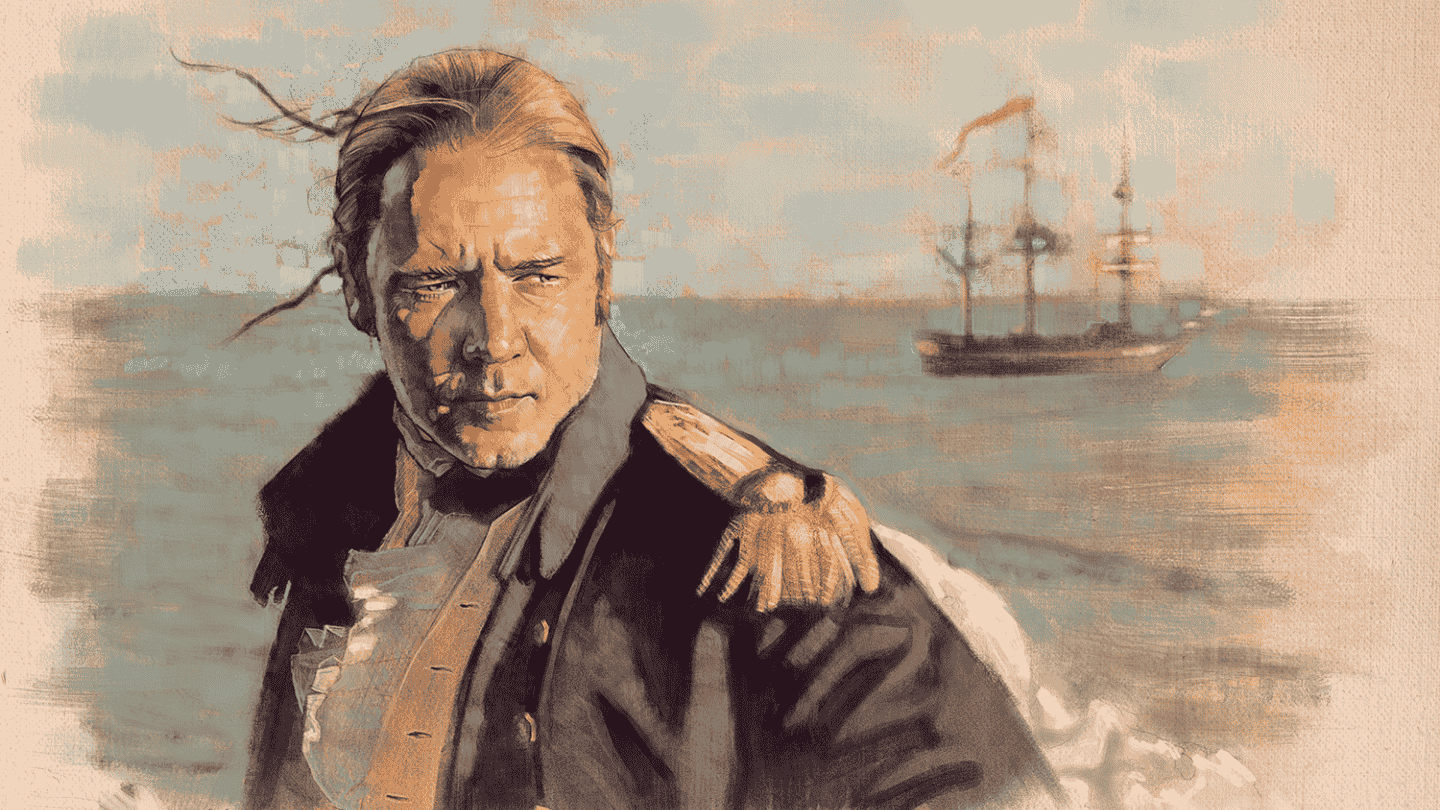
Santiago’s battle is solitary. But the sea has always been a stage for larger conflicts.
We’re staying on the seas but going back further in time, to the Napoleonic Wars, when a collection of European coalitions, including the British, fought against the French First Republic under their Emperor, Napoleon Bonaparte.
It’s 1805. Napoleon dominates the continent. Captain Jack Aubrey stands at the helm of HMS Surprise, a British warship given orders to hunt a larger, faster French vessel off the coast of South America. The sea is Britain’s only advantage. Aubrey’s orders are simple: sink or capture the enemy. That’s how the film opens. There’s no backstory or voyage. We are thrust straight into battle.
Peter Weir’s Master and Commander: The Far Side of the World is one of those extremely well-crafted classic sea adventures, full of intelligence and wit. It was filmed with real ships on real water. The world of the British Navy in the early nineteenth century is recreated so accurately and vividly that the brutal sea battles become characters in themselves. It was also the first movie to ever film on the Galápagos Islands, where Charles Darwin once caught sight of life’s many wonders.
Nominated for ten Academy Awards, including Best Picture and Best Director, it won two, including Best Cinematography. (That was the year The Return of the King swept the board with eleven). Based on the much-loved series by Patrick O’Brien, the film combines two novels: Master and Commander and The Far Side of the World, hence the slightly unwieldy title. The film centres on two men: the ship’s captain, Jack Aubrey, played imperiously by Russell Crowe, and the ship’s surgeon and naturalist, Stephen Maturin, played (also excellently) by Paul Bettany.
Aubrey is a strong but fair leader of men, impulsive and pragmatic. He sees the world as a battleground and is prepared to take the kind of risks that sink ships. But his men will follow him without question. He is charismatic and brilliant, a former protégé of the living legend Lord Horatio Nelson.
Maturin is more thoughtful, principled. He sees the world as a field of study. When they reach the Galápagos Islands, he can barely contain his excitement. His passion isn’t warfare but biology. And yet he’s no romantic. He can also keep a cool head under pressure, as we witness when he performs surgery on himself, removing a bullet from his own abdomen using a mirror and a steady hand.
Their friendship strains as the mission grows more desperate and impossible. The French ship, the Acheron, is stronger, faster, and led by a captain who seems to embody the best traits and talents of Aubrey. Against such odds, Aubrey can only rely on his ability for surprise, the loyalty of his men, and the myth of his own nickname—‘Lucky Jack’.
Their friendship also allows the director Peter Weir to give voice to the two men’s worldviews on human nature. While Aubrey and Maturin each share similar qualities, each has qualities the other lacks. One is made to lead, the other question. One to win, the other to learn. But between them is a shared respect that is strong enough to survive disagreement, hardship, and war itself.
Master and Commander is a story of endurance. Aubrey loses men. He makes mistakes. He doubts himself. But he carries the burden of command willingly. He does what needs doing. The sea—and the enemy—does not forgive hesitation.
And yet the film also gives us moments of grace: endless ocean, the grief of a funeral at sea, a violin played below deck. Weir gives us a world that is both brutal and human.
But it’s also grand. And glorious.
Anthony Lane, writing in The New Yorker, put it like this:
“What emerges…from this film…is the growing realisation that, although our existence [today] is indisputably safer, softer, cleaner, and more dependable than the lives led by Captain Aubrey and his men, theirs were in some immeasurable way better.”
Maybe he has a point. That there is some part of us that still longs for the spoils, danger, and adventure of a long-forgotten past and a world now out of reach.
The two characters of Santiago and Aubrey may be superficially connected by stories at sea, but beneath the surface is something far more elemental: resilience in the face of inevitable decline. Resilience isn’t just physical, it’s moral, existential, and lonely.
On reflection, Santiago and Aubrey could well be versions of the same man at different stages of life.
Santiago is utterly alone. He has the admiration of a boy in the village but no real companionship. His struggle with the marlin is solitary. Yet he rows out again, because it’s in his nature to return.
Aubrey by contrast is surrounded by men, but burdened by command. He carries the loneliness of leadership, especially at sea. There is only one captain. He’s respected, deeply competent, but stretched by the moral complexity of war and by the challenges of his learned friend, Stephen Maturin. Like Santiago, he can’t help but keep going. It’s not hard to imagine Aubrey, decades later, alone in a small boat—just like Santiago’s—chasing something just beyond reach.
Both men persist through loss.
Santiago returns with nothing, but Hemingway presents it as a kind of spiritual triumph. “A man can be destroyed but not defeated.”
Aubrey wins the battle but loses men, including one not yet fifteen. It pains him. At times, he even loses his own conviction. His path isn’t one of glory but of endurance.
It’s a channel many row.
Sometimes with hope, sometimes just out of habit and also because stopping is not an option.
Pass It On
If this idea was worth your time, it may be worth someone else’s.
Share this essay with a friend:
https://www.deeplifejourney.com/deep-life-reflections/january-23-2026
If you have a thought you’d like to share, please leave a comment below.
You can read all previous issues of Deep Life Reflections here.
This week’s title image:
Shore and Surf, Nassau by Winslow Homer. Credit: Amelia B. Lazarus Fund, 1910