
Diego and Maradona
What Naples saw in Maradona—and what it cost him to become it.
Deep Life Reflections | Essay 166 | James Gibb
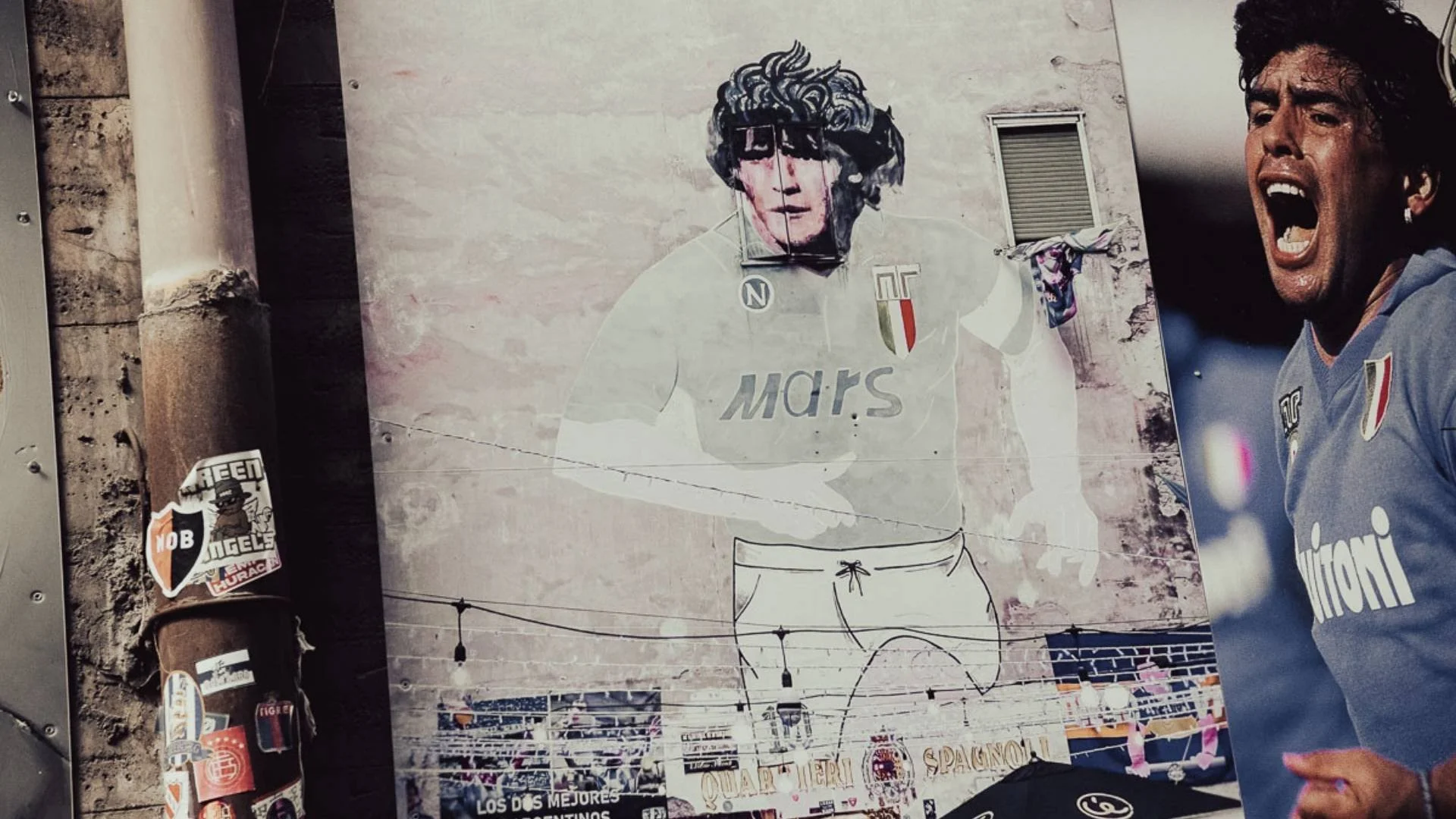
We do not have one self to protect, but several to negotiate. And sometimes the self that wins us love, status, or myth is the one that ruins us.
“When you go on the field, the life goes away, the problems go away, everything goes away.”—Diego Maradona
“Diego has nothing to do with Maradona, but Maradona drags Diego around wherever he goes.”—Fernando Signorini, Personal Trainer to Diego Maradona
Last week, I visited Naples. Staying in a B&B next to the historic old city, my landlady Valentina told me a story from her childhood. In 1984, her father asked if she wanted to go with him to Napoli’s first match of the new Italian football season. He had two match tickets. The club had just signed a new player from Barcelona, an Argentine for a then world record fee of £6.9 million. She went. By the end of the match, they’d bought two full season tickets, mesmerised by the new signing. Diego Maradona.
Diego Maradona was perhaps the finest player the world has seen. The ball seemed permanently attached to his left foot, until the moment of perfect release. Squat yet muscular, with a low centre of gravity, able to twist, turn, accelerate, feint, and put the ball wherever he wanted. Fuelled by a fury and indignation summoned at will, especially in Naples, a city long in the shadow of its wealthy northern neighbours, Maradona was the quintessential number ten, the playmaker. He turned the small provincial club into two-time Italian champions, Italian Cup winners, and UEFA Cup holders. They had won very little before his arrival.
Four decades since his arrival, Naples and Maradona remain inextricably linked. He is everywhere. On walls, restaurants, t-shirts, banners, motorbikes, the sides of squalid apartment buildings. The Maradona shrines are noisy, revered, and protected. A modern deity in a city with a thousand churches. This underdog city of the south both beautified and ensnared the man. This contradiction matters, especially because there is a sense that the city still remembers two figures at once: Diego, the man, and Maradona, the myth. Perhaps that is true of more lives than we admit. We are not always one person.
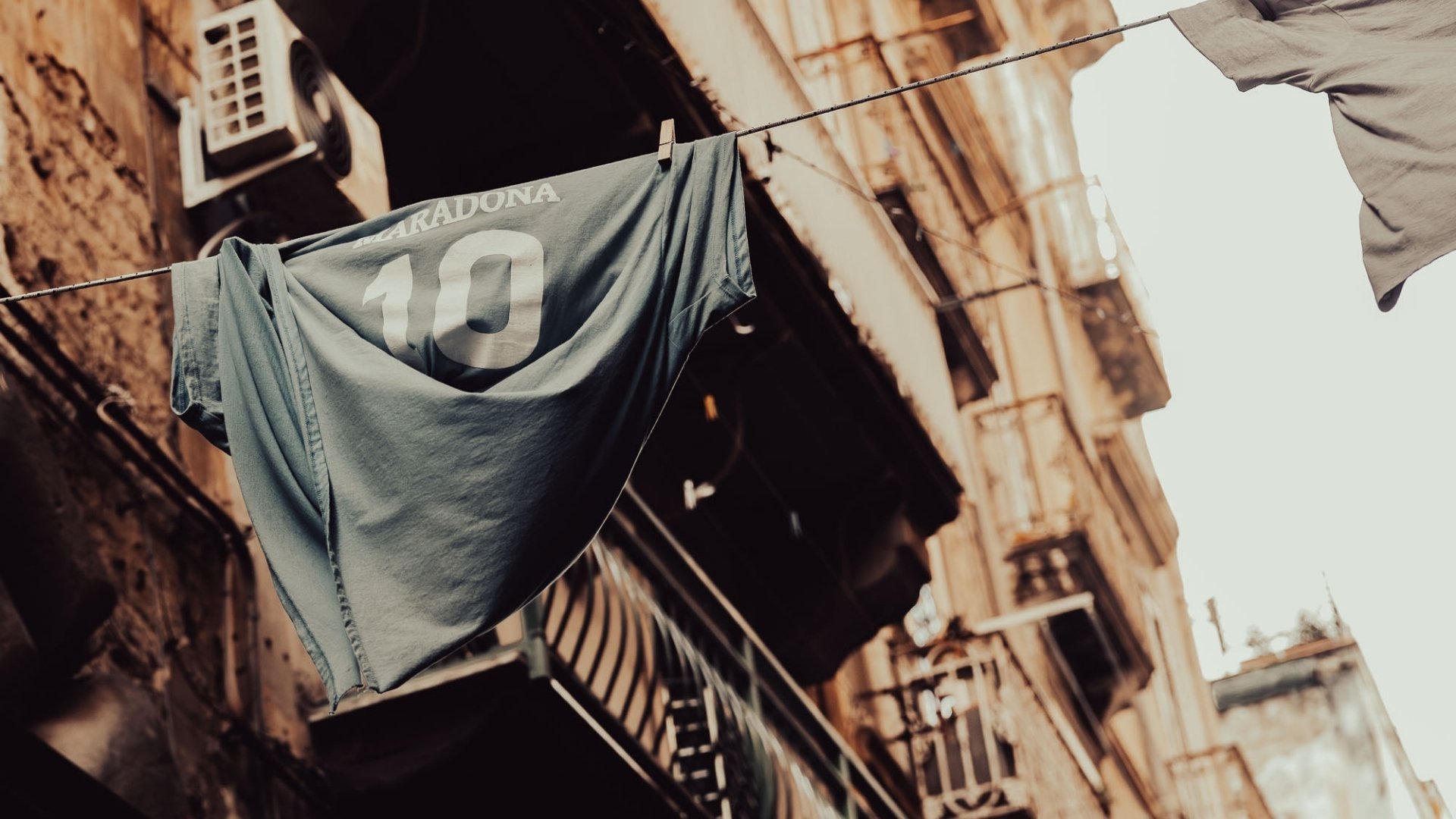
Maradona remains everywhere in Naples
Asif Kapadia’s 2019 documentary Diego Maradona makes the same split in its title.
In the documentary, Fernando Signorini, Maradona’s personal fitness coach, tells us there were two different personas within the player. There was Diego, a kid from the slums of Villa Fiorito in Buenos Aires, with no paved roads and a lack of drinking water and sewers, the youngest of five children, sweet and insecure, someone Signorini would go to the end of the world for. Then there was Maradona, an invented character—arrogant, confident, unable or unwilling to show any weakness. For Maradona, Signorini tells us he would not waste a step.
Diego Maradona agrees, but the problem is Diego the man cannot exist without Maradona the star. It is Maradona that single-handedly won a World Cup. Maradona that once scored a goal against hated Juventus that led to such delirium on the terraces of Napoli’s Sao Paolo stadium that five fainted and two had heart attacks.
It would be unwise to reduce a person to something as simple as a divided self. Diego Maradona, like the rest of us, was complex, contradictory, and multi-faceted. Yet, there is something tangible in the identity of Diego the person and Maradona the icon. The second constructed by the first to handle the almost impossible life handed to the very few.
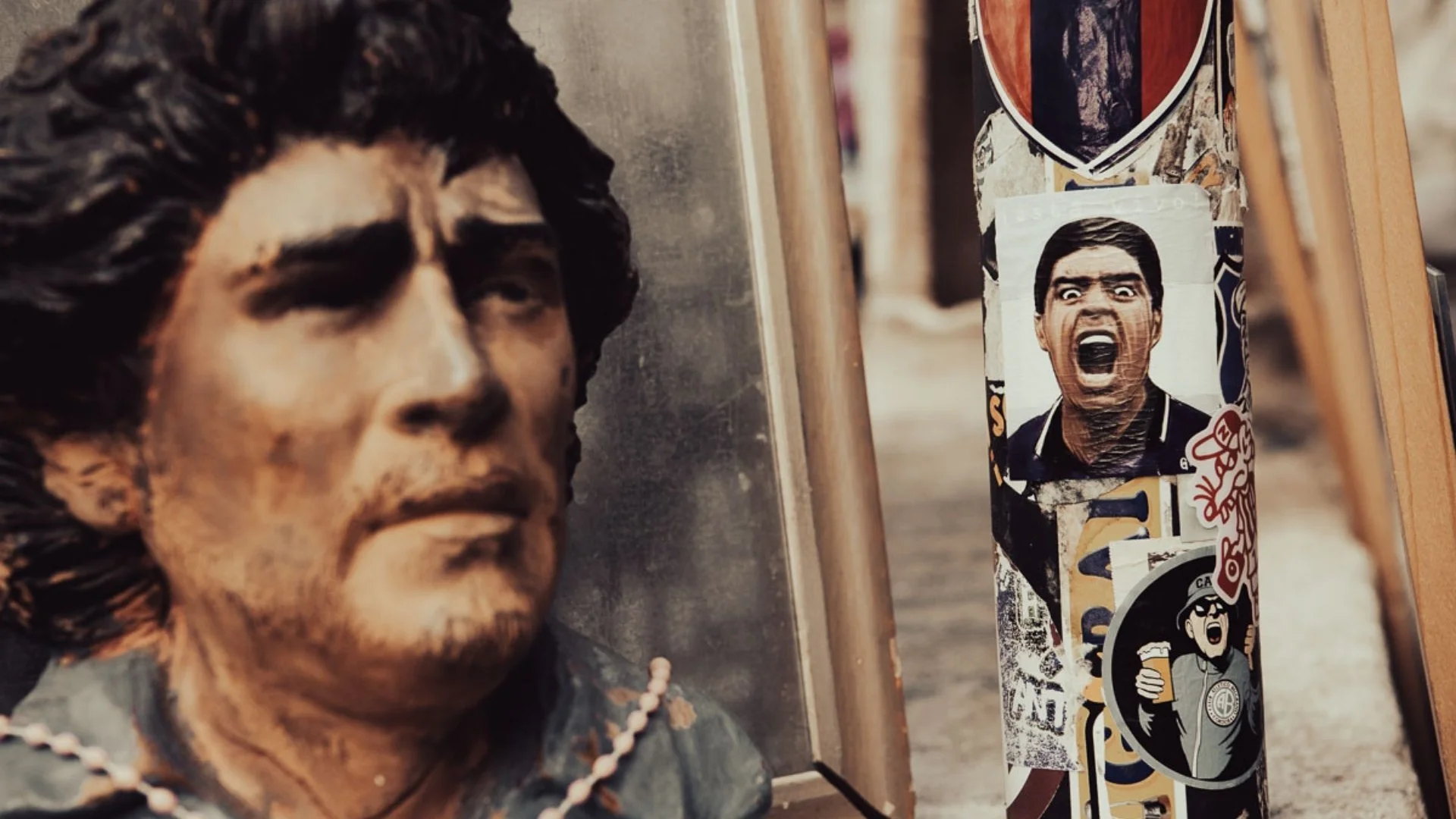
“Rebel. Cheat. Hero. God.”
We are often told to show our ‘authentic self,’ as if there were only one. But most lives are not lived that simply. There is the self we inherit, the self the world shapes, and the self we try to make for ourselves. They do not always want the same things. In most people, the tension between the three selves is manageable. But for Maradona, it became extreme. His selves became more and more fractured. On the pitch, he was free to be a genius. Off it, he was trying to be too many things at once: the devoted family man who would lift his family out of poverty, the new icon of Naples, the lover of life, the singer and dancer, the husband and father, and the womaniser with a son born from an affair he refused to acknowledge. His selves were stretched until they shattered.
Maradona’s story also turns the question back on us. Why do exceptional people matter so much to us? Part of the answer is that we get to live vicariously through exceptional people without having to carry the consequences of being them. Maradona had no such luxury.
Maradona and Naples shared a common heartbeat and soul, torn from the same page of history. The great Baroque painter, Caravaggio, another rebel (he fled Rome for Naples after killing a man in a duel in 1606) painted The Seven Works of Mercy, which hangs today in the church of Pio Monte della Misericordia. I sought it out last week. Caravaggio’s painting shows mercy entering the streets of Naples, combining the seven corporal acts of mercy into one dark, crowded street scene. The painting is not symbolic. It is literal and urgent. Figures are suffering. Someone is hungry, imprisoned, exposed, dead, homeless, thirsty, and in need of clothing. Naples becomes a theatre of human need in Caravaggio’s hands.
When Maradona arrived in Naples almost four centuries later, there was a similar need. Napoli had long suffered racial taunting from fans of the northern Italian clubs and felt looked down upon by the richer, more powerful north. This permeated right across the city. When he wrested the first of those Serie A titles in 1987, with Napoli finishing ahead of the established AC Milan, Juventus, and Inter Milan, Maradona became the solitary symbol of a restored and rebellious Neapolitan pride of the poorer south. Most had a photo of Maradona in their home. Many had it on top of their bed, next to Jesus.
Locals were unambiguous in their feelings:
“Maradona saved us. He chose us.”
“If you speak badly of Maradona, you are criticising God.”
Napoli defender Ciro Ferrara, a native of Naples, said of the championship win, “It marked the social redemption of our city.”
When Napoli won their second championship in 1990, graffiti on a cemetery wall read, “You don’t know what you missed.”
As in Caravaggio’s painting, Naples held grace and degradation in the same earthly, dark frame. Maradona did too.
The degradation manifested in Maradona’s involvement with Carmine Guiliano, the boss of the feared Camorra organised crime family that cast such a wide net over Naples. Maradona’s eagerness to please and be pleased was all too easy for the Camorra. He willingly accepted the Camorra’s currencies of champagne, cocaine, and prostitutes. It inevitably ended in disgrace, with a worldwide ban from football, plaguing the rest of his career and life. The lowest low would be admission to a psychiatric hospital and a tearful television interview recounting the experience in 2004.
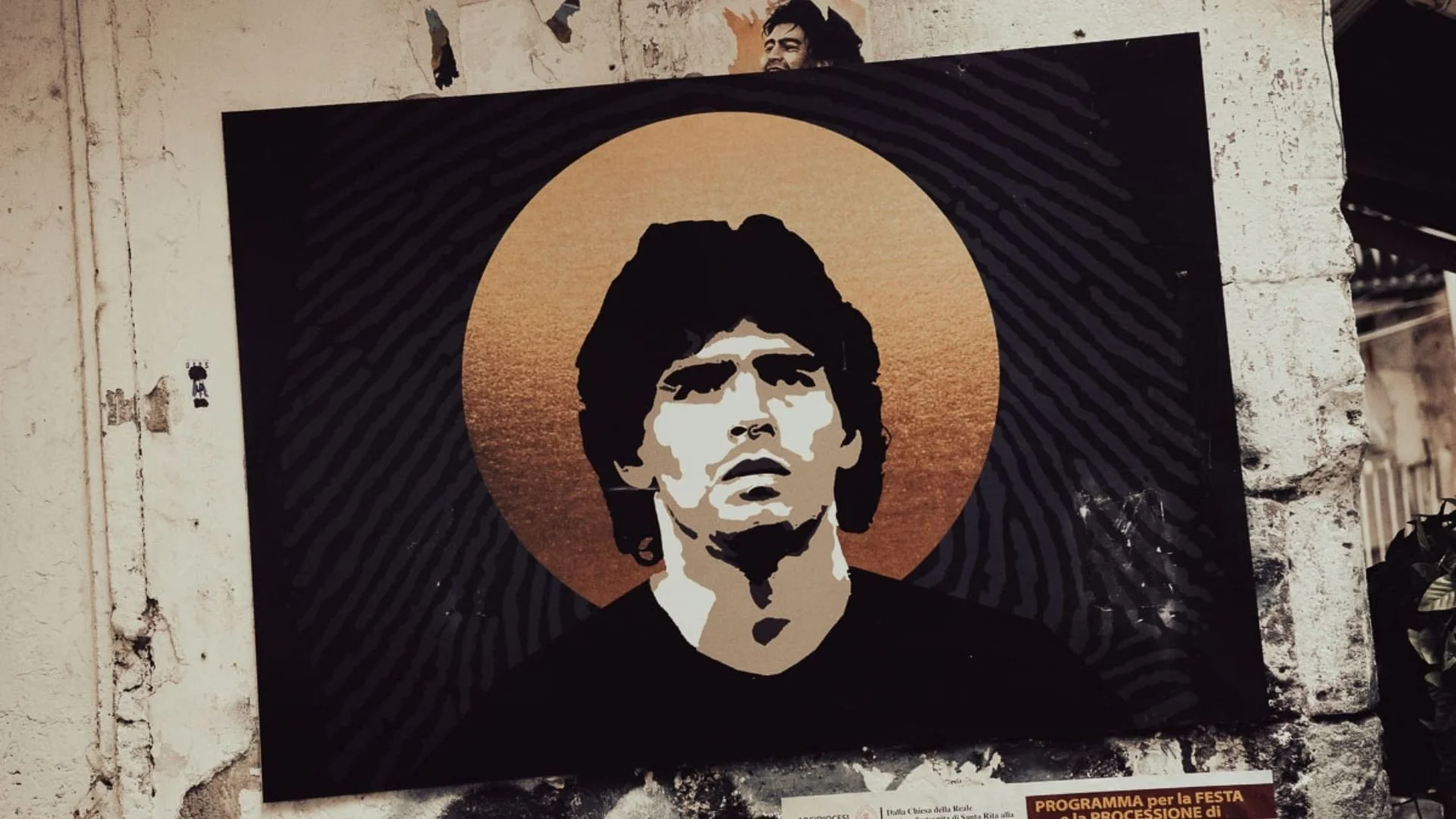
Maradona in Naples is the story of his life
When Maradona ignominiously exited Naples after the drugs charges against him, The Guardian’s Italy correspondent Ed Vulliamy memorably wrote he had fled “like a deck of cards stripped of both its joker and its ace.” But Naples adored him too much to feel betrayed wrote Vulliamy. Besides, Maradona had bled for the cause, as well as given the city its deliverance. His old trainer Fernando Signorini said, “Diego has had a life both tremendous and terrible.”
His sister, Maria, shared her side. “My brother from the age of 15, he stopped having a life. He became someone else. He always took care of everything. It was a heavy weight to be so famous. But he always wanted to solve his problems himself. He never wanted to involve his family. He was always the hero. But he couldn’t do it alone.”
Grainy black-and-white footage exists of a young Diego about eight years old juggling a football perfectly in the dirt with his left foot then his head. He talks of his father, a manual worker. Diego would watch his father rise at 4am every day to go to work and provide. “He would arrive home dead and fall asleep in front of me.” He would support his family the rest of his life. That was his responsibility as he saw it. Diego’s responsibility.
Diego Maradona the man died in 2020. Diego Maradona the player died a quarter of a century before that. All that remains is the myth, which lives on in Naples, distorted through time and memory. Not so much an eternal candle as an eternal icon cast half in light and half in shadow, waiting to live again. As an Italian sports journalist said, “Maradona in Naples is the story of his life. Rebel. Cheat. Hero. God.”
Even in death, Maradona’s different selves continue to be held up to the light by a rebellious and raucous city still trying to rediscover something. At times it feels almost like an attempted resurrection. That if enough reminders are visible, enough chants, enough prayers offered, the talisman might return, draped in light blue.
Very few people have that power.
Maradona was one. But for Diego, the price of becoming him was too high.
Pass It On
If this idea was worth your time, it may be worth someone else’s.
Share this essay with a friend:
https://www.deeplifejourney.com/deep-life-reflections/may-22-2026
If you have a thought you’d like to share, please leave a comment below.
You can read all previous issues of Deep Life Reflections here.