
John Smith, Believe It or Not
Being John Smith and why the most common name in the English-speaking world feels like a burden.
Deep Life Reflections | Essay 164 | James Gibb
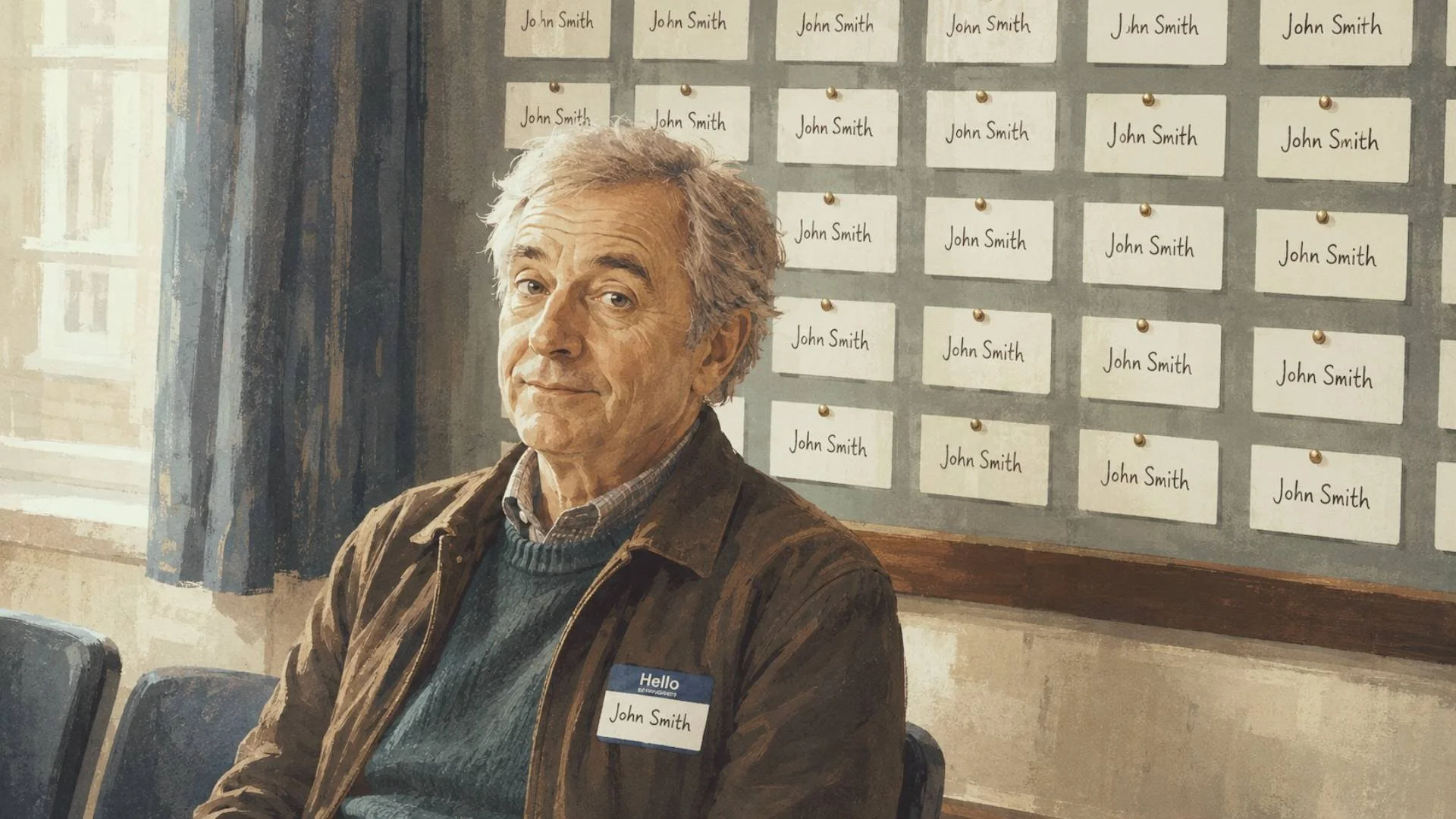
A name is supposed to identify us, but an overly common one can leave us feeling very ordinary.
“Being called John Smith still undermines my sense of individuality and self-worth on an almost daily basis.”
—John Smith
There’s an idea that being unpredictable in life makes you irreplaceable. If you’re unpredictable, you can surprise people in the best ways. Built deeply into the marble of this idea is that we have control over being predictable or not. But what if we get a bad starting hand? Say, a name that is the very definition of generic. A name that is used as the template for every online form. A name that is the commonest in the English-speaking world.
A name like John Smith.
In the U.K. alone there are over 10,000 John Smiths. One of them is a cult British documentary filmmaker. In his short 2024 film, Being John Smith, Smith discloses that his parents didn’t actually plan on calling him John. He was going to be called Ian. But his cousin Ian was born a few weeks before him, so they had to come up with a new name. This was 1952 when names like Hugo, Leo, Jasper, Felix, and Kai were still the sole domain of fairytales and cartoons.
Smith’s enjoyable and idiosyncratic documentary is not only a mini-bio, but, like his other films, finds odd and amusing forays into everyday subjects, from class and identity to political affiliations and Paul McCartney.
The film begins with grainy footage of family photos, early school life and early recollections. John Smith is now 71. He is looking back on an England that no longer exists. At school he was bullied and given a nickname of ‘Piddly Smith’ due to his diminutive stature, a nickname he hated. He recalls there were three other Smiths in his class: Peter R. Smith, Peter J. Smith, and William Shakespeare Smith, who for some reason was bullied too.
Our John Smith rebelled and became one of the gang. His nickname was shortened to Pid, which he didn’t mind. As his popularity went up, his grades went down. He was frequently belted by the headmaster. This was 1960s England. These things were done. He was eventually expelled at 17 for having long hair. See before.
It is at this early point in the film that a message appears against a black screen:
“I’m starting to worry that this film is going to be too conventional, just a voice-over accompanied by illustrative images.
I’m worried that it might lack the idiosyncratic wit and formal inventiveness of my earlier work.
Fortunately I’ve got to an age now where I can accept the commonly held opinion that an artist’s early work is often their best.”
Being John Smith continues to tell the life and times of John Smith, delivered in the same dry, self-deprecating, humorous, and irreverent way. But while the self-narration and photos tell the outer story, an inner story is told in parallel. Further messages pop up on screen, placed there by Smith to lay bare his doubt, fears, and insecurities. These inner monologues extend to both himself and the wider world. He reveals he had cancer recently and is self-conscious about his voice, which has been affected by the radiotherapy. He prefers to speak in captions. He’s worried about his brain. He’s also worried about the state of the world.
He once asked his parents why they gave him such a boring name. He didn’t get an answer although he did learn that it runs in the family. His middle name is Anthony, which is his father’s first name, further demonstrating a lack of flair. His father, by contrast, had the imaginative middle name of Lyle. Imaginative until Smith revealed that the maternity hospital where his father was born stood opposite the Tate & Lyle sugar refinery. Through the window of the ward, the building’s signage was clearly visible. Although just the bottom half of the name it would seem.

Captain John Smith, of Pocahontas fame. The best-ranked John Smith on Google.
When Smith was at art school, he decided he’d change his name to his mother’s maiden name, Pledger. He liked this idea of a name that sounded like pleasure. He fantasised about being called Johnny Pleasure. He desperately wanted to stand out. His parents couldn’t understand this need to stand out as it was the last thing they wanted. They knew their place in society and were content to stay there. In the end, however, John Smith decided to stay as John Smith because someone he respected told him he should change his name. That rankled.
As he tells us in the very next line: “I have regretted that decision ever since.”
When he meets new people and they ask him his name, he replies, “It’s John Smith, believe it or not.” But he still feels embarrassed about his name and says he always will.
“Being called John Smith still undermines my sense of individuality and self-worth on an almost daily basis.”
Had Smith known the internet would be invented, back in the 70s he would have changed his name in a shot. Run a Google search for ‘John Smith’ online and you’ll get about 35 million results. Great for the John Smiths who value their privacy, less great for the John Smiths who are artists with works to promote. Even narrowing the search down to ‘John Smith’ and ‘film’, still leaves about 6 million results. Most of the results are for Captain John Smith of the Disney film, Pocahontas.
Here, I empathise. Like everyone with an internet connection, I’ve Googled my own name. I’ve always been crestfallen with the results. There is not a sniff of any of my writings or work. Instead, ‘James Gibb’ is dominated by a Scottish property management company called James Gibb Residential Factors. Their website says they’ve been managing properties since 1872 (they even predate me by more than a century). I have never had any interaction with James Gibb Residential Factors, I cannot verify how well James Gibb Residential Factors serves their customers, but I can say hand on heart that I hate James Gibb Residential Factors.
Towards the end of the 27-minute film, Smith reveals he’s always had some desperation for fame but been too embarrassed to admit it. If he had a better name, that might have changed everything. But this is all said with that deadpan style.
Smith ends by talking about one of his former art students, Pulp frontman Jarvis Cocker. The singer-songwriter kindly gifted his former teacher tickets to a Hyde Park performance in 2023. One of Pulp’s most famous songs is ‘Common People,’ which somewhat appropriately closes out the film. Yet, even here, Smith is unsure. Another message from the inner monologue:
“I’m not sure what I think about this ending.
Although it seems to work very well here, I generally disapprove if a film ends with applause, as it can feel like a cheap self-congratulatory gesture on the part of the filmmaker.”
Whether he intended it or not, John Smith is still being constrained by being John Smith.
We are all, in some way, stuck between the person we feel ourselves to be and the easy, incomplete labels the world pins on us.
I wonder if William Shakespeare Smith went on to be a writer.
Pass It On
If this idea was worth your time, it may be worth someone else’s.
Share this essay with a friend:
https://www.deeplifejourney.com/deep-life-reflections/may-8-2026
If you have a thought you’d like to share, please leave a comment below.
You can read all previous issues of Deep Life Reflections here.