
Of Misfits and Men
Down and Out in Paris and London—and seeing the person beyond their circumstances.
Deep Life Reflections: Essay 187 | October 16, 2026 | James Gibb
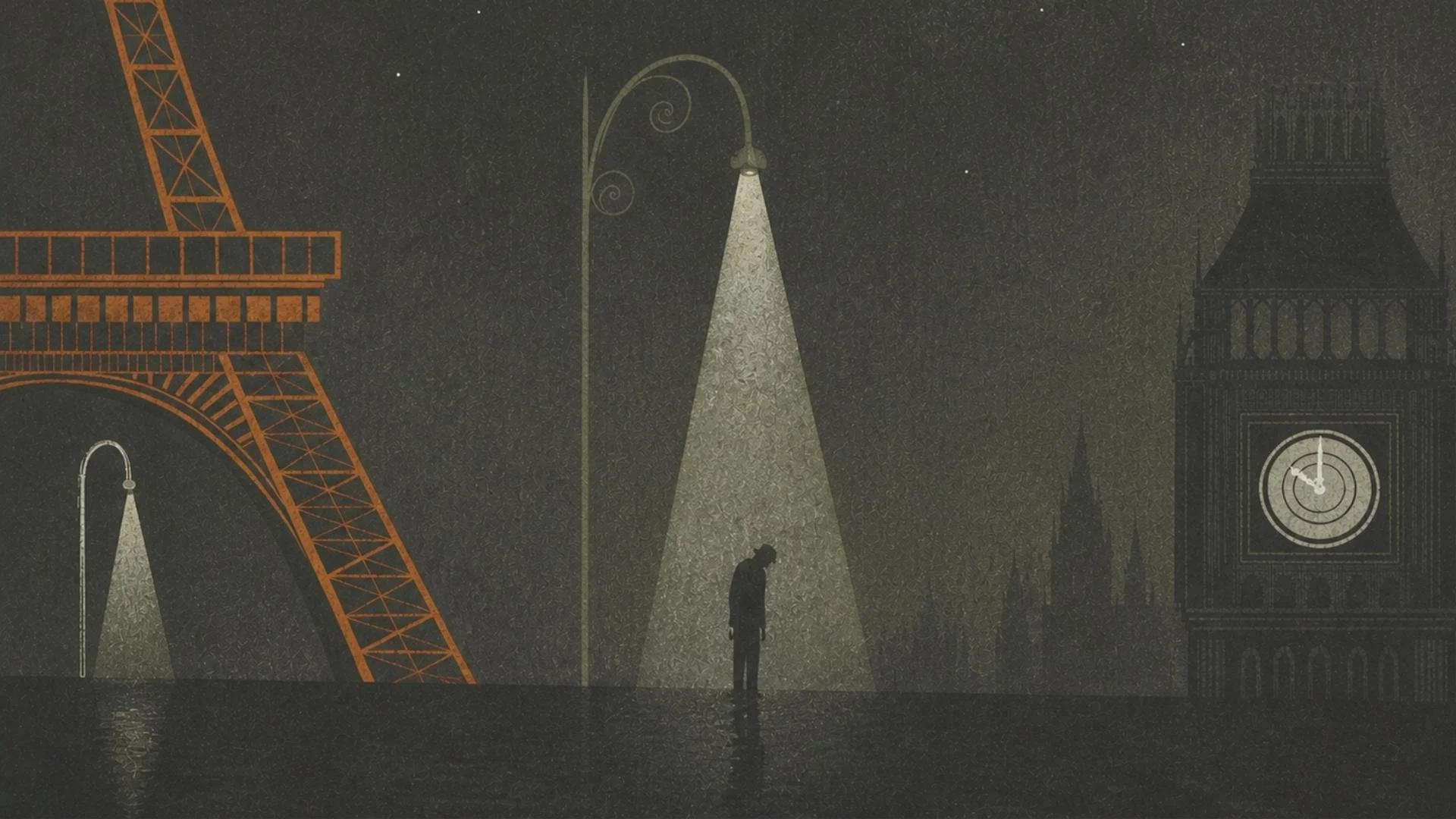
People are more than the worst thing life has done to them.
“Dirt is a great respecter of persons; it lets you alone when you are well dressed, but as soon as your collar is gone it flies towards you from all directions.”
—George Orwell, Down and Out in Paris and London
George Orwell is something of a contradiction. He was a would-be revolutionary who went to Eton, an exclusive public school in England; a political writer who despised dogma; a socialist who thrived on his image as a loner; and a member of the Imperial Indian Police who later chronicled the iniquities of imperialism. Orwell’s enduring legacy is found in his ability to make those contradictions work in his favour. His awareness of his own prejudices and his commitment to the cause of the less fortunate give his writing an honesty and a sense that here was a writer working from within the establishment but with no loyalty to it.
Down and Out in Paris and London was Orwell’s first published book, a first-person account of the lives of the working poor and the homeless in Paris and London. Orwell felt guilty over the plight of the disenfranchised and downtrodden, so he decided to live among them for a time, experiencing what they experienced as they went about their daily lives.
“It is fatal to look hungry. It makes people want to kick you.”
—George Orwell, Down and Out in Paris and London
The book is divided into two parts. The first details his life in Paris, working as a dishwasher—a plongeur—basically the bottom rung of the kitchen hierarchy, first at a hotel and then at a newly opened restaurant. Here, the staff work 16–18-hour days, seven days a week, in squalid conditions. Orwell writes, “The mass of the rich and the poor are differentiated by their incomes and nothing else, and the average millionaire is only the average dishwasher dressed in a new suit.” The second part follows his time in London, where he becomes a tramp, experiencing homelessness and the daily struggles to find food and shelter. The grim descriptions of various ‘spikes’ (homeless shelters) and overall bleakness make the London section seem even more futile.
Orwell writes without self-pity, focusing instead on the realities of life on the fringes faced by the working classes of the early twentieth century. We meet characters like Boris, a former Russian soldier with a bad leg who seems to have contacts everywhere in Paris, and tramps in London such as Paddy and Bozo, the latter a pavement artist who fell on hard times after once being a house-painter who became injured and lost his work. These characters fascinate Orwell. Their circumstances may have shrivelled the scope of their lives to the basics of food and shelter, but they have not erased their personalities, histories, or abilities. Boris still has his contacts. Bozo still has his art—and his ideas. Orwell shares the details of a conversation with him:
“It seems to me that when you take a man’s money away he’s fit for nothing from that moment.’
‘No, not necessarily. If you set yourself to it, you can live the same life, rich or poor. You can still keep on with your books and your ideas. You just got to say to yourself, ‘I’m a free man in here‘—he tapped his forehead—‘and you’re all right.’”
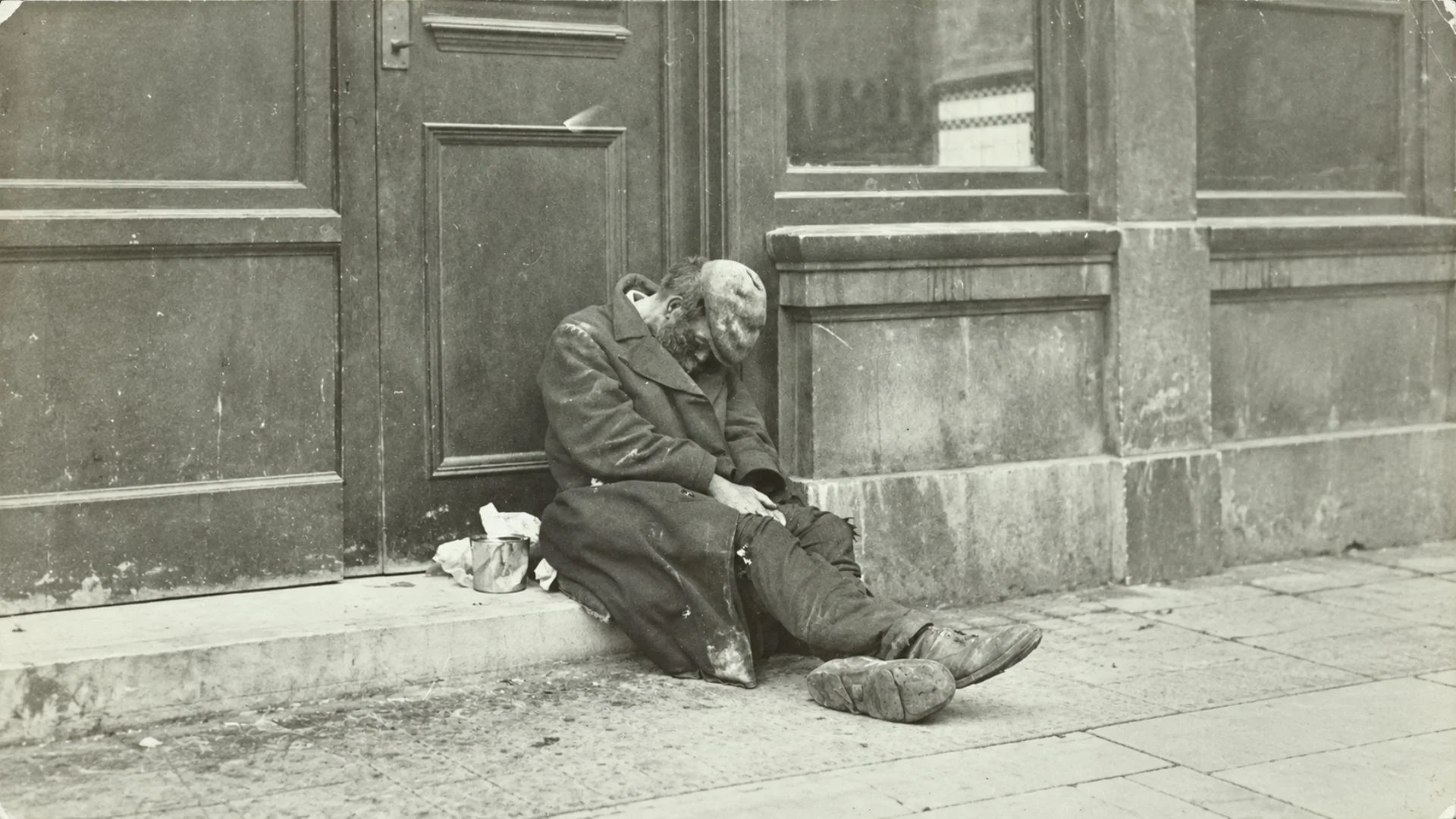
Published in 1933, Down and Out in Paris and London appeared during what Orwell’s contemporary, W.H. Auden called a “low, dishonest decade.” Orwell’s writing highlights how rapidly poverty can strip an individual of status and the respect of others. Once someone is seen as homeless or a tramp, in many ways the person becomes invisible. Their circumstances are all others can see.
Orwell saw his role as highlighting the plight of the poor to those in higher classes in the hope of change, or at the very least, a more humane understanding. But he was sceptical about the willingness of the comfortable to effect that change. He writes, “It is this fear of a supposedly dangerous mob that makes nearly all intelligent people conservative in their opinions.” Orwell saw stereotypes about the poor as one of the most entrenched obstacles to change.
For the majority of human history, deep poverty was the prevailing condition. Even as recently as 1820, the historian Michail Moatsos estimates that 75% of the world’s population lived in extreme poverty. Nearly a century after Orwell’s memoir, the material circumstances of many people have improved immensely. Yet, today, extreme poverty is still the reality for almost one in ten people worldwide. And even in wealthy countries, we walk past people sleeping in a doorway without much thought. We see the homelessness, but know nothing of the person.
Orwell’s words encourage the reader to recognise the dignity of those who slipped through the cracks of society. By writing about them as individuals, Orwell makes it harder for us to dismiss them as a type. We help preserve that dignity when people are not reduced to the worst thing life has done to them, but are instead seen and recognised as complex and whole.
In other words, as human.
Pass It On
If this idea was worth your time, it may be worth someone else’s.
Share this essay with a friend:
https://www.deeplifejourney.com/deep-life-reflections/of-misfits-and-men
If you have a thought you’d like to share, please leave a comment below.
You can read all previous issues of Deep Life Reflections here.