
Hunters in the Snow
How a 16th-century painting by a Flemish Renaissance master made me question why something moves us.
Deep Life Reflections: Essay 186 | October 9, 2026 | By James Gibb
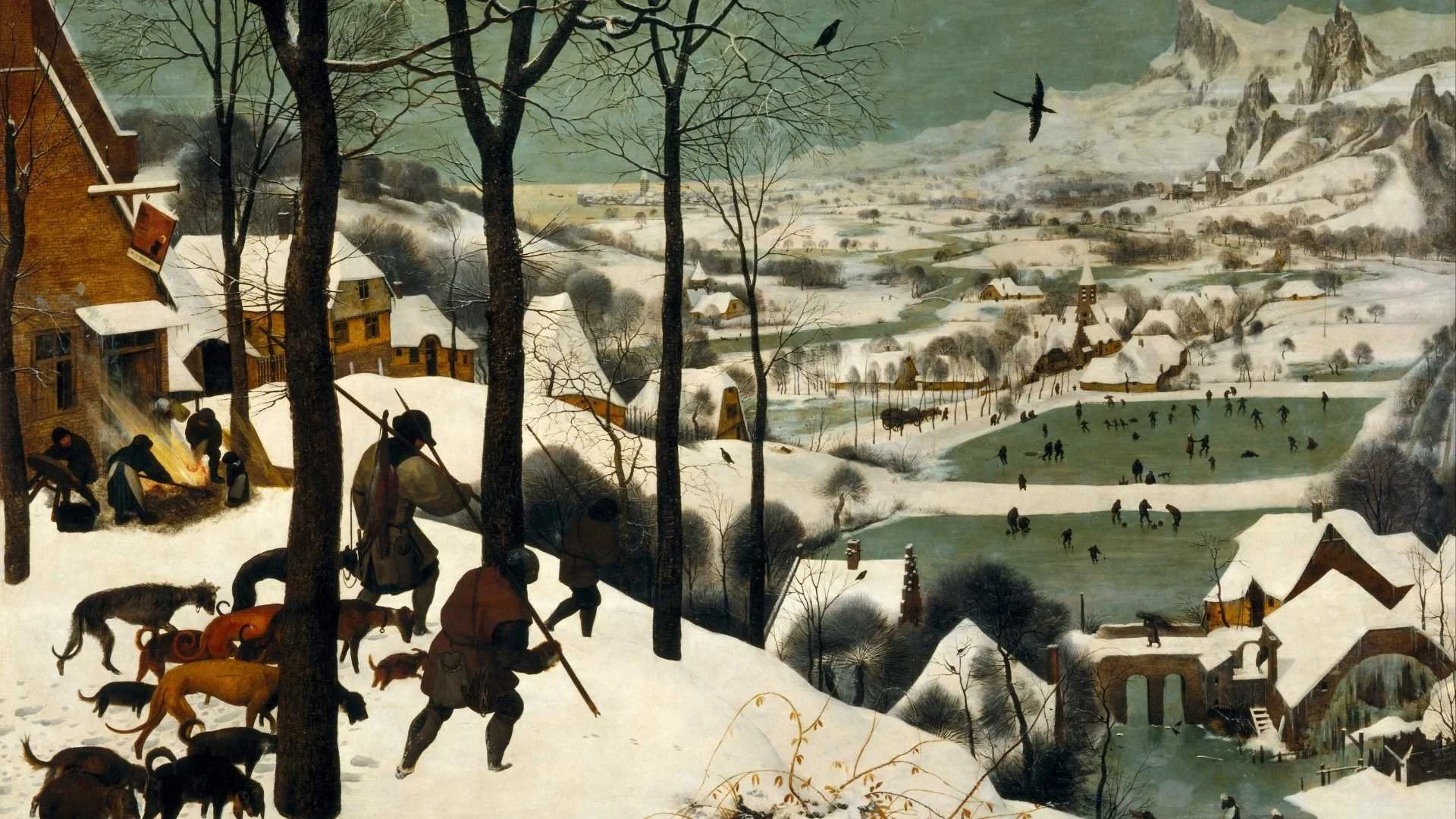
We like to think we can easily explain where our tastes come from. But sometimes, it’s the things long forgotten that can move us the most.
Last year, while on holiday with friends in northern Spain, I put together a general knowledge quiz and split my friends into two groups of three. We’d just had a majestic Basque lunch. Everyone was relaxed and in good spirits, sitting in the late afternoon sun of San Sebastián’s serene promenade. That was until I asked this question:
After the Second World War, two major European capital cities were split into four distinct zones, each one administered by one of four powers: the United States, the United Kingdom, France, and the Soviet Union. One of these capital cities was Berlin. What was the other?
This question was the quiz equivalent of a grenade, much like ‘What type of alien is Mr. Spock?’ from The Office. (“He was half-human, half-Vulcan,” insisted Brent, after going home to get a book as proof.) After much consternation, denial, some in-fighting, a little name-calling, and a roll-call of European cities that spanned the continent and beyond, I revealed the answer: Vienna. It almost led to a walk-out by the captain of one team, disgusted with himself at finding a chink in the armour of his usually impeccable knowledge of history.
I was thinking of this moment as I stood looking at the Giant Ferris Wheel of Vienna’s Prater Park this week. This is where Orson Welles as the black-market racketeer, Harry Lime, delivered his famous ‘cuckoo clock’ speech in the 1949 film, The Third Man, which was set in the postwar city. Vienna ranks as one of the great European cities, for centuries a seat of imperial power and influence. It’s where Mozart and Beethoven created music that would outlive them by centuries, where treaties would redraw the political map of Europe, and where opulence and art would walk hand in hand. On this visit, I wanted to see a little more of that art.
On Tuesday, I stood in line at the Kunsthistorisches Museum—better known locally as the KHM. It has one of the greatest collections of paintings in the world, housed in a magnificent building that rivals the collection. The collection can be traced back to the sixteenth century, amassed by members of the House of Habsburg, one of the most powerful royal dynasties in European history. Of the whole collection, there was one painter I was keen to spend more time with. Pieter Bruegel the Elder.
Bruegel lived at the same time as Michelangelo. Historians are unsure of his exact year of birth, but they estimate he was born somewhere between 1526 and 1531. He was a Flemish Northern Renaissance artist who lived in what are now the Netherlands and Belgium. Unlike many of the 16th-century painters consumed with classical myth or Italian nobility, Bruegel loved painting rowdy village festivals, peasant weddings, and ordinary people eating, dancing, and living. It led to his nickname, ‘Peasant Bruegel’. Many of his works are filled with people, as well as wonderful landscapes and skies. The detail is quite incredible. The KHM holds the world’s largest collection of paintings by Bruegel, twelve panel paintings in total. There was one in particular I wanted to see: Hunters in the Snow.
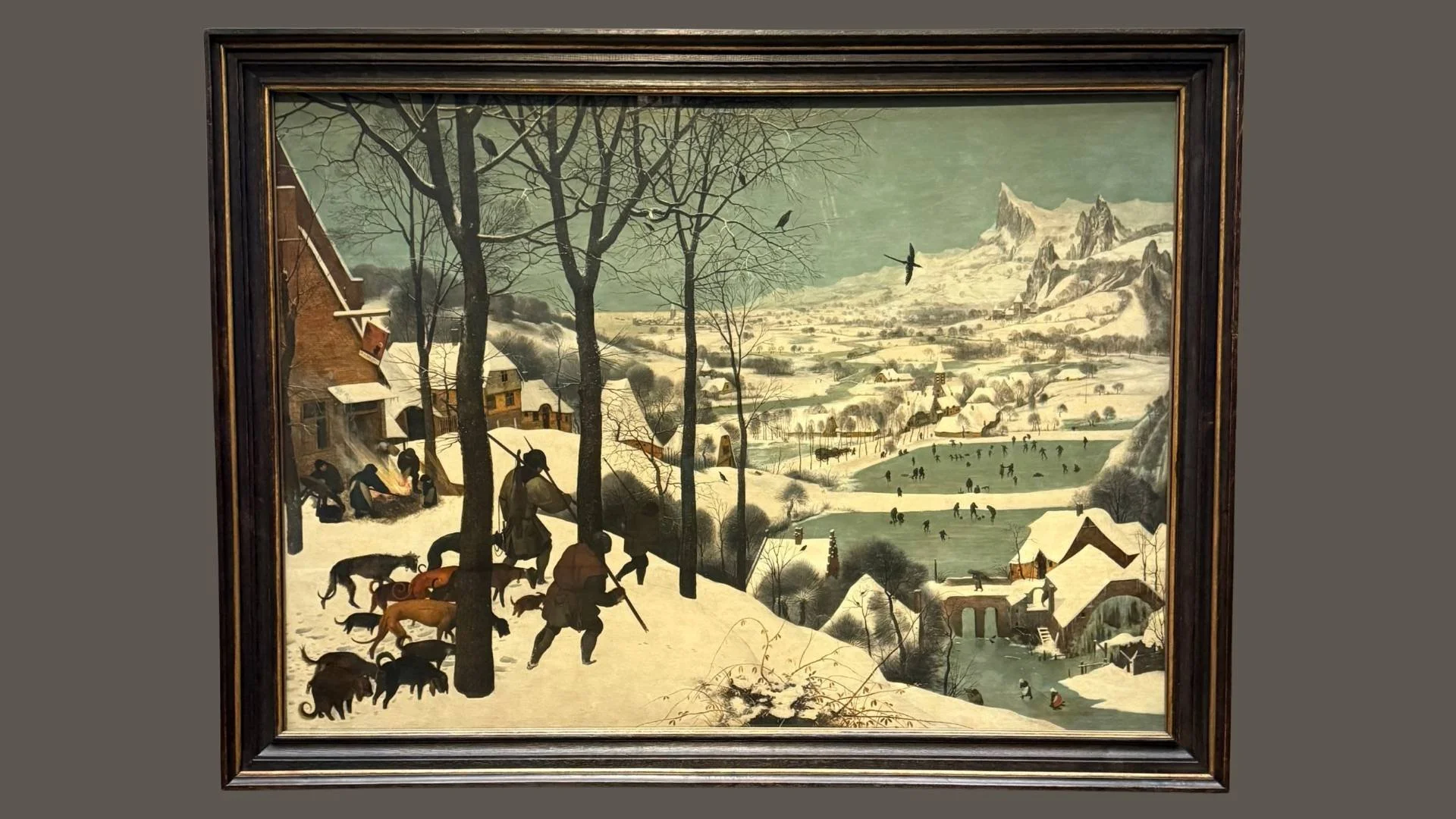
Pieter Bruegel’s Hunters in the Snow, 1565. On exhibition at the KHM, Vienna.
I first came across this picture a few years ago. It was the last of a series of six seasonal works, painted by Bruegel in 1565. It shows a group of hunters making their way back to their village below, accompanied by a pack of dogs. They appear tired and hunched against the cold. Their catch is meagre, only a single fox. Below and ahead of them, there is much activity stretched out in the expansive landscape. People ice-skating on frozen lakes, people going about their business, work and leisure. But the reason this is regarded as a masterpiece is Bruegel’s ability to completely capture the essence of cold. He does this through his use of composition and colour: the picture is dominated by blue-greens, whites, and browns. As I read in KHM’s Masterpieces of the Picture Gallery:
“The precise silhouette of the trees, the frozen mill-wheel at the lower right and the icy surface of the snow revealed by the hunters’ footprints blend together to convey the fundamental characteristics of winter.”
History records that the winter of 1564-1565 was one of the harshest, most brutal winters on record in Northern Europe. This might have heavily influenced Bruegel’s frozen imagery. The more I looked at the painting, the more I saw, discovering another village, way off in the background. There are also those Alpine mountains in the upper right, which give the painting a slight fantasy element. They fit the wintry mood, but feel strangely out of place.
I knew this painting made me feel somewhat nostalgic. Seeing it in person only reinforced that feeling. Its frozen, desaturated landscape reminded me of my childhood in south-west Scotland. The bitter cold and the smell of a coal fire. It wasn’t a negative feeling though—quite the opposite. There was something homely and comforting about it. But I couldn’t articulate exactly what. I shared the picture with my sister on my phone. She replied, “It reminds me of that book we used to have with the houses. I don’t know why!”
“The book with the houses.” I knew exactly which book she meant, although I don’t think I’ve thought about that book in over forty years. I loved it as a child. I tried to recall it in as much detail as I could. It was a large picture book, perhaps more square in shape than rectangular. It started with a landscape—rural—like where we used to live. The first page was just a house, beautifully drawn in colour. On the next page, a second building appeared—maybe a church, or another house. Each page brought a new building until, by the end, a small village had formed. That was the book, but there was no way I could remember the name of it.
Enter technology. I gave all that detail to ChatGPT and it came back with this: “I’ve found a strong candidate: Anno’s Counting Book by Mitsumasa Anno, first published in 1975. It’s a short, wordless colour picture book. The growing village matches your description remarkably closely.”
That was the book.
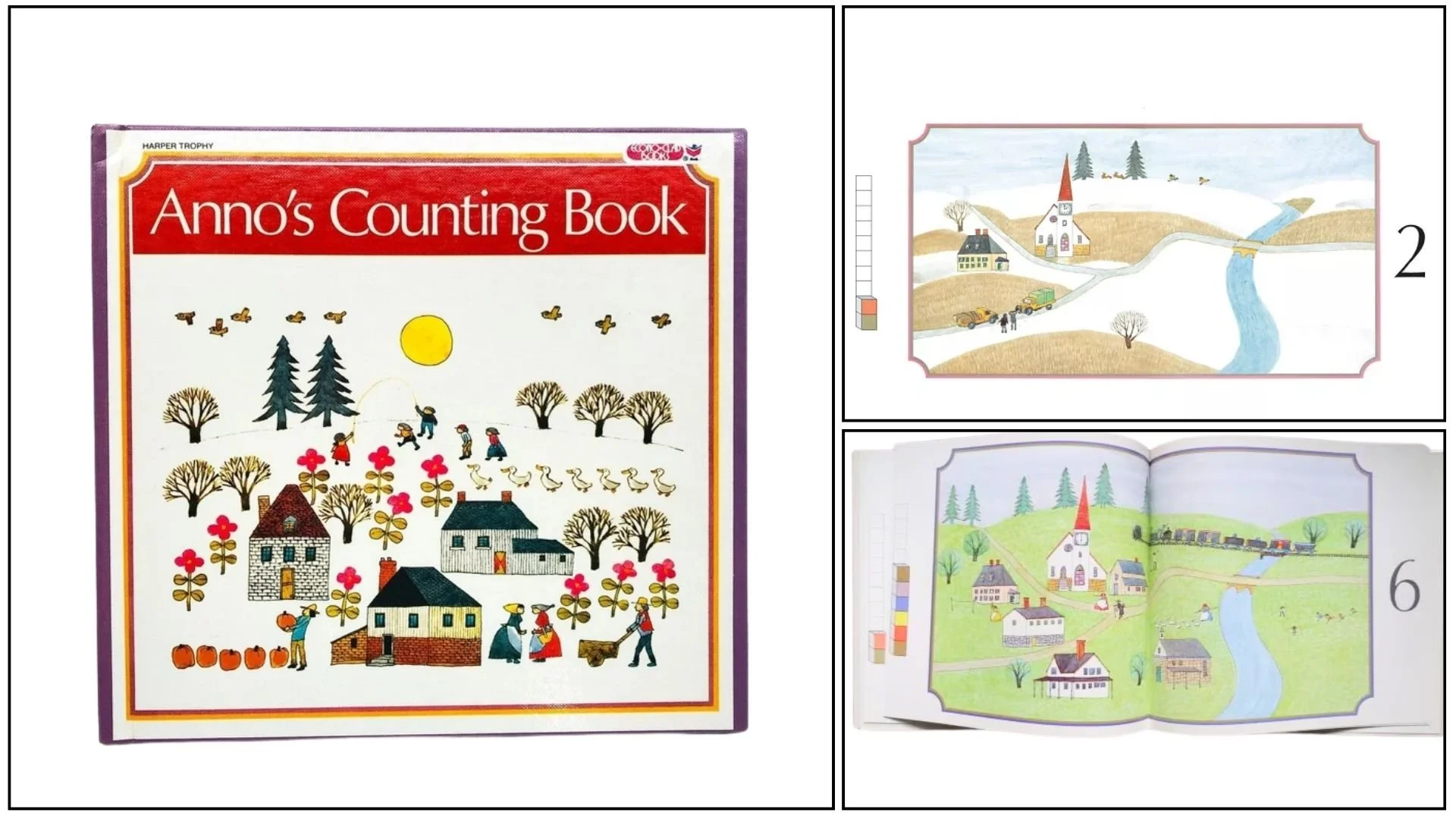
Anno’s Counting Book by Mitsumasa Anno. First published in 1975. A memory from childhood long forgotten.
I followed a few links and found the book, reacquainting myself with the images I hadn’t consciously thought about in over four decades. Of course, I can’t say with any degree of certainty that Anno’s Counting Book was the catalyst for my response to Bruegel’s Hunters in the Snow. The book, Scottish winters, expeditions and play, and the painting may all overlap in the way life often does, blending and bleeding onto new canvases. I think the interesting part is that I felt something before I understood what might be behind the curtain. My sister’s response—from her own memories—then changed my understanding of my own encounter with the painting.
And that poses a question: how well do we understand why something moves us?
We like to think we know where our tastes come from, but sometimes their origins remain hidden. In a 1980 experiment, psychologists William Kunst-Wilson and Robert Zajonc showed participants unfamiliar shapes so briefly that, afterwards, they were no better than chance at recognising them. Yet when later shown a mixture of familiar and new shapes, they were more likely to prefer those they had already seen over new ones. Repeated exposure had made the shapes more appealing, without giving participants a reliable memory of having seen them.
Of course, seeing a shape briefly isn’t the same as seeing a childhood picture book again decades later. And liking something isn’t the same as being moved by it. However, the experiment does suggest that an experience can influence us even if we can’t consciously remember it. Perhaps something similar happened in the KHM when I stood in front of Bruegel’s painting. My sister helped me recover a memory I hadn’t realised might be connected. And it stands to reason that we might consider what other forgotten experiences have influenced our tastes—and who might be the people who help us remember them. Family and close friends are obvious choices because they shared part of our childhood, but there are likely many others.
After the Bruegel painting, I was keen to visit another famous landmark from The Third Man—the famous doorway where we first see Harry Lime / Orson Welles. He’s encased in shadow before a resident switches on a light, illuminating his face while he stands in the doorway with that faint, knowing smile. I found the landmark at Schreyvogelgasse 8. The surrounding street looks much as it did in 1949, although the doorway itself doesn’t recede as much now. And it occurred to me that there’s an interesting difference between these two encounters in Vienna. I went to find the Harry Lime doorway because I knew its significance. With Hunters in the Snow, I encountered a significance I hadn’t known to search for.
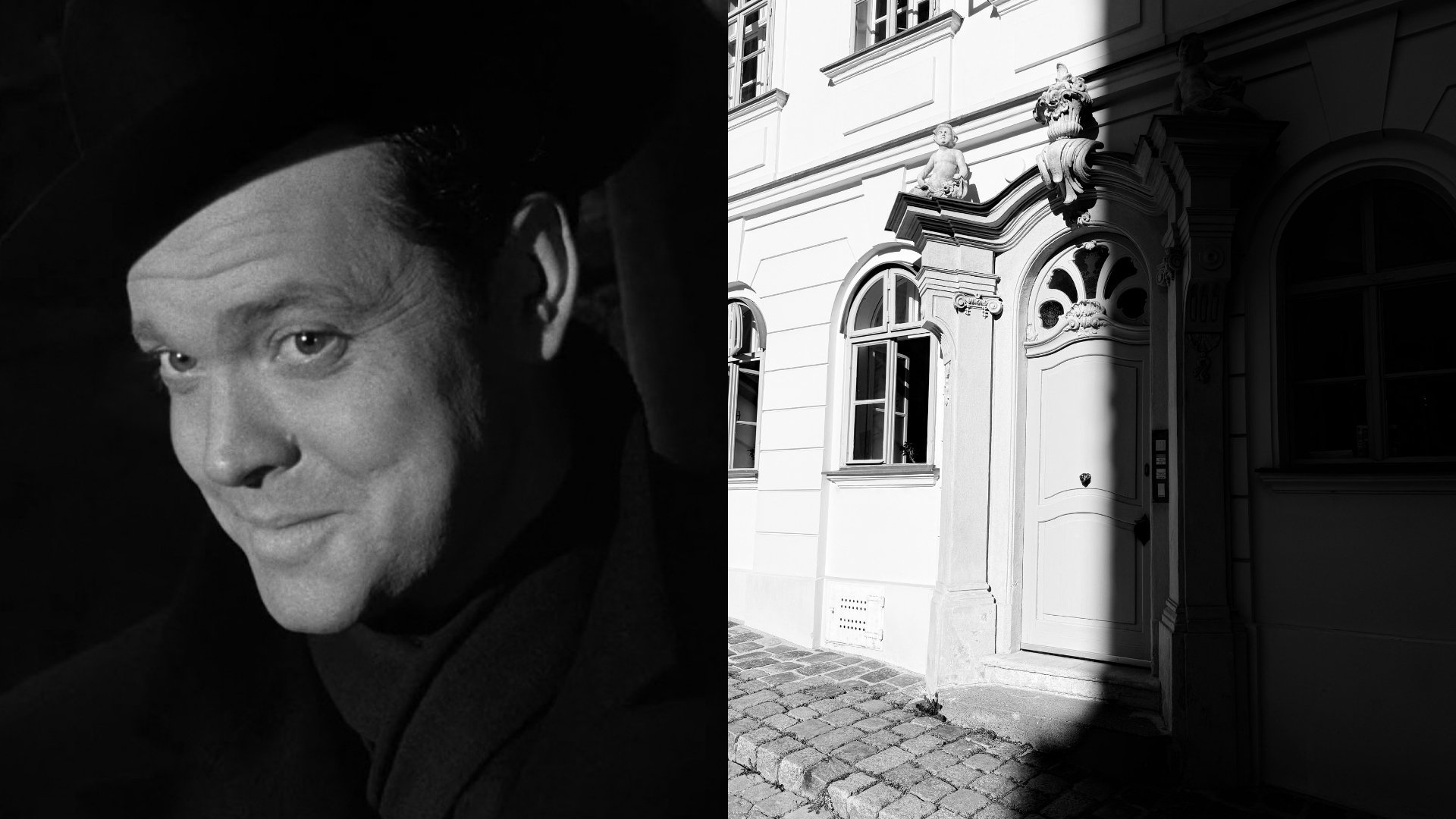
Orson Welles as Harry Lime from The Third Man. The famous doorway as it stands today.
Marcel Proust wrote, “The past is hidden somewhere outside the realm, beyond the reach of intellect, in some material object which we do not suspect. And as for that object, it depends on chance whether we come upon it or not before we ourselves must die.” Those words might help explain my experience in Vienna. Bruegel’s painting reminded me of a home I have long since left. My sister reminded me of a book I had long since forgotten. Between them, they brought something back I hadn’t thought about in many decades. I still can’t say exactly why Bruegel’s painting moved me. But I now have a little more of my own story to bring to it.
Vienna will do that.
Pass It On
If this idea was worth your time, it may be worth someone else’s.
Share this essay with a friend:
https://www.deeplifejourney.com/deep-life-reflections/hunters-in-the-snow
If you have a thought you’d like to share, please leave a comment below.
You can read all previous issues of Deep Life Reflections here.