
Whiplash, breaking the four-minute mile, and the search for greatness.
Deep Life Reflections: Essay 189 | October 30, 2026 | James Gibb

Does greatness demand that we make the rest of our life expendable?
The word obsession gets used a lot today. We seem to be in a constant state of being obsessed about something. Everything from a new show that’s just started streaming to a new flavour of coffee that’s just appeared on our daily commute. Of course, we are not really obsessed in the actual dictionary sense of the word, which is defined as our minds being so completely occupied by something that we can’t think of anything else, in a way that is neither reasonable nor normal. In other words, being obsessed isn’t a particularly healthy thing. Your new Cookie Dough-Maple Bacon-Bubblegum-Frappe might not be too healthy either, but you’re not obsessed with it. You just simply like it. For now at least.
We have linguistically diluted the word obsession—and that is unfortunate. Because real obsession is rare and unreasonable, and yet, we admire the great bounty of human creativity it has given us to enjoy. We stand in art galleries, plug ourselves into 70-year-old vinyl recordings, and sit in prestigious concert halls to see for ourselves the levels of genius and beauty obsession has created. Obsession has powered artists for centuries, always asking the same question: just what are you prepared to sacrifice for greatness?
One of the best modern examples of a study of obsession is Damien Chazelle’s Whiplash. Shot in only 19 days, Whiplash is a low-budget, high-tempo 2014 film driven by two virtuoso performances—Miles Teller as student and J. K. Simmons as teacher. Teller plays Andrew Neyman, a talented and ambitious but naive jazz drummer enrolled at an exclusive music school in New York. There he’s recruited to an even more exclusive jazz band ensemble overseen by the Machiavellian instructor/sadist Terence Fletcher, a role that won Simmons 47 awards, including an Oscar. From here, we watch Neyman and Fletcher’s combustible relationship ignite, a slow-burn which builds and builds into a seismic climactic explosion.
Neyman appears prepared to expend everything in the pursuit of being the greatest musician since Charlie Parker. We watch his obsession—fuelled by Fletcher’s unpredictable verbal assaults and insane demands for perfection—consume everything: his physical health, his relationships, and his sanity. As the film reaches its climax, we realise Neyman no longer exists outside of drumming. Everything else is expendable.
The film makes us uncomfortable as we don’t know where it’s going. We feel like we are in a car going too fast without a seatbelt. The title suits the premise. ‘Whiplash’ is typically associated with sudden, jarring injuries, like those from car crashes. It becomes symbolic of the film’s trajectory: jolting, brutal, but still compelling to watch. We are drawn to characters who have obsession in their genes.
Fletcher is clearly not a man likely to spend his spare time volunteering his support to vulnerable students. He is a man who prefers the perfect note over a moral code. Neyman is his perfect student, a willing masochist, literally happy to bleed for the cause. The greatness of the ending is the ambiguity. That final magnificent performance. Did we watch a young man achieve artistic transcendence right in front of our eyes, just like a Charlie Parker, or did we watch him disappear into his obsession, never to return? We might also question the true architect: was Fletcher a demon or a preacher? Chazelle gives us just enough glimpses of the inner Fletcher to leave it up to us to decipher Fletcher’s motivations. This might simply be a man whose ferociousness was a projection of his own personal failures. Conversely, it might have been part of a brilliant, calculated strategy to unearth a generational talent. The ending is difficult to decode. We might be watching a triumph or a tragedy, a victory or a defeat. It might even be both.
There is a counter-example to the type of obsession that consumed Chazelle’s characters in Whiplash. To better understand it, we can look to the work of social psychologist Robert Vallerand. He divides passion into two forms: obsessive passion, the kind that is rigid and prone to conflict and disharmony; and harmonious passion, which is flexible and compatible with the rest of life. Some years ago, I read Neal Bascomb’s The Perfect Mile, which told the story of British runner Roger Bannister’s quest to be the first person in history to run the mile in under four minutes. Bannister was focused, dedicated, and totally committed to achieving this mythical goal. But he was very much an example of harmonious passion. And his story bears looking at.
Bannister began his formal running career in the autumn of 1946 at the age of 17 when he started his undergraduate studies at Oxford University. He had been a junior cross-country champion during the years of the Second World War and recalled that as a child he “just ran anywhere and everywhere” because it felt easier than walking. When he started at Oxford, he’d never run on a track or worn running shoes with spikes. Despite this, he won the Freshman’s Mile in his first year, achieved on a very light training regime of just three 30-minute sessions per week.
Bannister’s era was that of the celebrated sporting amateur. It was seen as poor taste to compete for money. In those days, you competed solely for honour, and everyone had a day job. Bannister was studying to be a doctor. As his talent and reputation grew—and as talk of breaking the fabled four-minute barrier started to become a serious conversation—a three-way international rivalry began to take shape. And the world noticed. John Landy, a supremely gifted and relentless runner from Australia, and Wes Santee, the ‘Ashland Antelope’, a world-class American middle-distance runner with a flair for showmanship, became Bannister’s most intense competition. And in the early 1950s, all three came tantalisingly close to breaking what was still seen as an ‘impossible’ time. Landy, who ran 4:02 so many times but not a second faster, once declared to the press, “It’s like a brick wall. I think the four-minute mile is a fluke if anyone does it.”
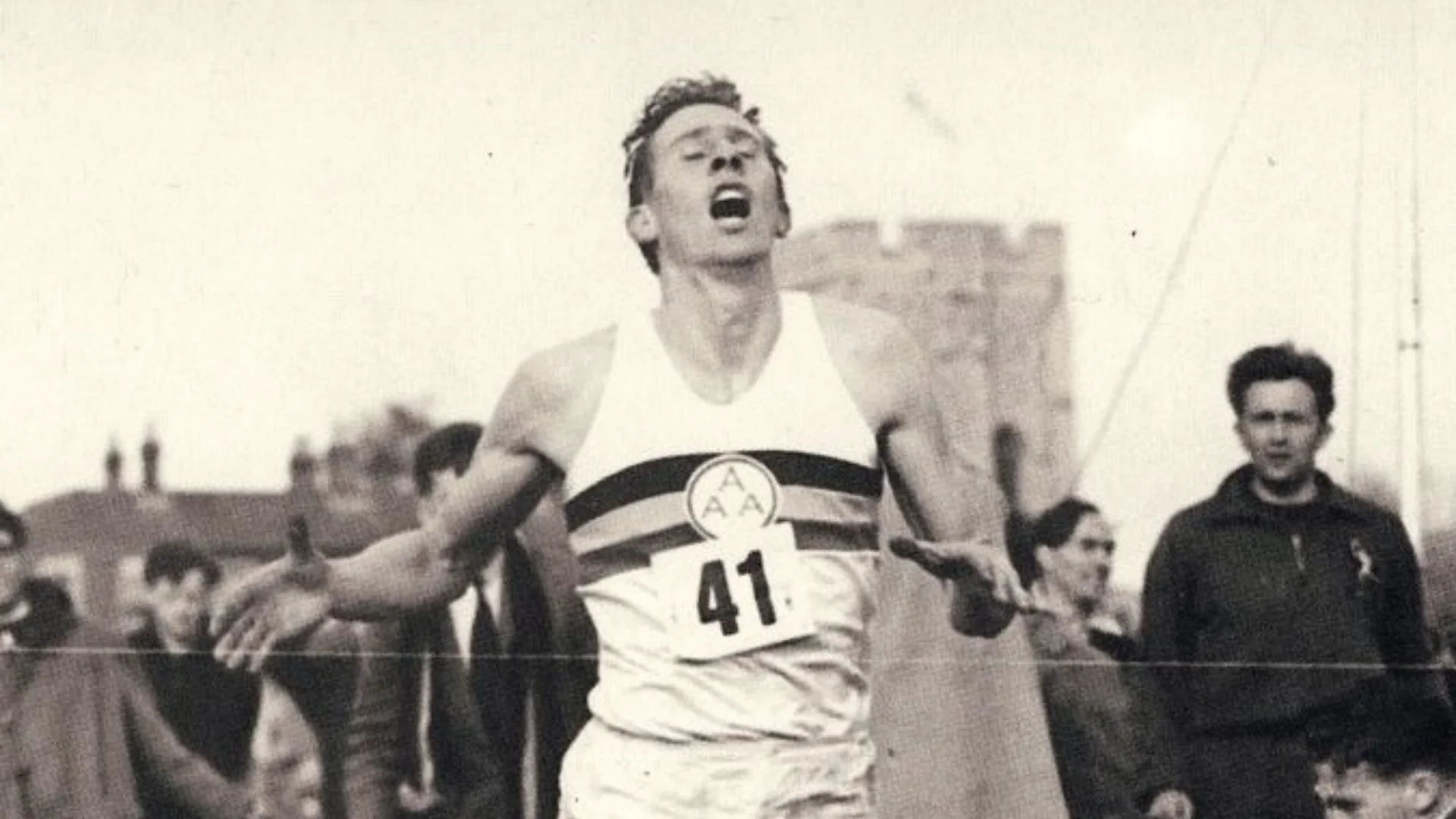
Roger Bannister becoming the first person in history to run the 4-minute mile in 1954.
But Bannister did do it. On May 6, 1954, at Oxford’s Iffley Road Track, Roger Bannister made history, clocking a time of 3:59.4. The first person to run a mile in under four minutes. What made Bannister’s feat even more impressive was his limited training time, just 45 minutes a day. He still had his responsibilities as a medical student and would squeeze in his training sessions between classes. Then, at just 25 and only a few months after his historic run, and after being hosted at Downing Street by Winston Churchill, Bannister retired from competitive running. He never returned. Instead, Bannister went on to practise medicine for 60 years, dedicating 40 of those specifically to clinical and academic neurology, where he became a pioneer and published more than 80 scientific papers. When asked about his legacy later in life, he considered his decades of work in medicine and neurology to be much more significant than his 4-minute mile. He died in 2018 at the age of 88.
John Landy ironically went on to eclipse Bannister’s time just 46 days later, completing the mile in 3:57.9 in Finland. But like the second or third man on the moon, we only remember the first. Wes Santee never managed it.
For Roger Bannister, breaking four minutes was something he absolutely wanted to do, but it didn’t become his entire identity. He didn’t expend everything else in his pursuit. Quite the opposite in fact, building a distinguished career in medicine. He may have achieved the impossible, but he was content to walk away and pursue medicine instead of going after 3:55 or 3:50, or another impossible running goal. Bannister could stop. He was disciplined. There’s an interesting dynamic between discipline and obsession. Discipline sets limits. In training regimes there are boundaries and numbers so that physical capacity isn’t stretched beyond a breaking point. Obsession on the other hand has a hard time with limits. It hurdles them or kicks them off the track.
When we think about obsession, there’s a danger we romanticise it, especially the people who destroy themselves in their pursuit of it. But Bannister’s story shows that greatness doesn’t need obsession. Not everything needs to become expendable. But obsession does have a certain allure because it can enable astonishing feats of human creativity and excellence. A recent review of Robert Vallerand’s model described obsessive passion as an “intensity amplifier”—producing exceptional results, while at the same time increasing the risks to the person themselves.
I don’t see obsession as simply wanting something intensely. Bannister wanted the four-minute mile intensely. The difference is the pursuit never ate up the rest of him. We can want something badly, we can put our body and soul into going after it, but the critical element is what we are unwilling to make expendable for it. Real obsession is when there is a real cost—and that’s something we all risk in life, whatever or whomever we happen to care about.
That conflict is embodied by Boris Lermontov, a character in the 1948 British film The Red Shoes, about a young ballet dancer who gets her shot with the greatest ballet company in the world. Lermontov was likely modelled on Sergei Diaghilev and his Ballets Russes, seen as the world’s most influential ballet company of the twentieth century. Lermontov, like the character of Fletcher from Whiplash, is cut from the same cloth. They are evangelists for a doctrine of total artistic commitment. They view ordinary life as the enemy. Moderation, comfort, and stable relationships all threaten the work. At one point in the film, Lermontov asks his star dancer why she wants to dance. She answers, “Why do you want to live?” Lermontov embodies in human form the conflict between artistic life and personal life. After years of being asked to die for freedom and democracy, now go and die for art. Greatness demands everything.
Or does it?
Pass It On
If this idea was worth your time, it may be worth someone else’s.
Share this essay with a friend:
https://www.deeplifejourney.com/deep-life-reflections/the-nature-of-obsession
If you have a thought you’d like to share, please leave a comment below.
You can read all previous issues of Deep Life Reflections here.