
The Memories That Aren’t Ours
On Portmeirion, Dylan Thomas, and how the lives of others shape what we remember.
Deep Life Reflections | Essay 156 | James Gibb

Some memories don’t belong to us, but they stay with us anyway.
Today, March 13, would have been the 78th birthday of my mother.
One of the places she loved visiting was a village in North Wales called Portmeirion. When I was only two or three, my parents drove to Wales for a holiday. A snowstorm erupted and we almost became cut off. I remember my mum telling me this story many years later. I had no memories of it myself.
Portmeirion isn’t my memory either. It’s a place I’ve never been. But I have the photos and stories my mum shared with me. Even a pottery set made there. It was a special place to her. It’s easy to see why. The village stands as something timeless and dreamlike, anchored in a world that bridges to the bards and poets of the past.
Portmeirion feels like it has been lifted from the Amalfi Coast and spiritually dropped into the Welsh woodlands and dark green hills. It is an Italian-inspired village, built in the Italianate style, where buildings resemble classical Mediterranean architecture. And so we have a Mediterranean vision in pinks, teals, and terracotta; a nest of domes and towers amid the distinctly Welsh countryside of mountains, seas, coves, and vistas.

The village was the vision of Welsh architect Clough Williams-Ellis, and it took him fifty years to realise it, between 1925 and 1975. He finished it the year I was born. I recognise the photos from the postcards my mum sent me. A row of multicoloured beach huts on perfect alabaster sand, Victorian Gothic mansions, watchful clock towers, Mediterranean-style houses he designed himself, mermaid ironworks, rescued Grade II-listed colonnades, and a great domed statue of Buddha. Williams-Ellis called his creation the “home for fallen buildings.”
Portmeirion and North Wales feel like stepping into another world. And many artists did. Inspired by the landscapes of rural Wales—the shimmering lakes, foggy mountains, and lilting language—J.R.R. Tolkien is said to have imagined parts of Middle-earth here for The Lord of the Rings. In the 1960s, a cult television series was filmed in Portmeirion, The Prisoner, about a man imprisoned, robbed of his identity and known only as Number Six. The show reflected a time of eccentrics and adventurers, where not everything could be neatly boxed up and explained.
Dylan Thomas belongs to that same cultural atmosphere.
Thomas, born in 1914 at the outbreak of the Great War, was a Welsh poet and master of lyric and musicality. He was the archetypal Romantic poet. His most famous poem, Do not go gentle into that good night isa powerful meditation on resisting death, and featured heavily in Christopher Nolan’s homage to memory, Interstellar, in 2014. A book of Thomas’ collection of poems sat on my mum’s bookshelf. When she passed last year, I was offered the book, but I chose to leave it on her shelf. There it remains.
Unlike many of the literary greats, Thomas left school at 16 and went to work as a junior reporter at the South Wales Daily Post in Swansea. Journalism trained him to observe people and listen to speech, which might explain the extraordinary musicality of his poetry.
Thomas wrote most of his later, mature work in Laugharne, a small coastal town in South Wales. He wrote in a small shed overlooking the Taf Estuary. The shed had a desk facing the water, notebooks and drafts piled everywhere, windows looking across the sea. He would often walk through town in the morning then retreat there to write. There he wrote one of his most beautiful poems, Poem in October, on his 30th birthday.
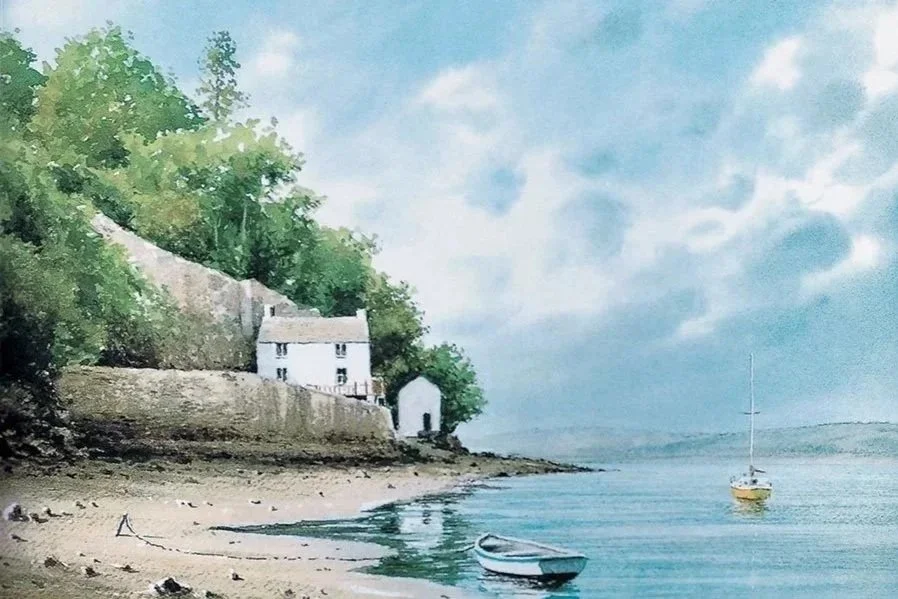
It's a poem about the passage of time—place, memory, childhood. As he walks, Thomas observes his surroundings: the harbour, the woods, the call of seagulls. He begins to slide into memory, returning to his younger self, childhood. Past and present collapse together.
An extract from the poem:
It turned away from the blithe country
And down the other air and the blue altered sky
Streamed again a wonder of summer
With apples
Pears and red currants
And I saw in the turning so clearly a child's
Forgotten mornings when he walked with his mother
Through the parables
Of sun light
And the legends of the green chapels
You can read the full poem here.
Thomas recognises how time moves through us. He loved the sound of words more than their explanation and believed poetry should be experienced like music. This poem captures introspection, time as cyclical, and emotional legacy. Thomas perhaps sees his thirtieth birthday as a threshold; a gateway separating youth and innocence from adulthood and experience. It is visual, musical, and poignant. The poem is fully alive. His childhood is alive, surviving through memory and imagination.
It is the preservation of what is most human and natural. Memory.
It lives on.
Not always in what we remember, but in what stays with us from those closest to us.
Pass It On
If this idea was worth your time, it may be worth someone else’s.
Share this essay with a friend:
https://www.deeplifejourney.com/deep-life-reflections/march-13-2026
If you have a thought you’d like to share, please leave a comment below.
You can read all previous issues of Deep Life Reflections here.