
So It Goes
Kurt Vonnegut and Slaughterhouse-Five on how we process the irrational.
Deep Life Reflections: Essay 184 | September 25, 2026 | By James Gibb

Some experiences can’t be made reasonable or coherent. The task of the writer is to find the form honest enough to capture that incoherence.
“And so it goes...”
―Kurt Vonnegut, Slaughterhouse-Five
There is a wonderful story about Kurt Vonnegut, one of America’s most satirical writers of the twentieth century. As the story goes, in 2006, Ms. Lockwood, an English teacher at Xavier High School in New York City told her students to write to their favourite author and ask them to visit the school. It was to test their persuasive writing skills. Five of those pupils chose Kurt Vonnegut. He was the only author to respond. While he declined the trip—he was 84 and no longer made public appearances “because I now resemble nothing so much as an Iguana”—he gave them something better. A letter. In it was an assignment.
“Write a six line poem, about anything, but rhymed… Make it as good as you possibly can. But don’t tell anybody what you’re doing. Don’t show it or recite it to anybody, not even your girlfriend or parents or whatever, or Ms Lockwood. Tear it up into teeny-weeny pieces, and discard them into widely separated trash recepticals. You will find you have already been gloriously rewarded for your poem. You have experienced becoming.”
Vonnegut believed that art was how we discover what is inside us.
Vonnegut’s advice about discovering oneself through making art came from his own experience of having to do exactly that. As a young man, Vonnegut entered the U.S. army in 1943 during the Second World War. He survived the 1945 Allied fire-bombing of Dresden, sheltering underground in a slaughterhouse as a prisoner of war. When he emerged, he saw a smouldering city, with around 25,000 civilians dead. Vonnegut was ordered to gather and burn the remains of the dead. For weeks this was his job. The experience became so important to him that he felt compelled to write about it. But it took two decades to find the right words and the right story.
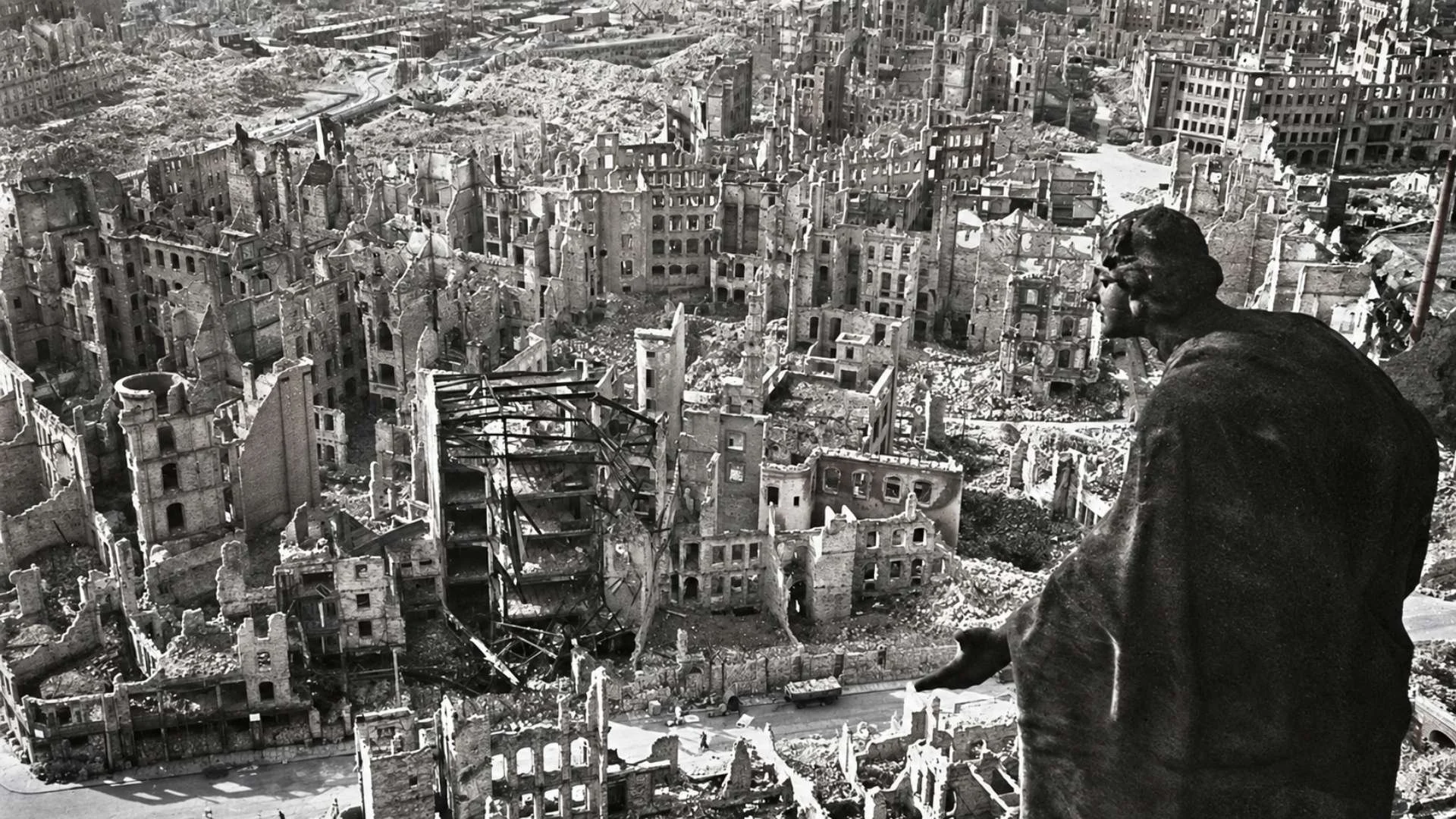
The aftermath of the Allied bombing raids of Dresden, February 13-15, 1945
That story eventually became Slaughterhouse-Five, published in 1969, a surreal and compassionate semi-autobiographical take on the bleakness and senselessness of war, as well as a broader commentary on a society that had to live with the effects. I’ve read it twice, once at university over thirty years ago, and once more recently, buying a special 50th anniversary edition, which includes some of Vonnegut’s early drafts, with various words and sentences scrawled out and new words scribbled in, still trying to find the right ones. The novel is often informally paired with Catch-22, written by Vonnegut’s friend, Joseph Heller, another canonical anti-war book that came out of the destruction of the same war.
Slaughterhouse-Five revolves around the life of Billy Pilgrim, an awkward, ill-suited soldier who survives Dresden as a prisoner of war. After the war, he returns to America, becomes a wealthy optometrist, and starts a family. However, Billy has become “unstuck in time”—jumping back and forth, reliving splintered moments of his life, from the war to childhood to his post-war mundane suburban experience. Everything is out of order and happening all at once. This disjointed narrative structure can be read as mirroring the fractured and intense impact of trauma. This might be Billy’s coping mechanism, escaping into his own mind.
Vonnegut adds further absurdity to his novel, often with irony and pitch-black humour. Billy believes he was abducted by aliens and taken to their planet, Tralfamadore, where he learned their philosophy: time is not linear, and all moments in life—past, present and future—exist simultaneously. For the Tralfamadorians, death is just an illusion. When a person dies, they only appear to die. They are still very much alive in the past. Vonnegut perhaps created the bizarre world of Tralfamadore to represent both an escape from pain and the numbness that comes with avoiding it. It’s telling that Billy is as happy there as he is on Earth.
Throughout the novel, Vonnegut uses the phrase, “So it goes”, which appears after every mention of death. It’s used 106 times. While we might perceive this phrase as the equivalent of verbally shrugging our shoulders and accepting what life gives us, in Slaughterhouse Five “So it goes” is not a way of accepting life, but rather of facing death. It is with no little irony that Billy (and Vonnegut) survived the bombing of Dresden packed into the meat-lockers of a slaughterhouse (number five, hence the book’s title) while thousands outside died.
Dresden was largely rebuilt in two major phases: immediately after the war and in the post-reunification of Germany after the fall of the Berlin Wall in 1989. Some of this work took place across many years. The Frauenkirche, for example, the famous Lutheran Baroque church, was severely damaged during the bombing raid and collapsed two days later. It was left as a pile of rubble for 45 years under East Germany’s communist government as a war memorial before being rebuilt stone by stone with thousands of the salvaged originals. The rebuild took 11 years and was completed in 2005. Two years later, Kurt Vonnegut died. The city had been reconstructed but Vonnegut’s reckoning with it was less complete.
A letter to a fellow veteran in 2001 revealed that, despite spending decades finding a form that could make incoherence feel honest to him, Vonnegut was still processing the Dresden atrocity in the years before he died. In the letter he wrote that:
“‘Billy Pilgrim’ was a young man called Edward Krone, a sophomore in engineering when he was drafted. He starved himself to death. He never should have been in the army.”
So it goes.
Pass It On
If this idea was worth your time, it may be worth someone else’s.
Share this essay with a friend:
https://www.deeplifejourney.com/deep-life-reflections/september-25-2026
If you have a thought you’d like to share, please leave a comment below.
You can read all previous issues of Deep Life Reflections here.