
What Survival Requires
With the Old Breed, Apollo 13, and the human bonds required to make it home.
Deep Life Reflections | Essay 80 | James Gibb
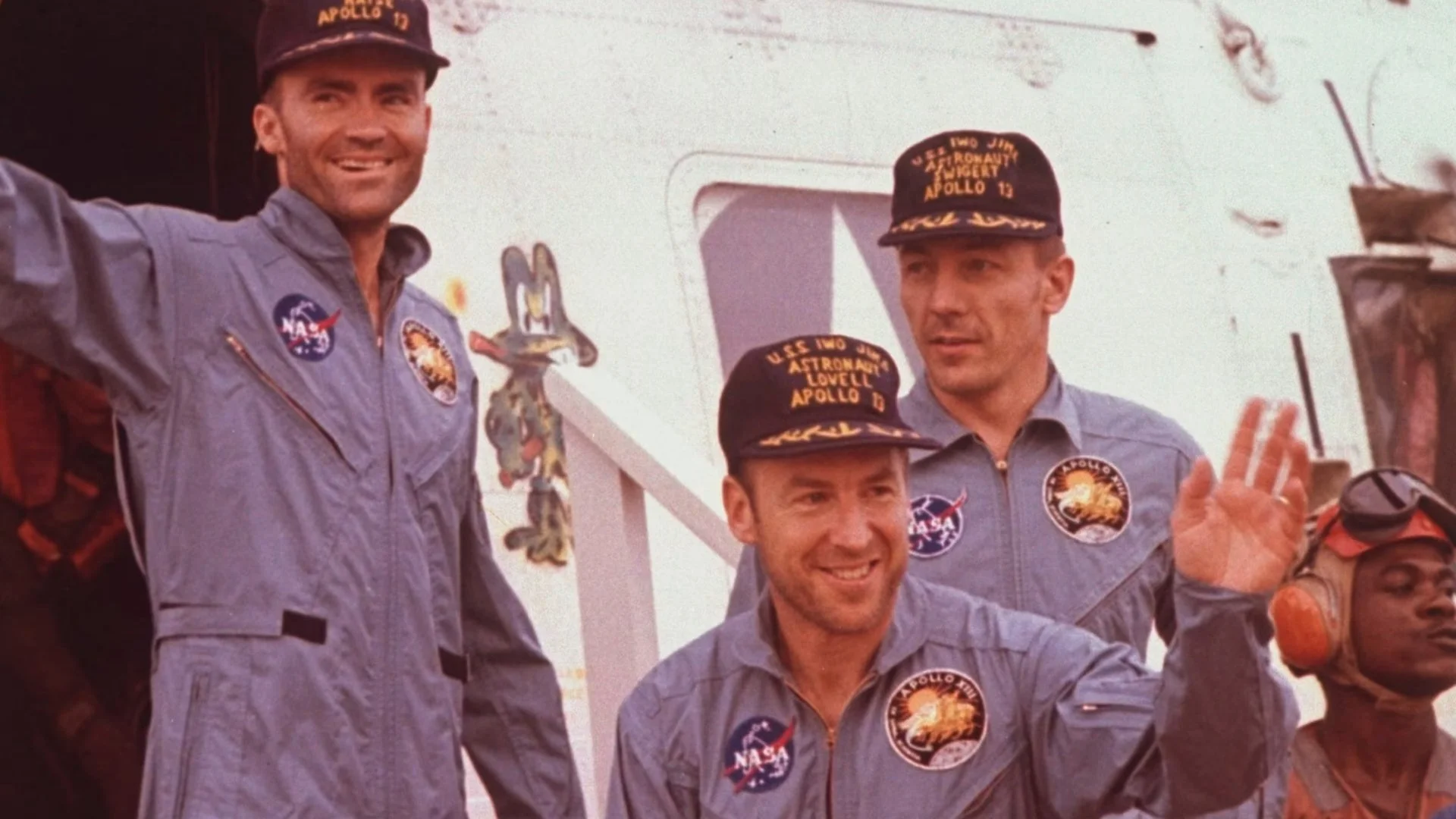
The stories we call survival stories are often stories of trust, leadership, and the earthly bonds that keep us alive.
Eugene Bondurant (E. B.) Sledge was just 19 when he volunteered for the U.S. Marine Corps in 1942. As a private, he was sent from his hometown of Mobile, Alabama, to the Pacific Theatre, where U.S. forces were engaged in a ferocious war with Japan that would eventually leave more than 30 million soldiers and civilians dead, twice as many as in Europe. During his time there, Sledge wrote and kept notes in his pocket-sized New Testament. After the war, he compiled these bloody notes into his memoir, With The Old Breed, written nearly forty years later in 1981.
In a previous essay, I reflected on HBO’s 2010 mini-series The Pacific, which drew partly from Sledge’s account. After finishing the show, I wanted to explore his story further and began reading the book itself, which recounts the raging horrors of the battles at Peleliu and Okinawa. I had only heard of the second.
What struck me most was the quality of Sledge’s writing. His ability to recall and articulate both the events and his emotions is exceptional. It’s brutally honest and haunting. There’s no false patriotism, only the actual reality of what it was like to be in that war. Sledge is the voice of the common soldier, dropped into a zone of terror where a thick blanket of destruction and death lies. He writes that men prayed for the ‘million-dollar wound’—an injury that would end their war but let them live. Few were so lucky.
In ordinary life, compassion is one of our most vital human traits. But in war it becomes a heavy burden for those who feel it. Sledge was a compassionate man and through his writing we see how he struggled to maintain his humanity in the face of relentless violence. He reflects on how war debases us, citing Wilfred Owen’s First World War poem Insensibility, which captures the cost of empathy in combat: “Those who feel most for others suffer most in war.”
On September 15, 1944, Sledge joined the U.S. Marines’ assault on Peleliu, a small island 500 miles east of the Philippines. The battle, often called “The Forgotten Hell,” was one of the war’s most vicious.
“Something in me died at Peleliu,” Sledge recalls. “Perhaps it was a childish innocence that accepted as faith the claim that man is basically good. Possibly I lost faith that politicians who do not have to endure war’s savagery will ever stop blundering and sending others to endure it. But I also learned important things. A man’s ability to depend on his comrades and immediate leadership is absolutely necessary.”
For Sledge, survival came down to trust in those around him and good leadership. Yet even with these, there were many moments when he simply waited to die, the shelling and carnage around him too overwhelming to think otherwise. That he survived, he recognised as pure luck.
And even for those who lived, the war changed them forever.
With the Old Breed occupies one part of the world’s moral landscape in the twentieth century. This is the part fashioned by senseless human violence. On that same moral landscape, but at a different end, is the story of Apollo 13. Here, the story is framed by technical failure and the brutal indifference of space. But they share a connection. Survival. Specifically, that when survival is genuinely at stake, self-reliance is never enough.
We all know the famous words: “Houston, we have a problem.” Spoken by command module pilot Jack Swigert after an explosion onboard Apollo 13 en route to the Moon, except, that’s not quite what was said. Swigert actually told Mission Control, “Okay, Houston…we’ve had a problem here.” When asked to repeat his words by the capsule communicator, mission commander Jim Lovell confirmed: “Ah, Houston, we’ve had a problem.” All this is to say how important details can be, and the new documentary Apollo 13: Survival is meticulous in telling the story exactly as it happened through archival material.
The story of how three NASA astronauts bound for the moon on Apollo 13 survived a near-fatal explosion 210,000 miles from Earth captivated the world in April 1970. After an oxygen tank exploded and tore through one side of their spacecraft, the crew—Fred Haise, Jack Swigert, and Jim Lovell—were left with severely limited oxygen, electrical power, and heat. They endured four harrowing, ice-cold, near-suffocating days in a lunar module built for just two people, with less power than a basic digital watch. That they survived at all is a miracle.
Filmmaker Peter Middleton adopts an archival, visual approach to retelling one of the greatest survival stories of the twentieth century. This in-the-moment style allows the footage to speak for itself, whether it’s spacecraft imagery, lunar shots, or grainy news broadcasts, all supplemented by reflective off-camera voices, including Jim Lovell, his wife Marilyn, Jack Swigert, and NASA flight controller Gene Kranz. The NASA Mission Control scenes are fascinating for how unfazed and pragmatic each engineer remains. Every focus is on finding a solution, or perhaps more aptly, as economist Thomas Sowell puts it, “There are no solutions. There are only trade-offs,” reflecting the ingenuity and resilience of the NASA team when facing challenges never before tested.
Apollo 13: Survival takes a rather clinical approach, devoid of sentimentality and fanfare, and for me, that restraint works. It’s more in line with how NASA actually operated, focused on saving the astronauts with precision and calm pragmatism. By contrast, Ron Howard’s 1995 film, Apollo 13, has a much broader emotional scope, as you’d expect from a Hollywood blockbuster. It’s a great movie and Tom Hanks is a great Jim Lovell: the everyman Hanks excels at, this time in space.
The Apollo 13 mission remains a rare and magnificent story of survival, ingenuity, and unity. As Jack Swigert reflects over footage of front-page news from around the world, “Apollo 13 did something that’s never happened before in the history of man—that for a brief moment in time, the whole world was together.”
Both With the Old Breed and Apollo 13: Survival share a clear theme of survival, one amid the horrors of war, the other in the almost unimaginable situation of being stranded 200,000 miles from Earth without enough oxygen to return home. For E. B. Sledge, survival was a lottery, but he found hope and a sense of humanity in the men beside him and strong leadership. For the astronauts of Apollo 13, survival also hinged on their reliance on each other, but they needed the ingenuity, skill, and calm pragmatism of NASA’s Mission Control to safely bring them home.
It occurs to me that if an event like Apollo 13 were to happen today, Jack Swigert’s belief that such a rescue mission would bring the world together, even briefly, would probably not happen, and that’s a sad reflection of where we are. In the 50 years since, our world has become fragmented by acute political divisiveness, conspiratorial thinking, widespread distrust in government, and a tsunami of misinformation.
In such an environment, a modern-day version of Apollo 13 might not unite us in collective support of the astronauts’ safe return, but rather be met with scepticism and division, creating polarised camps, some doubting the mission’s true purpose, others questioning whether the spacecraft and astronauts themselves even exist. The 2021 film Don’t Look Up explores a version of this idea, where even an imminent, observable disaster (a deadly massive comet hurtling willingly towards Earth) is met with an equal measure of disbelief and denial.
But as both works show, survival often depends on more than just the self. It relies on those around us. On trust, cooperation, and a common belief in something a little bigger than ourselves. Perhaps that’s the real key to survival. Whether in war, in space, or, for the vast majority of us, in our ordinary lives, our ability to trust and work together may ultimately decide our fate.
We survive because others help carry what would otherwise be unbearable.
Pass It On
If this idea was worth your time, it may be worth someone else’s.
Share this essay with a friend:
https://www.deeplifejourney.com/deep-life-reflections/september-27-2024
If you have a thought you’d like to share, please leave a comment below.
You can read all previous issues of Deep Life Reflections here.